






Roles, Powers, and Responsibilities of Lok Sabha Speakers Explained
The Speaker of the Lok Sabha is one of the most important constitutional authorities in India. The Speaker presides over the Lower House of Parliament and ensures that its proceedings are conducted in an orderly and democratic manner. The position carries immense responsibility as the Speaker acts as the guardian of parliamentary traditions, rules, and privileges. For students preparing for competitive exams like UPSC, SSC, Banking, Railways, and other government exams, understanding the List of Lok Sabha Speakers and their roles is an essential part of Indian Polity and General Knowledge.
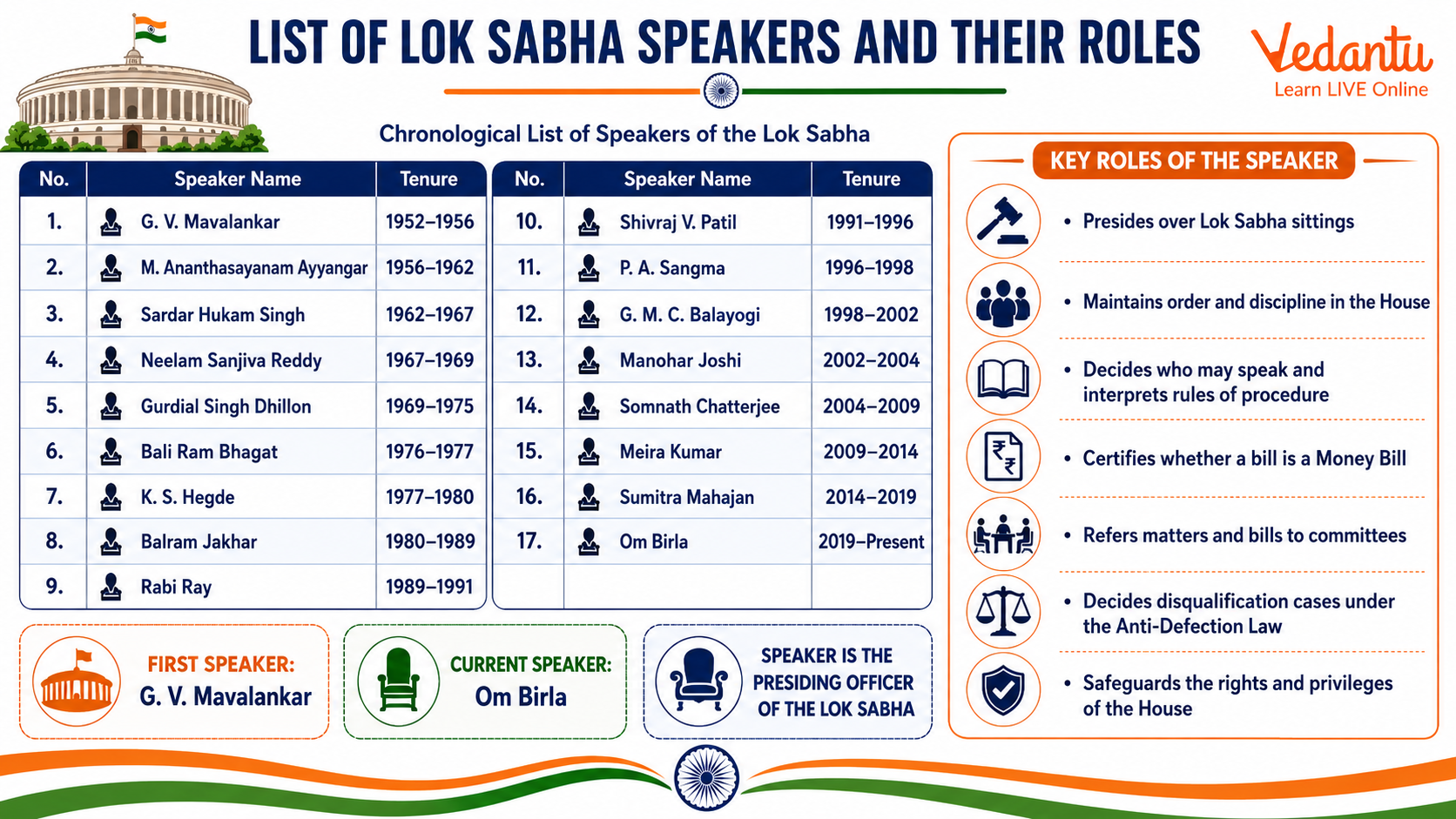
Who is the Speaker of the Lok Sabha?
The Speaker of the Lok Sabha is the presiding officer of the House of the People. The Speaker is elected by the members of the Lok Sabha from among themselves. The office of the Speaker is mentioned in Article 93 of the Indian Constitution. Once elected, the Speaker is expected to function impartially and uphold the dignity of the House.
- Elected by members of Lok Sabha
- Presides over parliamentary sittings
- Ensures discipline and decorum in the House
- Acts as the final authority on interpretation of rules
List of Lok Sabha Speakers
Complete List of Lok Sabha Speakers (1947 - Present)
| Name of Speaker | Tenure | Lok Sabha |
|---|---|---|
| G. V. Mavalankar | 1952 - 1956 | 1st Lok Sabha |
| M. A. Ayyangar | 1956 - 1962 | 1st and 2nd |
| Sardar Hukam Singh | 1962 - 1967 | 3rd Lok Sabha |
| Neelam Sanjiva Reddy | 1967 - 1969 | 4th Lok Sabha |
| G. S. Dhillon | 1969 - 1975 | 4th and 5th |
| Bali Ram Bhagat | 1976 - 1977 | 5th Lok Sabha |
| K. S. Hegde | 1977 - 1980 | 6th Lok Sabha |
| Balram Jakhar | 1980 - 1989 | 7th and 8th |
| Rabi Ray | 1989 - 1991 | 9th Lok Sabha |
| Shivraj Patil | 1991 - 1996 | 10th Lok Sabha |
| P. A. Sangma | 1996 - 1998 | 11th Lok Sabha |
| G. M. C. Balayogi | 1998 - 2002 | 12th and 13th |
| Manohar Joshi | 2002 - 2004 | 13th Lok Sabha |
| Somnath Chatterjee | 2004 - 2009 | 14th Lok Sabha |
| Meira Kumar | 2009 - 2014 | 15th Lok Sabha |
| Sumitra Mahajan | 2014 - 2019 | 16th Lok Sabha |
| Om Birla | 2019 - Present | 17th and 18th Lok Sabha |
G. V. Mavalankar was the first Speaker of the Lok Sabha after independence. Meira Kumar became the first woman Speaker in 2009. Om Birla is the current Speaker and has been serving since 2019.
Roles and Powers of the Speaker of Lok Sabha
1. Presiding Over the House
The Speaker conducts the proceedings of the Lok Sabha. They decide who will speak and ensure that debates are held according to parliamentary rules.
2. Maintaining Order and Discipline
The Speaker maintains decorum in the House. If a member behaves in a disorderly manner, the Speaker can suspend or expel the member.
3. Interpretation of Rules
The Speaker interprets the rules of procedure and their decision is final. This ensures smooth functioning of legislative business.
4. Certification of Money Bills
The Speaker decides whether a bill is a Money Bill under Article 110 of the Constitution. This decision cannot be challenged in court.
5. Casting Vote
The Speaker does not vote in the first instance but can exercise a casting vote in case of a tie.
6. Anti Defection Law
The Speaker decides on matters related to disqualification of members under the Tenth Schedule, also known as the Anti Defection Law.
Election and Removal of the Speaker
Election Process
- The Speaker is elected by members of Lok Sabha.
- The election takes place after the general elections.
- A simple majority is required to win.
Removal Process
The Speaker can be removed by a resolution passed by a majority of all the members of the Lok Sabha. A 14 day notice is required before moving the resolution.
Importance of the Speaker in Indian Democracy
The Speaker plays a crucial role in protecting the independence and dignity of the Lok Sabha. As the head of the Lower House, the Speaker ensures fair debate, smooth functioning, and protection of members' rights. The office symbolizes impartiality and parliamentary sovereignty. The effectiveness of legislative functioning largely depends on how efficiently the Speaker performs their duties.
Key Facts for Competitive Exams
- Article 93 deals with the Speaker and Deputy Speaker of Lok Sabha.
- First Speaker - G. V. Mavalankar
- First Woman Speaker - Meira Kumar
- Speaker decides on Money Bills.
- Speaker has casting vote in case of tie.
Understanding the List of Lok Sabha Speakers and their roles helps students grasp the functioning of the Indian Parliament. Questions related to Speakers, their tenure, constitutional provisions, and powers are frequently asked in competitive examinations. A clear understanding of this topic strengthens overall knowledge of Indian Polity and governance.
FAQs on List of Lok Sabha Speakers and Their Functions in Indian Parliament
1. Who is the Speaker of the Lok Sabha?
The Speaker of the Lok Sabha is the presiding officer and highest authority of the Lower House of Parliament in India. The Speaker is responsible for conducting proceedings and maintaining order in the House.
Key points:
• Elected by members of the Lok Sabha
• Presides over parliamentary debates and discussions
• Ensures rules and procedures are followed
• Acts as the final authority in matters of parliamentary procedure
• Represents the Lok Sabha in national and international forums
This role is crucial in maintaining the dignity and smooth functioning of the Indian Parliament.
2. Who was the first Speaker of the Lok Sabha?
The first Speaker of the Lok Sabha was Ganesh Vasudev Mavalankar, who served from 1952 to 1956. He is known as the founding Speaker of independent India.
Important facts:
• Presided over the First Lok Sabha (1952)
• Played a key role in establishing parliamentary conventions
• Strengthened democratic practices in early independent India
His contribution laid the foundation for the modern parliamentary system of India.
3. How is the Speaker of the Lok Sabha elected?
The Speaker of the Lok Sabha is elected by a majority vote of the members of the House after general elections.
Election process:
• Conducted in the first meeting of the newly elected Lok Sabha
• Nominated by ruling or opposition parties
• Elected by a simple majority vote
• Usually chosen from the ruling party or coalition
This process ensures democratic selection within the Indian parliamentary system.
4. What are the powers and functions of the Lok Sabha Speaker?
The Speaker of the Lok Sabha holds extensive administrative, legislative, and judicial powers to regulate House proceedings.
Main powers and functions:
• Maintains order and discipline during debates
• Decides on Money Bills under Article 110
• Interprets rules of procedure
• Allows motions, adjournments, and discussions
• Decides disqualification under the Anti-Defection Law
The Speaker ensures the smooth functioning of the Lower House of Parliament and protects members’ rights.
5. What is the tenure of the Lok Sabha Speaker?
The tenure of the Speaker of the Lok Sabha lasts from their election until the dissolution of the House.
Tenure details:
• Remains in office for five years (normal Lok Sabha term)
• Continues until a new Speaker is elected
• Can resign or be removed by a resolution passed by majority
The Speaker’s position remains valid even after dissolution until the next Lok Sabha convenes.
6. Who is the current Speaker of the Lok Sabha?
The current Speaker of the Lok Sabha (as per the latest update) is Om Birla, elected during the 17th Lok Sabha.
Key information:
• Member of Parliament from Rajasthan
• Assumed office in 2019
• Oversees parliamentary proceedings and legislative debates
For competitive exams and GK updates, candidates should verify the latest Speaker from official parliamentary sources.
7. Can the Speaker of the Lok Sabha vote in Parliament?
The Speaker of the Lok Sabha does not vote in the first instance but can exercise a casting vote in case of a tie.
Voting rules:
• No regular voting participation
• Uses casting vote only when there is a tie
• Ensures neutrality and impartiality
This provision maintains the Speaker’s unbiased role in the Indian legislative process.
8. How can the Speaker of the Lok Sabha be removed?
The Speaker of the Lok Sabha can be removed by passing a resolution with a majority of all members of the House.
Removal procedure:
• A 14-day prior notice is required
• Resolution must be passed by majority
• Speaker cannot preside during the removal debate
This ensures accountability within the Parliament of India while protecting democratic principles.
9. What is the role of the Speaker in the Anti-Defection Law?
Under the Anti-Defection Law (Tenth Schedule), the Speaker decides on disqualification of members who switch parties.
Responsibilities include:
• Examining defection petitions
• Giving final decisions on disqualification
• Acting as a quasi-judicial authority
The Speaker’s decision can be reviewed by the Supreme Court of India, ensuring judicial oversight.
10. Why is the Speaker of the Lok Sabha important in Indian democracy?
The Speaker of the Lok Sabha plays a vital role in safeguarding parliamentary democracy and ensuring fair legislative functioning.
Importance:
• Maintains discipline and decorum
• Protects rights of ruling and opposition members
• Ensures transparent law-making process
• Upholds constitutional values
The office of the Lok Sabha Speaker strengthens India’s democratic governance and parliamentary traditions.
