






Major Rulers and Causes Behind the Fall of the Later Mughal Dynasty
The Later Mughals refer to the Mughal emperors who ruled India after the death of Aurangzeb in 1707. This period marks the gradual decline of the Mughal Empire due to weak leadership, internal conflicts, economic instability, and external invasions. The authority of the central government weakened, regional powers became stronger, and foreign invasions further destabilized the empire. The study of the Later Mughals is important for understanding the political fragmentation of India in the 18th century and the rise of regional kingdoms and European powers.
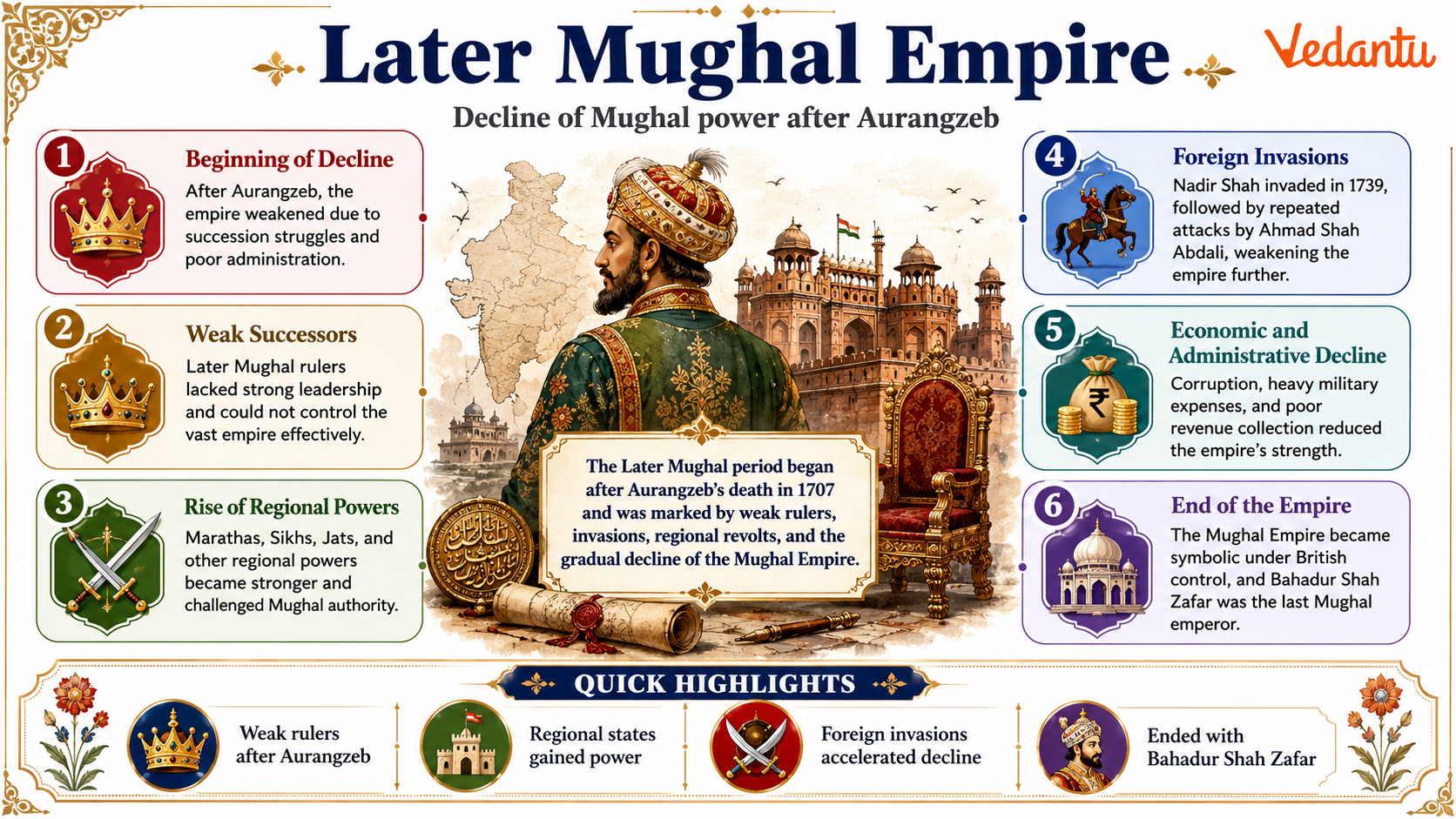
Background of the Later Mughals
After Aurangzeb’s death, the Mughal Empire faced a crisis of succession. There was no fixed rule of inheritance, which led to frequent wars among princes. The empire had already been weakened by continuous wars in the Deccan, heavy taxation, and administrative problems. The later rulers lacked the strength and administrative ability of earlier emperors like Akbar and Shah Jahan.
- Frequent succession wars weakened central authority.
- Provincial governors became independent.
- Financial crisis due to continuous military campaigns.
- Rise of powerful regional states like the Marathas, Sikhs, and Rajputs.
Major Later Mughal Emperors
Important Later Mughal Rulers
| Emperor | Reign Period | Important Events |
|---|---|---|
| Bahadur Shah I | 1707 - 1712 | Attempted reconciliation with Rajputs and Sikhs |
| Jahandar Shah | 1712 - 1713 | Weak ruler influenced by nobles |
| Farrukhsiyar | 1713 - 1719 | Granted trading rights to British East India Company |
| Muhammad Shah | 1719 - 1748 | Nadir Shah invaded India in 1739 |
| Bahadur Shah Zafar | 1837 - 1857 | Last Mughal emperor, Revolt of 1857 |
During this period, the Mughal emperors became puppets in the hands of powerful nobles and court factions such as the Sayyid Brothers. The invasion of Nadir Shah in 1739 led to massive destruction and looting of Delhi, including the Peacock Throne and Kohinoor diamond. Later, Ahmad Shah Abdali’s repeated invasions further weakened the empire.
Causes of Decline of the Mughal Empire
Political Causes
- Weak successors after Aurangzeb.
- Lack of clear law of succession.
- Court intrigues and factionalism.
- Loss of control over provinces.
Economic Causes
- Empty treasury due to prolonged wars.
- Corruption in revenue collection.
- Decline in trade and agriculture in some regions.
Military and External Causes
- Invasions by Nadir Shah in 1739.
- Repeated attacks by Ahmad Shah Abdali.
- Rise of European powers, especially the British.
Impact of the Later Mughal Period
The decline of the Mughal Empire led to the emergence of independent regional states such as Hyderabad, Awadh, Bengal, and the Maratha Confederacy. The weakening of central authority created opportunities for the British East India Company to expand its influence in India. The final blow came after the Revolt of 1857, when Bahadur Shah Zafar was exiled and the Mughal dynasty officially ended.
- Political fragmentation of India.
- Rise of regional powers.
- Expansion of British control.
- End of Mughal rule in 1857.
Later Mughals and the Revolt of 1857
Bahadur Shah Zafar, the last Mughal emperor, became the symbolic leader of the Revolt of 1857. Although he had little real power, rebels declared him the Emperor of Hindustan. After the revolt was suppressed, the British exiled him to Rangoon in 1858. This marked the formal end of the Mughal Empire and the beginning of direct British rule under the Crown.
Key Points for Competitive Exams
- Later Mughal period begins after 1707.
- Nadir Shah invaded in 1739 and looted Delhi.
- Farrukhsiyar granted trade privileges to the British.
- Bahadur Shah Zafar was the last Mughal emperor.
- Mughal rule officially ended in 1858.
Conclusion
The Later Mughals represent the final phase of the Mughal Empire in India. This period was marked by political instability, economic decline, and foreign invasions. The weakening of Mughal authority led to the rise of regional states and paved the way for British domination. Understanding this period helps in analyzing the transformation of India from a powerful empire to a colonized nation under British rule.
FAQs on Later Mughal Empire: History, Rulers and Decline in India
1. Who were the Later Mughals in Indian history?
The Later Mughals were the Mughal emperors who ruled India after the death of Aurangzeb in 1707, marking the decline of the Mughal Empire.
• Period: 1707 to 1857
• Important rulers: Bahadur Shah I, Jahandar Shah, Farrukhsiyar, Muhammad Shah, Shah Alam II, Bahadur Shah II
• Era marked by weak central authority, court conspiracies, and foreign invasions
• Ended with the Revolt of 1857 and exile of Bahadur Shah Zafar
This phase is often referred to as the Decline of the Mughal Empire in GK and competitive exams.
2. Why did the Mughal Empire decline during the Later Mughals?
The decline of the Mughal Empire was caused by weak rulers, internal conflicts, and external invasions.
• Lack of strong leadership after Aurangzeb
• Court conspiracies and succession wars
• Rise of regional powers like Marathas, Sikhs, Jats, and Rajputs
• Invasions by Nadir Shah (1739) and Ahmad Shah Abdali
• Growing influence of the British East India Company
These factors led to political instability and fragmentation of Mughal authority.
3. Who was the first ruler of the Later Mughal period?
The first ruler of the Later Mughal period was Bahadur Shah I, also known as Shah Alam I.
• Reigned from 1707 to 1712
• Son of Aurangzeb
• Faced revolts by Rajputs, Sikhs, and Marathas
• Tried to maintain stability but lacked strong authority
His reign marked the beginning of the weakening of central Mughal power.
4. What was the impact of Nadir Shah’s invasion on the Mughal Empire?
The invasion of Nadir Shah in 1739 severely weakened the Mughal Empire both politically and economically.
• Defeated Muhammad Shah at the Battle of Karnal
• Looted Delhi and massacred thousands
• Took away the Peacock Throne and Koh-i-Noor diamond
• Exposed Mughal military weakness
This invasion accelerated the decline of Mughal authority and encouraged foreign invasions.
5. Who was the last Mughal emperor of India?
The last Mughal emperor was Bahadur Shah II, also known as Bahadur Shah Zafar.
• Ruled from 1837 to 1857
• Played a symbolic role in the Revolt of 1857
• Captured by the British after the revolt
• Exiled to Rangoon (Myanmar)
His exile officially ended the Mughal dynasty and established direct British rule in India.
6. How did the British East India Company gain power during the Later Mughals?
The British East India Company gained power by exploiting Mughal weakness and winning key battles.
• Victory in the Battle of Plassey (1757)
• Victory in the Battle of Buxar (1764)
• Granted Diwani rights of Bengal by Shah Alam II
• Expanded political and economic control across India
The weakening of the Later Mughals allowed British colonial dominance to grow rapidly.
7. Who were the Sayyid Brothers in the Later Mughal period?
The Sayyid Brothers were powerful kingmakers during the Later Mughal period.
• Known as Kingmakers of the Mughal Empire
• Influenced the throne between 1713–1720
• Controlled emperors like Farrukhsiyar
• Played a major role in court politics and instability
Their dominance reflects the weakening authority of Mughal emperors.
8. What was the role of Muhammad Shah in the Later Mughal period?
Emperor Muhammad Shah, also called Rangeela, ruled during a critical phase of Mughal decline.
• Reigned from 1719 to 1748
• Known for patronizing art and culture
• Faced Nadir Shah’s invasion (1739)
• Failed to strengthen military power
His reign symbolizes cultural revival but political weakness in Mughal history.
9. What was the significance of the Revolt of 1857 for the Later Mughals?
The Revolt of 1857 marked the final end of the Mughal Empire.
• Rebels declared Bahadur Shah Zafar as Emperor of India
• United soldiers, peasants, and rulers against British rule
• British suppressed the revolt brutally
• Ended Mughal rule and began British Crown rule (1858)
This event is also known as the First War of Independence in Indian history.
10. Which regional powers emerged during the Later Mughal period?
Several strong regional states emerged as Mughal central authority weakened.
• Marathas under Peshwas
• Sikhs under Guru Gobind Singh and later Maharaja Ranjit Singh
• Jats and Rajputs
• Nawabs of Bengal, Awadh, and Hyderabad
The rise of these regional powers contributed significantly to the fragmentation of the Mughal Empire and reshaped Indian political history.
