






Key Features and Growth of the Mahajanapadas in Ancient India
The Janapadas and Mahajanapadas mark an important phase in ancient Indian history during the period of the 6th century BCE. This era witnessed the transition from small tribal settlements to large territorial states. The term Janapada means foothold of a tribe, while Mahajanapada refers to great kingdoms that emerged later with stronger political structures. This period is significant for understanding the rise of kingdoms, urbanization, economic growth, and the background of major religions like Buddhism and Jainism. Knowledge of Janapadas and Mahajanapadas is important for school exams, competitive exams, and general awareness.
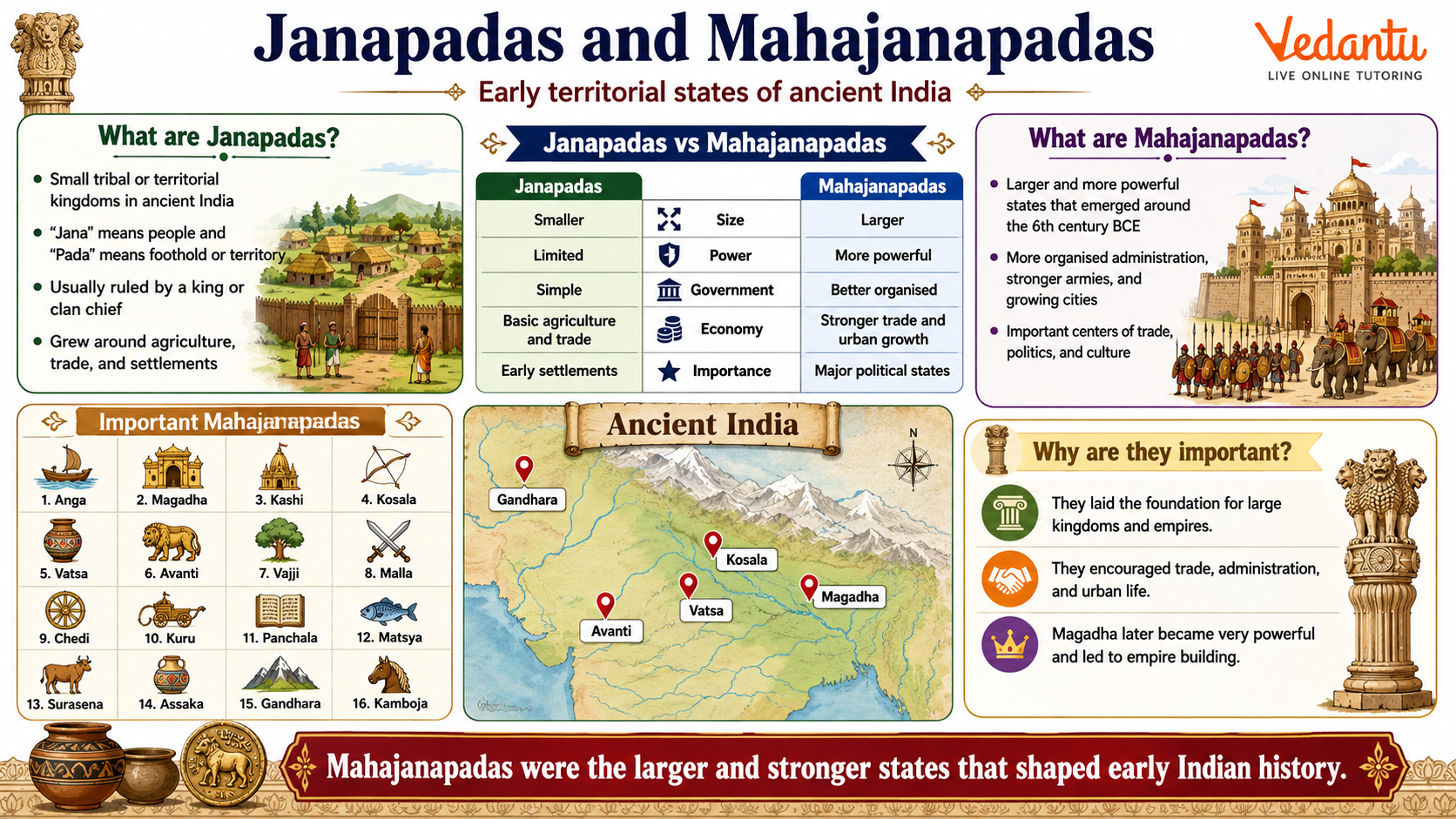
Meaning of Janapadas
The word Janapada is derived from two Sanskrit words - Jana meaning people and Pada meaning foot or foothold. It refers to the territory where a particular tribe or community settled. Around 1000 BCE to 600 BCE, many tribes in northern India began settling permanently, forming small political units known as Janapadas.
Features of Janapadas
- Formed by Aryan tribes after settling in the Indo-Gangetic plains.
- Each Janapada was ruled by a king or tribal chief.
- Agriculture was the main occupation.
- Society was organized based on the Varna system.
- Conflicts were common among different Janapadas.
Rise of Mahajanapadas
By the 6th century BCE, some Janapadas became powerful due to fertile land, iron tools, better administration, and trade. These larger and stronger states were called Mahajanapadas. There were sixteen major Mahajanapadas mentioned in Buddhist texts like the Anguttara Nikaya.
Causes for the Rise of Mahajanapadas
- Use of iron tools which improved agriculture and warfare.
- Growth of trade and development of towns.
- Control over fertile regions like the Gangetic plains.
- Strong military organization and efficient administration.
Sixteen Mahajanapadas
| Mahajanapada | Capital | Present Location |
|---|---|---|
| Magadha | Rajagriha, later Pataliputra | Bihar |
| Kosala | Sravasti | Eastern Uttar Pradesh |
| Vatsa | Kausambi | Allahabad region |
| Avanti | Ujjaini | Madhya Pradesh |
| Vajji | Vaishali | North Bihar |
| Kashi | Varanasi | Uttar Pradesh |
Other Mahajanapadas included Anga, Gandhara, Kuru, Panchala, Matsya, Surasena, Chedi, Malla, Assaka, and Kamboja. Among them, Magadha became the most powerful and later laid the foundation for the Mauryan Empire.
Types of Government
The Mahajanapadas had two main types of political systems.
1. Monarchy
In monarchies, the king held supreme power. The throne was usually hereditary. Examples include Magadha, Kosala, and Avanti.
2. Republic or Gana-Sangha
In republics, power was not concentrated in one king. Instead, a group of people or clan heads governed the state. Decisions were taken collectively. Vajji and Malla were examples of republics.
Economic and Social Life
The period of Mahajanapadas saw significant economic and social development.
- Agriculture flourished due to iron ploughshares.
- Punch-marked coins were used for trade.
- Cities like Rajagriha and Vaishali became trade centers.
- New religious movements like Buddhism and Jainism emerged.
Importance of Magadha
Magadha emerged as the most powerful Mahajanapada due to several advantages.
- Fertile land and abundant natural resources.
- Availability of iron ore in nearby regions.
- Efficient rulers like Bimbisara and Ajatashatru.
- Strategic location for trade and defense.
Conclusion
The Janapadas and Mahajanapadas represent a turning point in Indian history. This period laid the foundation for large empires and advanced political systems. The development of cities, trade networks, and new religious ideas shaped the cultural and political landscape of ancient India. Understanding this topic helps students grasp the early stages of state formation and the evolution of governance in the Indian subcontinent.
FAQs on Janapadas and Mahajanapadas: Rise of Early Kingdoms in India
1. What were Janapadas and Mahajanapadas in ancient India?
The Janapadas and Mahajanapadas were early political states that emerged in ancient India during the Vedic and post-Vedic periods.
• Janapadas were small tribal kingdoms formed around 1500–600 BCE.
• Mahajanapadas were larger and more powerful kingdoms that developed around 600 BCE.
• These states marked the beginning of organized political systems and urbanization in Indian history.
They are important topics in ancient Indian history, early kingdoms of India, and political development in India.
2. How many Mahajanapadas were there?
There were 16 Mahajanapadas mentioned in Buddhist and Jain texts.
• Important ones include Magadha, Kosala, Vatsa, Avanti, Anga, and Gandhara.
• These kingdoms existed around the 6th century BCE.
• They were located mainly in the fertile Indo-Gangetic plains.
This question is commonly asked in GK, UPSC, SSC, and state PSC exams.
3. Which was the most powerful Mahajanapada?
The most powerful Mahajanapada was Magadha.
• Ruled by famous dynasties like the Haryanka, Shishunaga, and Nanda dynasties.
• Important rulers included Bimbisara and Ajatashatru.
• Its capital was initially Rajagriha and later Pataliputra.
Magadha later became the foundation of the Mauryan Empire, making it a key topic in ancient Indian polity.
4. What is the difference between Janapadas and Mahajanapadas?
The main difference lies in their size, power, and political organization.
• Janapadas: Smaller tribal states with simple governance.
• Mahajanapadas: Larger kingdoms with strong armies and administrative systems.
• Mahajanapadas had developed capitals, taxation systems, and trade networks.
This distinction explains the transition from tribal societies to organized kingdoms in ancient India.
5. What were the main sources of information about Mahajanapadas?
Information about the Mahajanapadas comes mainly from religious and literary texts.
• Buddhist texts like the Anguttara Nikaya.
• Jain texts such as Bhagavati Sutra.
• Early Sanskrit literature and archaeological findings.
These sources help historians study early Indian kingdoms, political history, and urban development.
6. What type of governments existed in the Mahajanapadas?
The Mahajanapadas had two main types of governments: monarchy and republic.
• Monarchy (Rajya): Ruled by a king, such as in Magadha and Kosala.
• Republic (Gana-Sangha): Ruled by an assembly of elders or chiefs, like the Vajji Confederacy.
This political diversity shows the early development of democratic and monarchical systems in India.
7. Why were the Mahajanapadas important in Indian history?
The Mahajanapadas were important because they laid the foundation of large empires in India.
• Led to the rise of the Mauryan Empire.
• Encouraged urbanization, trade, and use of coins.
• Witnessed the rise of religions like Buddhism and Jainism.
They mark a crucial phase in ancient Indian civilization and state formation.
8. Where were the Janapadas mainly located?
The Janapadas were mainly located in the Indo-Gangetic plains and northern India.
• Spread across present-day Uttar Pradesh, Bihar, Punjab, and Rajasthan.
• Settled near rivers for agriculture and trade.
• Fertile land supported population growth and economic activities.
Their location played a key role in the rise of early Indian kingdoms.
9. Who were some important rulers of the Mahajanapadas?
Several powerful rulers strengthened the Mahajanapadas.
• Bimbisara of Magadha.
• Ajatashatru, who expanded Magadha’s territory.
• Prasenajit of Kosala.
These rulers contributed to the growth of strong centralized kingdoms in ancient India.
10. What economic activities were common during the Mahajanapada period?
Agriculture, trade, and crafts were the main economic activities during the Mahajanapada period.
• Use of iron tools improved farming.
• Growth of trade routes and marketplaces.
• Introduction of punch-marked coins.
This period saw major progress in economic development, urban centers, and commercial expansion in ancient India.
