






Why Tipu Sultan Is Called the Tiger of Mysore and Other Lesser-Known Facts
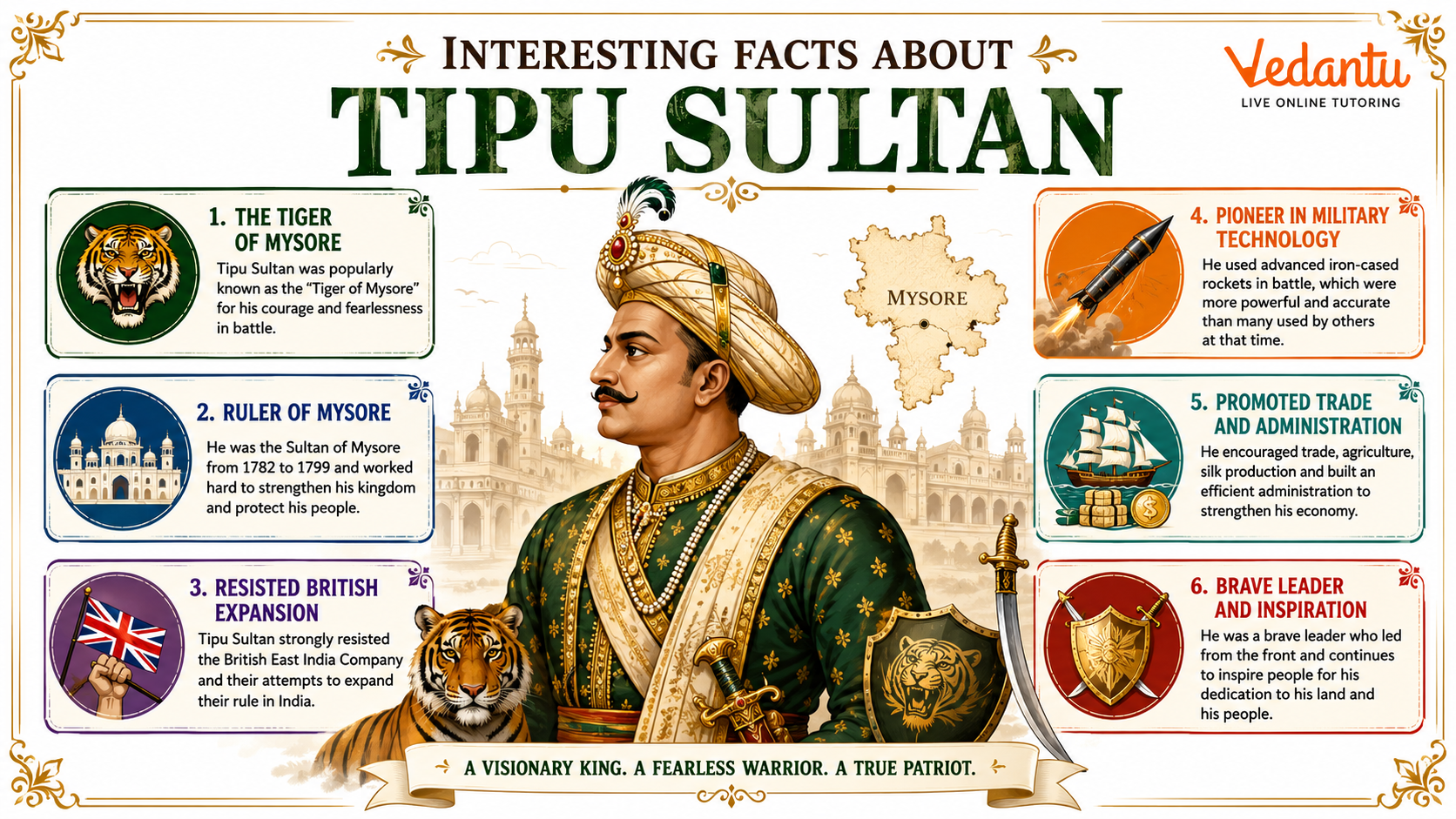
Tipu Sultan, also known as the Tiger of Mysore, was one of the most powerful and dynamic rulers in Indian history. He ruled the Kingdom of Mysore in the late 18th century and is remembered for his bravery, administrative skills, military innovations, and strong resistance against British expansion in India. His life is full of remarkable events that make him an important topic for students, competitive exam aspirants, and general knowledge learners. Below are some interesting facts about Tipu Sultan that highlight his personality, achievements, and historical importance.
Early Life and Background
Tipu Sultan was born on 20 November 1750 in Devanahalli, near present-day Bengaluru. He was the eldest son of Haidar Ali, a military officer who later became the ruler of Mysore. Tipu received a strong education in subjects such as Persian, Arabic, Islamic theology, and military tactics. From a young age, he accompanied his father on military campaigns and gained practical experience in warfare.
- Born - 20 November 1750
- Birthplace - Devanahalli, Karnataka
- Father - Haidar Ali
- Mother - Fatima Fakhr-un-Nisa
Why He Was Called the Tiger of Mysore
Tipu Sultan earned the title Tiger of Mysore because of his courage and fierce resistance against enemies, especially the British. He admired the tiger as a symbol of strength and bravery. The tiger symbol was widely used in his kingdom, including on weapons, coins, flags, and even his throne. A famous artifact known as Tipu's Tiger, a mechanical toy showing a tiger attacking a British soldier, reflects his strong opposition to British rule.
Military Innovations and Achievements
Tipu Sultan was a skilled military strategist. He modernized his army by introducing advanced weapons and techniques. One of his most significant contributions was the use of iron-cased rockets in warfare. These rockets were later studied by the British and inspired the development of rocket technology in Europe.
- Introduced iron-cased rockets in battles
- Strengthened the Mysore army with modern weapons
- Fought four Anglo-Mysore Wars against the British
- Formed alliances with France to counter British power
Administration and Economic Reforms
Apart from being a warrior, Tipu Sultan was also an efficient administrator. He introduced several reforms to improve agriculture, trade, and revenue collection. He promoted the cultivation of crops like sugarcane and sericulture. He also established state trading centers and tried to reduce dependency on foreign traders.
- Introduced a new coinage system
- Promoted silk production in Mysore
- Encouraged trade with countries like France, Turkey, and Arabia
- Improved irrigation and agricultural practices
Religious Policy and Governance
Tipu Sultan followed Islam and built several mosques, but he also donated to temples and respected religious institutions in his kingdom. Historical records show grants given to Hindu temples such as the Sringeri Sharada Peetham. His governance included people from different communities in administrative roles.
Death and Legacy
Tipu Sultan died on 4 May 1799 during the Fourth Anglo-Mysore War at the Siege of Srirangapatna. He chose to fight until his last breath rather than surrender to the British. His death marked the end of strong resistance from Mysore against British rule, and it paved the way for British dominance in South India.
Key Facts About Tipu Sultan
| Aspect | Details | Year |
|---|---|---|
| Birth | Devanahalli, Karnataka | 1750 |
| Death | Siege of Srirangapatna | 1799 |
| Title | Tiger of Mysore | 18th Century |
These key facts help students quickly revise important details about Tipu Sultan for exams and quizzes. His life remains a significant chapter in the history of resistance against colonial rule in India.
Interesting Lesser Known Facts
- Tipu Sultan introduced a new calendar system known as the Mauludi calendar.
- He was one of the first Indian rulers to understand the threat of British imperialism.
- His capital, Srirangapatna, was a major political and commercial center.
- He maintained diplomatic relations with the Ottoman Empire and Afghanistan.
Importance of Tipu Sultan in General Knowledge
Tipu Sultan is an important figure in Indian history and frequently appears in school exams, competitive exams like UPSC, SSC, and state PSC, and general knowledge quizzes. Questions are often asked about the Anglo-Mysore Wars, his rocket technology, administrative reforms, and his role in resisting British rule. Understanding his life provides insight into 18th century Indian politics and the early stages of colonial expansion.
In conclusion, Tipu Sultan was not only a brave warrior but also a visionary ruler who contributed to military science, economic reforms, and diplomatic relations. His courage, innovations, and resistance against the British make him one of the most fascinating personalities in Indian history.
FAQs on Interesting Facts on Tipu Sultan and His Legacy
1. Who was Tipu Sultan?
Tipu Sultan was the ruler of the Kingdom of Mysore and one of the strongest opponents of the British East India Company in India.
- Born in 1751, son of Hyder Ali
- Ruled Mysore from 1782 to 1799
- Known as the "Tiger of Mysore"
- Played a key role in the Anglo-Mysore Wars
- Remembered as a freedom fighter, military innovator, and reformer
2. Why is Tipu Sultan called the Tiger of Mysore?
Tipu Sultan earned the title "Tiger of Mysore" because of his bravery and fierce resistance against the British.
- The tiger symbolized his courage and power
- He used tiger emblems on weapons, coins, and his throne
- A famous artifact called Tipu’s Tiger shows a tiger attacking a British soldier
- The title reflects his image as a fearless warrior king
3. What were the major wars fought by Tipu Sultan?
Tipu Sultan fought in the four major Anglo-Mysore Wars against the British East India Company.
- First Anglo-Mysore War (1767–1769)
- Second Anglo-Mysore War (1780–1784)
- Third Anglo-Mysore War (1790–1792)
- Fourth Anglo-Mysore War (1799)
- He died defending Srirangapatna in the Fourth War
4. How did Tipu Sultan die?
Tipu Sultan died on 4 May 1799 during the Fourth Anglo-Mysore War while defending his capital.
- Killed at the Siege of Srirangapatna
- Fought bravely against British forces led by Lord Wellesley
- Refused to surrender to the British
- His death marked the end of Mysore’s strong resistance
5. What were the administrative reforms introduced by Tipu Sultan?
Tipu Sultan introduced several administrative and economic reforms to strengthen the Mysore Kingdom.
- Introduced a new coinage system
- Promoted state-controlled trade
- Improved land revenue system
- Established factories for arms and textiles
- Encouraged agriculture and irrigation development
6. Was Tipu Sultan the first to use rockets in warfare?
Tipu Sultan was one of the first Indian rulers to use advanced rocket artillery in warfare.
- Improved iron-cased rockets developed by Hyder Ali
- Used rockets effectively against British troops
- Inspired the British to develop the Congreve rockets
- Considered a pioneer in early modern military technology
7. What was Tipu Sultan’s relationship with foreign powers?
Tipu Sultan formed alliances with foreign powers to counter British expansion in India.
- Maintained diplomatic ties with France
- Sought support from the Ottoman Empire and Afghanistan
- Supported anti-British alliances
- Attempted to modernize his army with French assistance
8. What are some interesting facts about Tipu Sultan?
Tipu Sultan is remembered for many unique and lesser-known historical facts.
- Introduced a new calendar system called Mauludi calendar
- Issued coins in his own name
- Had a mechanically designed toy called Tipu’s Tiger
- Encouraged silk production in Mysore
- Known for his famous quote: "Better to live one day as a tiger than a thousand years as a sheep."
9. What was the capital of Tipu Sultan’s kingdom?
Srirangapatna was the capital of Tipu Sultan’s Kingdom of Mysore.
- Located in present-day Karnataka
- Fortified city with strong defenses
- Site of the final battle in 1799
- Houses Tipu Sultan’s summer palace and tomb (Gumbaz)
10. Why is Tipu Sultan important in Indian history?
Tipu Sultan is important in Indian history for his strong resistance against British colonial rule and administrative reforms.
- One of the earliest rulers to challenge British expansion
- Modernized military and economic systems
- Symbol of resistance and patriotism
- Frequently asked in GK questions, UPSC, SSC, and competitive exams
