






Core Features of India's Polity and Governance Framework
Indian Polity and Governance is a crucial area of General Knowledge that helps in understanding how India is governed, how laws are made, and how constitutional institutions function. It covers the structure of the Constitution, roles of the Executive, Legislature and Judiciary, as well as important bodies like the Election Commission and Comptroller and Auditor General. This topic is highly important for students, competitive exam aspirants, and informed citizens because it explains the framework within which democracy operates in India.
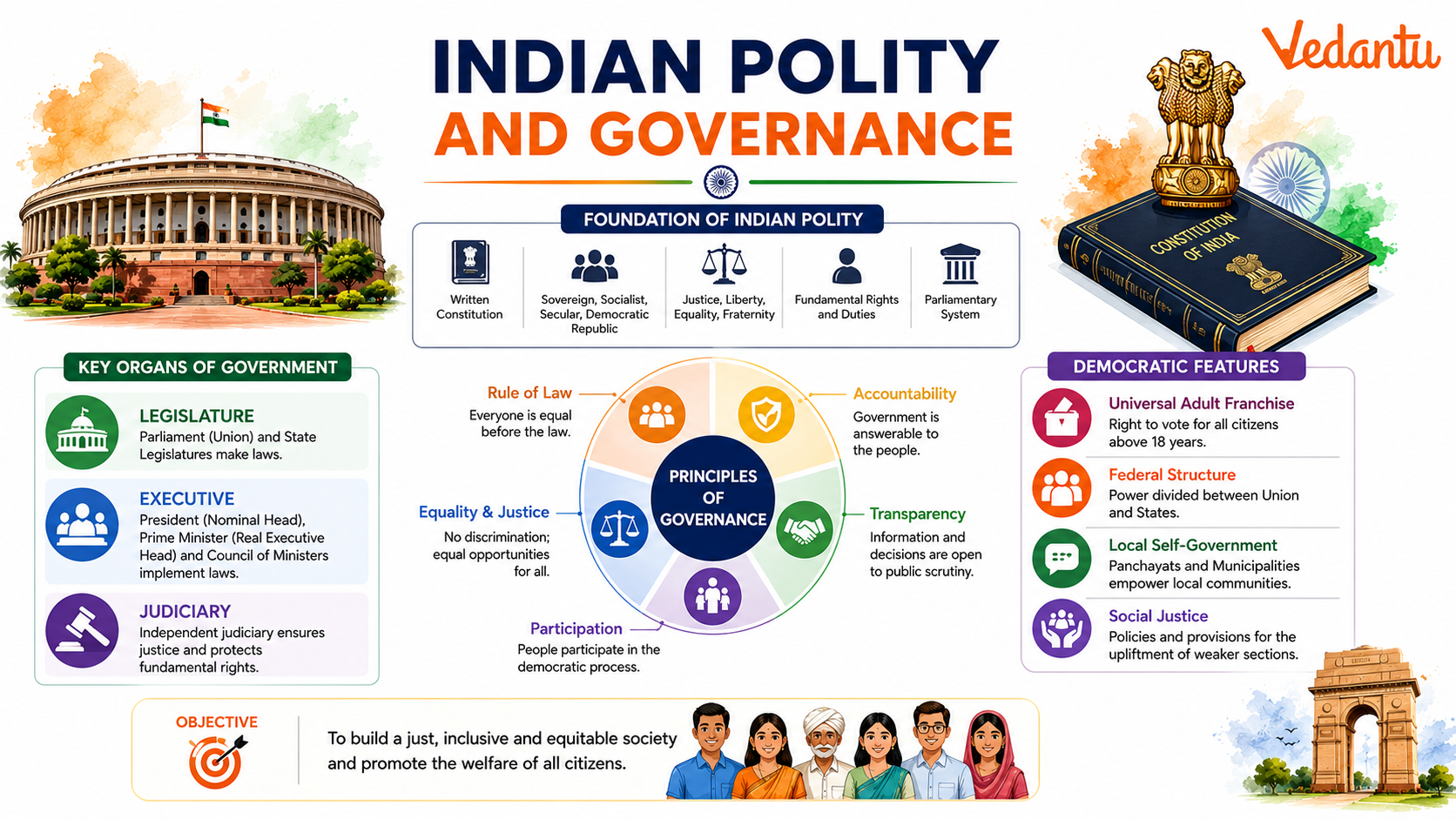
What is Indian Polity?
Indian Polity refers to the constitutional and political system of India. It explains the nature of the Indian State, distribution of powers, rights and duties of citizens, and the functioning of central, state and local governments. The Indian political system is based on the Constitution of India, which came into effect on 26 January 1950.
Key Features of Indian Polity
- Written and detailed Constitution
- Federal system with unitary features
- Parliamentary form of government
- Independent judiciary
- Fundamental Rights and Fundamental Duties
- Universal adult franchise
The Constitution of India
The Constitution is the supreme law of the land. It lays down the framework for governance and defines the powers and responsibilities of different organs of the government. It also protects the rights of citizens and ensures justice, liberty, equality and fraternity.
Important Parts of the Constitution
- Preamble - States the objectives of the Constitution
- Fundamental Rights - Basic rights guaranteed to citizens
- Directive Principles of State Policy - Guidelines for the government
- Fundamental Duties - Moral obligations of citizens
- Schedules - Additional details related to administration and governance
Organs of Government
The Indian government functions through three main organs. Each organ has separate powers and responsibilities to maintain a system of checks and balances.
Three Organs of Government
| Organ | Main Function | Examples |
|---|---|---|
| Legislature | Makes laws | Parliament, State Legislatures |
| Executive | Implements laws | President, Prime Minister, Council of Ministers |
| Judiciary | Interprets laws | Supreme Court, High Courts |
These three organs work independently but coordinate with each other to ensure smooth governance and protection of constitutional values.
Parliament of India
Parliament is the supreme legislative body of the country. It consists of the President, Lok Sabha and Rajya Sabha. Lok Sabha represents the people directly, while Rajya Sabha represents the states.
Types of Bills in Parliament
- Ordinary Bill
- Money Bill
- Constitutional Amendment Bill
- Financial Bill
President and Prime Minister
The President is the constitutional head of the State, while the Prime Minister is the real executive head of the government. The Prime Minister leads the Council of Ministers and is responsible for running the administration.
Powers of the President
- Executive powers
- Legislative powers
- Judicial powers
- Emergency powers
Judiciary in India
The judiciary safeguards the Constitution and protects Fundamental Rights. The Supreme Court is the highest judicial authority, followed by High Courts and subordinate courts. Judicial review allows courts to examine the constitutionality of laws and actions of the government.
Functions of the Supreme Court
- Original jurisdiction in federal disputes
- Appellate jurisdiction
- Advisory jurisdiction
- Judicial review
Constitutional and Non-Constitutional Bodies
Indian governance also includes several important bodies that ensure transparency, accountability and smooth functioning of democracy.
Important Constitutional Bodies
| Body | Article | Function |
|---|---|---|
| Election Commission | Article 324 | Conducts free and fair elections |
| CAG | Article 148 | Audits government accounts |
| UPSC | Article 315 | Conducts civil services examinations |
These bodies operate independently to maintain transparency, accountability and integrity in governance.
Local Government in India
Local self-government ensures democratic decentralization. The 73rd and 74th Constitutional Amendments provided constitutional status to Panchayats and Municipalities.
Levels of Panchayati Raj
- Gram Panchayat - Village level
- Panchayat Samiti - Block level
- Zila Parishad - District level
Why Indian Polity and Governance is Important
Understanding Indian Polity helps citizens know their rights and duties. It builds awareness about democratic values and institutions. For competitive exams, questions are frequently asked about the Constitution, Parliament, Judiciary, and important constitutional bodies. A strong foundation in this topic improves analytical ability and civic understanding.
Preparation Tips for Students
- Read the basic structure and key articles of the Constitution.
- Understand the functions of Parliament, President and Prime Minister.
- Focus on important constitutional bodies and amendments.
- Revise through tables and comparative charts for clarity.
- Practice previous year questions for better retention.
Conclusion
Indian Polity and Governance forms the backbone of India’s democratic system. It explains how power is distributed, how laws are created and implemented, and how citizens are protected by constitutional provisions. A clear understanding of this topic not only helps in examinations but also empowers individuals to become responsible and informed citizens of India.
FAQs on Indian Polity and Governance: Structure, Powers and Functions in India
1. What is Indian Polity and why is it important for competitive exams?
Indian Polity refers to the system of governance, constitutional framework, and political structure of India as defined by the Constitution of India. It is crucial for UPSC, SSC, State PSC, and other competitive exams.
• Covers Constitutional provisions, Fundamental Rights, and Directive Principles
• Explains the functioning of the Executive, Legislature, and Judiciary
• Includes topics like Parliament, President, Prime Minister, Supreme Court
• Helps understand governance, public administration, and political system of India
2. What are the key features of the Indian Constitution?
The Indian Constitution is the longest written constitution in the world with unique federal and unitary features. Its key features define Indian governance.
• Written and Lengthiest Constitution
• Federal system with unitary bias
• Parliamentary form of government
• Fundamental Rights and Duties
• Independent Judiciary
• Secularism and Sovereignty
These features shape India’s democratic political system.
3. What is the difference between Parliamentary and Presidential forms of government?
The Parliamentary and Presidential systems differ in executive authority and accountability. India follows the Parliamentary system.
• In a Parliamentary system, the Prime Minister is the real executive and is accountable to Parliament
• In a Presidential system, the President is both head of state and government
• Parliamentary system ensures collective responsibility
• Presidential system ensures separation of powers
Examples: India and UK follow Parliamentary, USA follows Presidential system
4. What are Fundamental Rights under the Indian Constitution?
Fundamental Rights are basic human rights guaranteed by the Indian Constitution (Part III, Articles 12–35) to protect individual liberty and equality.
• Right to Equality (Articles 14–18)
• Right to Freedom (Articles 19–22)
• Right against Exploitation
• Right to Freedom of Religion
• Cultural and Educational Rights
• Right to Constitutional Remedies (Article 32)
These rights are enforceable by courts and are essential for democracy.
5. What is the role of the President of India in governance?
The President of India is the constitutional head of the state and exercises executive powers under Article 52 of the Constitution.
• Appoints the Prime Minister and Council of Ministers
• Summons and prorogues Parliament sessions
• Acts as Supreme Commander of Armed Forces
• Can declare National, State, or Financial Emergency
• Gives assent to bills and promulgates Ordinances
The President acts on the advice of the Council of Ministers.
6. What are Directive Principles of State Policy (DPSP)?
Directive Principles of State Policy are guidelines given in Part IV (Articles 36–51) to promote social and economic democracy in India.
• Aim to establish a welfare state
• Promote equal justice and free legal aid
• Ensure uniform civil code
• Provide right to work, education, and public health
• Promote international peace and security
Though non-justiciable, DPSPs are fundamental in governance and policy-making.
7. How does the Indian Parliament function?
The Indian Parliament is the supreme legislative body consisting of the President, Lok Sabha, and Rajya Sabha.
• Lok Sabha represents the people (Lower House)
• Rajya Sabha represents the states (Upper House)
• Makes and amends laws
• Controls the executive through Question Hour and No-Confidence Motion
• Approves Budget and Financial Bills
This structure ensures democratic law-making and accountability.
8. What is Judicial Review in Indian Polity?
Judicial Review is the power of the Supreme Court and High Courts to examine the constitutionality of laws and government actions.
• Derived from Articles 13, 32, and 226
• Ensures laws do not violate Fundamental Rights
• Maintains supremacy of the Constitution
• Part of the Basic Structure Doctrine
This mechanism protects democracy and limits misuse of power.
9. What is Federalism in the Indian political system?
Federalism in India refers to the division of powers between the Central Government and State Governments under the Constitution.
• Powers divided into Union List, State List, and Concurrent List
• Written Constitution and Supremacy of Constitution
• Independent Judiciary to resolve disputes
• Strong Centre with unitary features during emergencies
India is often described as a quasi-federal state.
10. What is the Basic Structure Doctrine of the Indian Constitution?
The Basic Structure Doctrine limits Parliament’s power to amend the Constitution and was established in the Kesavananda Bharati Case (1973).
• Parliament can amend under Article 368
• Cannot alter the basic structure of the Constitution
• Includes Supremacy of Constitution, Secularism, Federalism, Judicial Review, and Democracy
This doctrine safeguards the core values of Indian governance.
