






Key Administrative and Military Terms of the Maratha Kingdom
The Maratha Kingdom was one of the most powerful regional powers in Indian history, emerging in the 17th century under the leadership of Chhatrapati Shivaji Maharaj. It played a crucial role in challenging the Mughal Empire and later became a dominant force in India during the 18th century. Understanding the important terms related to the Maratha Kingdom is essential for students and competitive exam aspirants, as these terms frequently appear in General Knowledge, history examinations, and civil services preparation. This page explains the key administrative, military, revenue, and political terms associated with the Maratha state in a simple and structured manner.
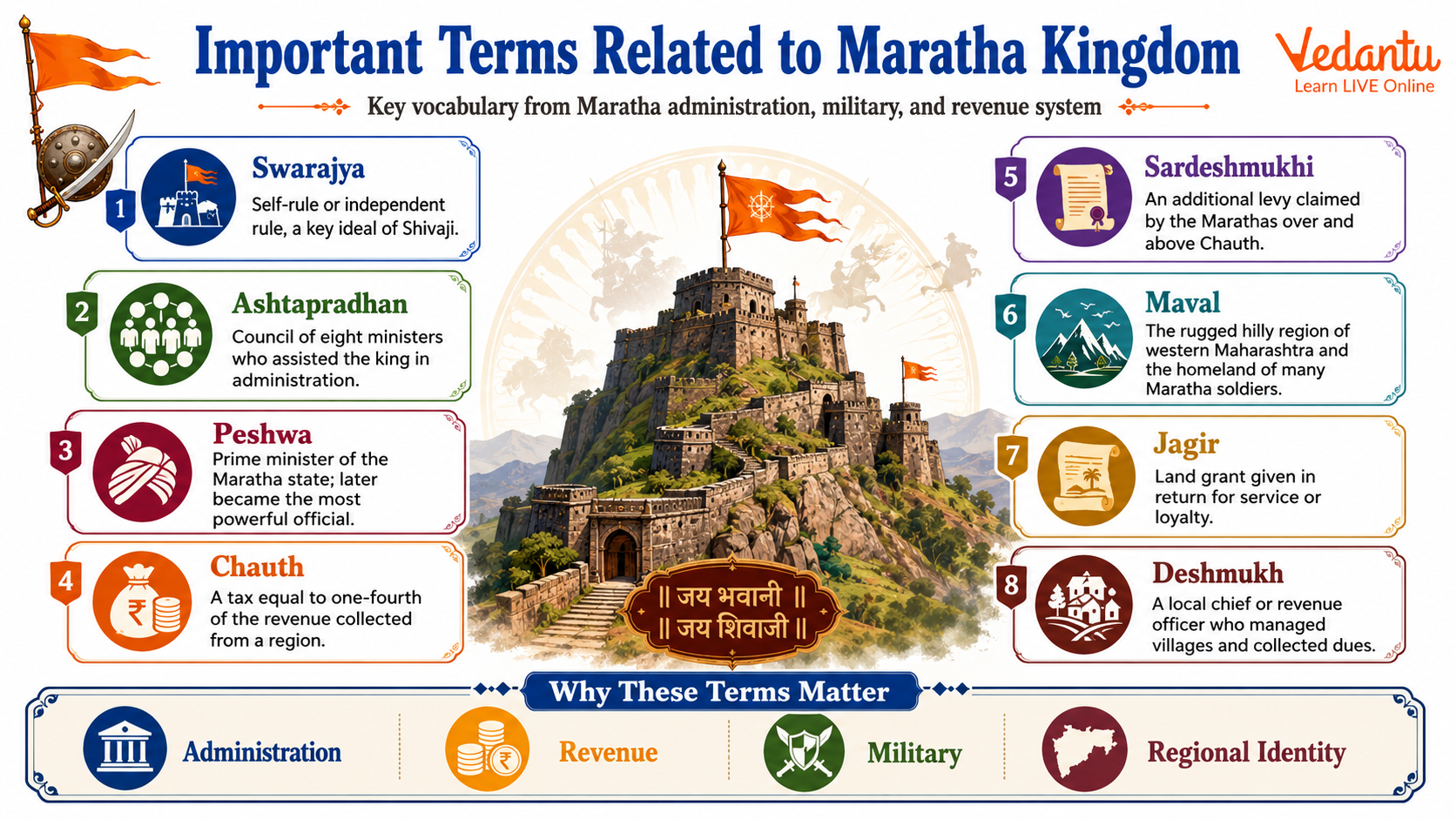
Foundation of the Maratha Kingdom
The Maratha Kingdom was founded by Shivaji Maharaj in 1674 with his coronation at Raigad. He established a strong administrative system, efficient military organization, and revenue structure. Many important terms originated during his reign and continued under his successors and the Peshwas.
Important Administrative Terms
Key Administrative Terms of the Maratha Kingdom
| Term | Meaning | Function |
|---|---|---|
| Ashtapradhan | Council of Eight Ministers | Advised the king and managed administration |
| Peshwa | Prime Minister | Head of administration after Shivaji |
| Amatya | Finance Minister | Managed state finances |
| Sachiv | Secretary | Handled royal correspondence |
| Mantri | Interior Minister | Maintained internal intelligence |
| Senapati | Commander-in-Chief | Led the military forces |
The Ashtapradhan system was introduced by Shivaji to ensure efficient governance. Over time, the Peshwa became the most powerful authority, especially during the 18th century when the Maratha power expanded significantly.
Revenue and Taxation Terms
The Maratha economy depended largely on agriculture and taxation. Several unique revenue terms were used in their administration.
- Chauth - A tax amounting to one-fourth of the revenue collected from a territory. It was imposed on areas not directly under Maratha rule.
- Sardeshmukhi - An additional tax of 10 percent claimed by the Marathas as hereditary rights.
- Jagir - Land granted to officials in return for service.
- Mokasa - Land assigned for maintaining troops.
Chauth and Sardeshmukhi became major sources of income and helped the Marathas expand their influence across large parts of India.
Military Terms
The Maratha military was known for its mobility, guerrilla warfare tactics, and strong cavalry. Several terms are associated with their military organization.
- Guerrilla Warfare - A strategy of surprise attacks and swift movements, known as Ganimi Kava.
- Mavale - Soldiers recruited from the hilly regions of the Western Ghats.
- Fort Administration - Each fort was managed by three officers to prevent misuse of power.
- Bargir - Cavalrymen provided with horses and equipment by the state.
- Shiledar - Cavalrymen who owned their horses and equipment.
The effective use of forts and guerrilla tactics allowed the Marathas to resist larger armies such as the Mughals.
Political and Expansion Terms
As the Maratha Kingdom expanded into a confederacy, several political terms became important.
- Confederacy - A union of semi-autonomous states under the Peshwa.
- Chhatrapati - Title used by the Maratha king.
- Subha - Province under Maratha control.
- Kamavisdar - Revenue officer in charge of a district.
Major Maratha houses such as the Scindias, Holkars, Gaekwads, and Bhonsles became powerful chiefs under the confederacy system.
Why These Terms Are Important for Exams
Important terms related to the Maratha Kingdom are frequently asked in school exams, state PSC, UPSC, SSC, and other competitive examinations. Questions may be objective, match the following, or descriptive. Understanding these terms helps students connect administrative structure, military strategy, and revenue policies of the Maratha state.
- Revise the Ashtapradhan members and their roles.
- Memorize revenue terms like Chauth and Sardeshmukhi.
- Understand military classifications such as Bargir and Shiledar.
- Study the transition from kingdom to confederacy under the Peshwas.
Conclusion
The Maratha Kingdom developed a distinctive administrative, military, and revenue system that contributed to its rapid rise in Indian history. Key terms such as Ashtapradhan, Chauth, Sardeshmukhi, Peshwa, and Ganimi Kava reflect the efficiency and innovation of the Maratha rulers. A clear understanding of these important terms helps students grasp the structure and functioning of the Maratha state and strengthens their preparation for competitive examinations.
FAQs on Important Terms of the Maratha Kingdom Explained for Students
1. What are the important terms related to the Maratha Kingdom?
The Maratha Kingdom used several administrative, military, and revenue-related terms that are important for understanding its governance system.
• Chhatrapati – The supreme ruler (e.g., Chhatrapati Shivaji Maharaj)
• Peshwa – Prime Minister and later de facto ruler
• Ashtapradhan – Council of eight ministers
• Swaraj – Self-rule or independent kingdom
• Chauth – 25% tax collected from neighboring territories
• Sardeshmukhi – Additional 10% revenue levy
• Mansab – Military rank (also used in Mughal system)
These terms are frequently asked in GK questions, competitive exams, and People Also Ask queries about the Maratha administration system.
2. Who was the Chhatrapati in the Maratha Empire?
The Chhatrapati was the supreme king and head of the Maratha Empire.
• First Chhatrapati: Shivaji Maharaj (crowned in 1674)
• Role: Political head, military commander, and protector of Swaraj
• Later rulers included Sambhaji and Shahu Maharaj
This title symbolized sovereignty and is a key term in Maratha history frequently searched by students and exam aspirants.
3. What was the role of the Peshwa in the Maratha Kingdom?
The Peshwa was the Prime Minister and later became the most powerful authority in the Maratha administration.
• Head of civil administration
• Led military campaigns
• Managed revenue and expansion policies
• Famous Peshwas: Baji Rao I, Balaji Vishwanath
Over time, the Peshwas became the de facto rulers, especially after the reign of Shahu Maharaj, making this term important in People Also Search queries about Maratha governance.
4. What was the Ashtapradhan in the Maratha administration?
The Ashtapradhan was a council of eight ministers appointed by Shivaji Maharaj to assist in administration.
• Peshwa – Prime Minister
• Amatya – Finance Minister
• Sachiv – Secretary
• Mantri – Interior Minister
• Senapati – Army Chief
• Sumant – Foreign Affairs Minister
• Nyayadhish – Chief Justice
• Panditrao – Religious Head
This system ensured efficient governance and is a key concept in GK about Maratha political structure.
5. What was Chauth in the Maratha revenue system?
The Chauth was a tax equal to 25% of the revenue collected by the Marathas from neighboring territories.
• Imposed on non-Maratha regions
• Provided military protection in return
• Major source of income for empire expansion
This revenue system strengthened the Maratha economy and is often asked in competitive exams under Maratha taxation policies.
6. What is Sardeshmukhi in Maratha history?
The Sardeshmukhi was an additional 10% tax levied by the Marathas over and above the Chauth.
• Claimed as hereditary right of the Maratha king
• Collected from territories under influence
• Strengthened royal treasury
This term is commonly searched along with Chauth in questions about the Maratha revenue administration.
7. What does Swaraj mean in the context of the Maratha Kingdom?
The term Swaraj means self-rule and was the guiding principle of Shivaji Maharaj.
• Freedom from Mughal domination
• Establishment of independent Hindu kingdom
• Focus on regional pride and autonomy
Swaraj remains a key ideological term in Maratha history and Indian freedom-related discussions (People Also Ask: meaning of Swaraj).
8. Who was the Senapati in the Maratha Empire?
The Senapati was the commander-in-chief of the Maratha army.
• Led military campaigns
• Managed forts and defense strategy
• Reported directly to the Chhatrapati
This position was vital in Maratha military organization, especially during wars against the Mughals and other regional powers.
9. What were Mavalas in the Maratha army?
The Mavalas were loyal soldiers and followers of Shivaji from the Maval region of Maharashtra.
• Expert in guerrilla warfare
• Skilled in hill-fort battles
• Played key role in establishing Swaraj
Their bravery is often highlighted in discussions about Maratha military tactics and guerrilla strategy.
10. What was the importance of forts in the Maratha Kingdom?
Forts were the backbone of the Maratha military and administrative system.
• Provided strategic defense points (e.g., Raigad, Pratapgad, Sinhagad)
• Served as administrative centers
• Enabled guerrilla warfare tactics
The Marathas controlled over 300 forts, making fort management a key term in Maratha history GK and exam preparation.
