






Why Does Ice Stay Above Water Instead of Sinking?
Ice floats on water because of a unique property of water related to its molecular structure and density. This simple observation hides an important scientific principle that plays a major role in environmental balance, aquatic life survival, and climate regulation. Understanding why ice floats is essential for students preparing for competitive exams like NEET, as it involves concepts such as density, hydrogen bonding, and anomalous expansion of water.
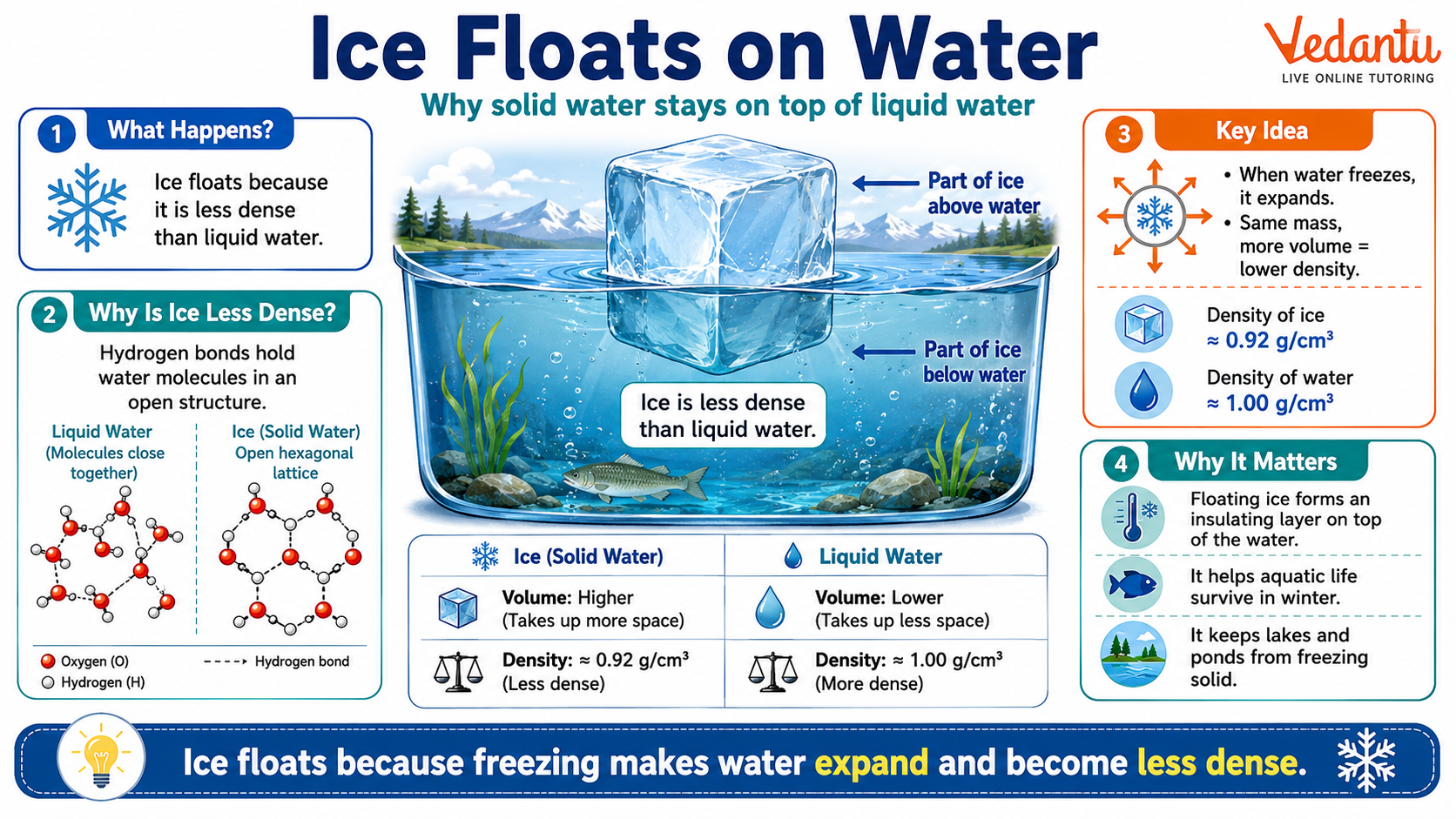
Why Does Ice Float on Water?
Most substances become denser when they freeze, causing their solid form to sink in the liquid state. However, water behaves differently. When water freezes into ice, its molecules arrange themselves in a specific pattern that increases the space between them. This increases volume and decreases density, allowing ice to float.
Role of Density
Density is defined as mass per unit volume. A substance with lower density floats on a substance with higher density. Ice has a lower density than liquid water, so it floats.
- Density of water at 4°C - approximately 1 g/cm³
- Density of ice at 0°C - approximately 0.92 g/cm³
- Lower density means ice occupies more volume for the same mass
Hydrogen Bonding in Water
Water molecules are connected by hydrogen bonds. In liquid water, these bonds continuously break and reform, allowing molecules to stay relatively close together. When water freezes, hydrogen bonds form a stable hexagonal lattice structure. This structure creates empty spaces between molecules, increasing volume and lowering density.
Anomalous Expansion of Water
Water shows anomalous expansion, meaning it behaves differently compared to most substances when cooled. Instead of continuously contracting, water contracts until 4°C and then starts expanding as it approaches 0°C.
- Water cools from high temperature to 4°C - volume decreases
- At 4°C - water reaches maximum density
- From 4°C to 0°C - water expands
- At 0°C - water freezes and forms ice with lower density
Comparison Between Ice and Water
| Property | Liquid Water | Ice |
|---|---|---|
| Density | 1 g/cm³ at 4°C | 0.92 g/cm³ at 0°C |
| Molecular Arrangement | Closely packed | Hexagonal open lattice |
The lower density and open molecular arrangement of ice make it lighter than water, allowing it to float. This difference is crucial for maintaining life on Earth.
Importance of Ice Floating
The floating nature of ice has significant environmental and ecological importance. If ice were denser than water, it would sink, causing water bodies to freeze from bottom to top.
- Lakes and rivers freeze only at the surface
- Aquatic organisms survive in liquid water below the ice layer
- Ice acts as an insulating layer
- Helps regulate Earth’s climate
Scientific Explanation in Simple Terms
When water freezes, its molecules slow down and form a rigid structure due to hydrogen bonding. This structure creates more space between molecules than in liquid water. Because the same mass now occupies a larger volume, density decreases. Since floating depends on relative density, ice floats on water.
NEET Preparation Points
For NEET and other competitive exams, this topic is frequently linked with physical chemistry and biology concepts.
- Understand the concept of density and its formula - Density = Mass ÷ Volume
- Remember that water has maximum density at 4°C
- Know the term anomalous expansion of water
- Understand hydrogen bonding and lattice structure in ice
- Be able to explain ecological significance in biology context
Conclusion
Ice floats on water because it is less dense than liquid water. This reduced density results from hydrogen bonding that forms an open hexagonal lattice structure when water freezes. The phenomenon of anomalous expansion makes water unique among most substances. This simple yet powerful concept supports aquatic life, stabilizes climate, and remains an important topic in science education and competitive examinations like NEET.
FAQs on Ice Floats on Water: Why Solid Ice Stays Above Liquid
1. Why does ice float on water?
Ice floats on water because it is less dense than liquid water. • When water freezes, hydrogen bonds form a rigid crystal lattice structure • This structure increases the volume and lowers the density of ice • Since floating depends on density, ice remains on the surface. This explains the science behind why ice floats, a common People Also Ask query.
2. What is density and how does it affect floating?
Density determines whether an object sinks or floats in a liquid. • Density means mass per unit volume • Objects with lower density than water float • Objects with higher density sink • Ice has lower density than liquid water, so it floats. This concept is important in understanding buoyancy and floating objects.
3. What happens to water molecules when water freezes?
When water freezes, its molecules spread out into a fixed pattern. • Water molecules slow down due to cooling • Strong hydrogen bonding forms a hexagonal crystal structure • Molecules move farther apart than in liquid state • This increases volume and decreases density. This molecular change explains ice formation and floating behavior.
4. Why is ice less dense than liquid water?
Ice is less dense because its molecules are arranged in an open lattice structure. • In liquid water, molecules are closer together • In solid ice, molecules form a rigid crystalline network • The open spaces in this structure reduce overall density • Lower density allows ice to float on water. This is a unique property of water.
5. Is water the only substance that expands on freezing?
Water is one of the few substances that expands when it freezes. • Most liquids contract and become denser when solid • Water expansion on freezing is due to hydrogen bonding • This expansion lowers density and causes floating • Other materials generally sink when solidified. This anomaly makes water scientifically special.
6. How does ice floating help aquatic life?
Ice floating protects aquatic life during winter. • Ice forms on the surface of lakes and rivers • The ice layer acts as an insulator • Water below remains liquid, allowing fish and plants to survive • If ice sank, water bodies would freeze completely. This shows the ecological importance of ice floating on water.
7. What is hydrogen bonding in water?
Hydrogen bonding is the attractive force between water molecules. • Each H2O molecule has a positive and negative end • Opposite charges attract, forming hydrogen bonds • These bonds create the crystalline structure of ice • Hydrogen bonding explains many unique properties of water. It is a key concept in chemistry and physics.
8. What would happen if ice sank instead of floating?
If ice sank, aquatic ecosystems would collapse. • Ice would sink to the bottom of oceans and lakes • Water bodies would freeze from bottom to top • Marine life would struggle to survive • Earth's climate would be drastically affected. The fact that ice floats maintains environmental balance.
9. How is buoyancy related to ice floating?
Buoyancy is the upward force that allows ice to float. • According to Archimedes’ Principle, an object floats if it displaces water equal to its weight • Because ice is less dense, it displaces enough water to stay afloat • This demonstrates the principle of buoyant force. Buoyancy explains why some objects float while others sink.
10. At what temperature does water freeze into ice?
Water freezes into ice at 0°C or 32°F under normal conditions. • The freezing point of water is 0 degrees Celsius • At this temperature, molecular motion slows significantly • Hydrogen bonds lock molecules into a solid structure • This transformation leads to lower density and floating ice. Freezing temperature is a common GK and exam question.
