






Major Reforms and Benefits of NEP 2020 for School and College Students
The New Education Policy 2020 is a landmark reform introduced by the Government of India to transform the education system of the country. Approved on 29 July 2020, it replaces the 34-year-old National Policy on Education 1986. The policy aims to make education holistic, flexible, multidisciplinary, skill-oriented, and aligned with the needs of the 21st century. It focuses on improving quality, equity, accessibility, and affordability in education from school level to higher education. Understanding the highlights of the New Education Policy 2020 is important for students, competitive exam aspirants, and general readers.
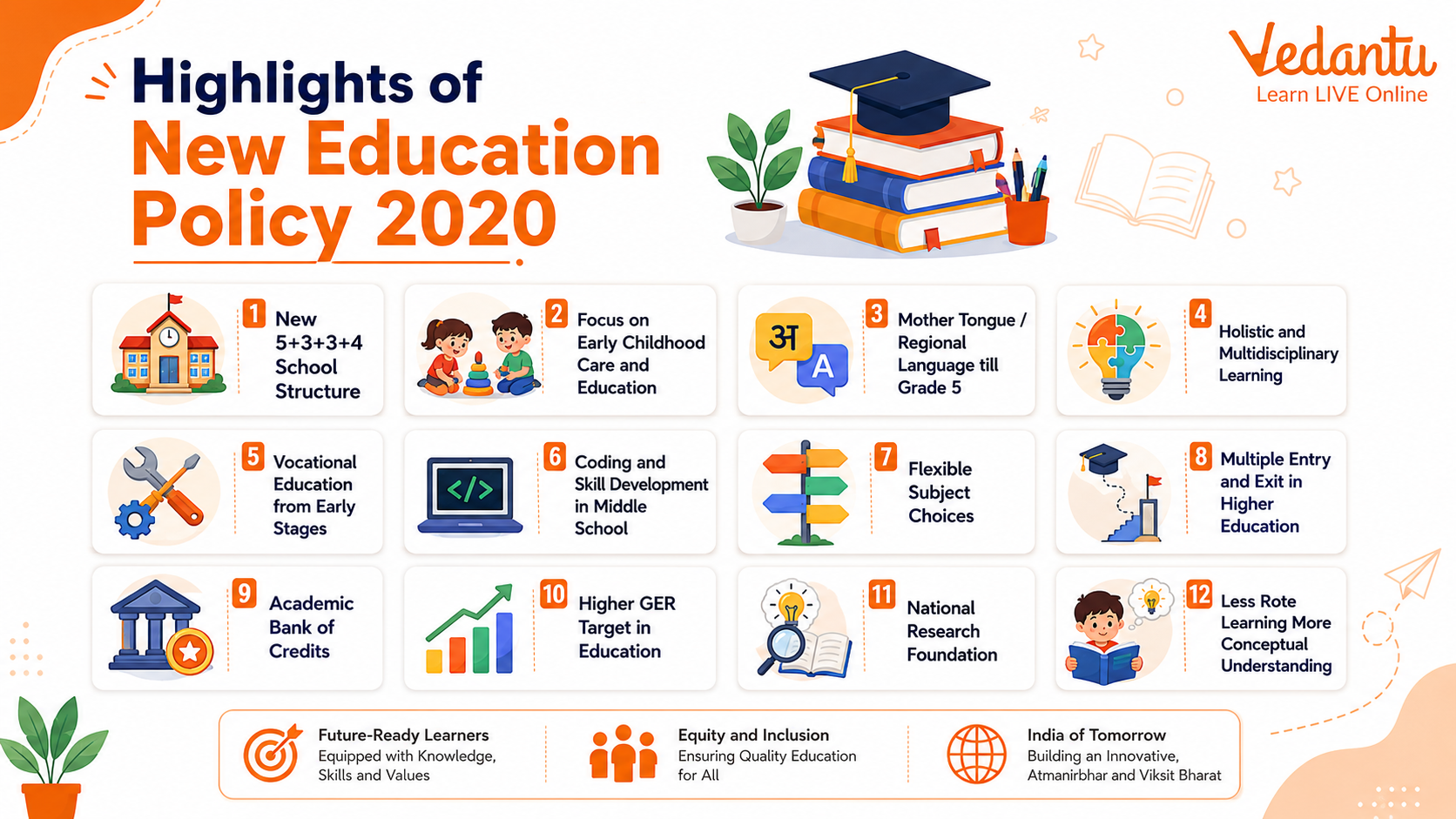
Objectives of New Education Policy 2020
The main objective of NEP 2020 is to create an education system that contributes directly to transforming India into an equitable and vibrant knowledge society. The policy emphasizes conceptual understanding, critical thinking, and practical learning rather than rote memorization.
- Universal access to quality education at all levels
- Holistic and multidisciplinary education
- Promotion of Indian languages and culture
- Focus on skill development and vocational training
- Increased use of technology in education
- Improvement in Gross Enrolment Ratio in higher education
Major Structural Change - 5 + 3 + 3 + 4 System
One of the most important highlights of NEP 2020 is the replacement of the traditional 10 + 2 system with a new 5 + 3 + 3 + 4 curricular structure. This structure is based on the cognitive development stages of children.
New School Structure Under NEP 2020
| Stage | Age Group | Classes Covered |
|---|---|---|
| Foundational Stage | 3 to 8 years | Pre-school to Class 2 |
| Preparatory Stage | 8 to 11 years | Class 3 to 5 |
| Middle Stage | 11 to 14 years | Class 6 to 8 |
| Secondary Stage | 14 to 18 years | Class 9 to 12 |
This new system integrates early childhood care and education into the formal schooling structure. It emphasizes play-based learning in early years and gradually introduces experiential and multidisciplinary learning in higher classes.
Key Highlights of School Education
Early Childhood Care and Education
NEP 2020 gives special importance to early childhood education for children between 3 to 6 years. It aims to provide universal access to quality early childhood care and education through Anganwadi centers and pre-schools.
Mother Tongue as Medium of Instruction
The policy recommends that the medium of instruction until at least Grade 5, and preferably till Grade 8, should be the mother tongue or regional language wherever possible.
Board Exam Reforms
Board exams will be made easier and redesigned to test core competencies instead of memorization. Students may be allowed to take exams twice a year to improve performance.
Vocational Education from Class 6
Vocational education and skill development will start from Class 6 with internships and hands-on training to enhance practical knowledge.
Highlights of Higher Education Reforms
NEP 2020 introduces significant reforms in higher education to make it flexible and multidisciplinary.
- Multiple entry and exit options in undergraduate programs
- Four-year undergraduate degree with research option
- Academic Bank of Credits for credit transfer
- Establishment of Higher Education Commission of India
- Increase in Gross Enrolment Ratio to 50 percent by 2035
- Phasing out of MPhil programs
Role of Technology in NEP 2020
The policy promotes the use of digital tools and online learning platforms. It supports virtual labs, digital libraries, and e-learning resources to improve accessibility and quality of education, especially in remote areas.
- National Educational Technology Forum establishment
- Promotion of online and digital education
- Use of technology for teacher training
Significance of New Education Policy 2020
The New Education Policy 2020 is significant because it addresses long-standing issues in the Indian education system such as rote learning, lack of flexibility, and limited vocational training. It aims to prepare students for global competitiveness while preserving Indian values and culture.
- Encourages critical thinking and creativity
- Reduces curriculum burden
- Promotes inclusive and equitable education
- Aligns education with global standards
Conclusion
The Highlights of New Education Policy 2020 reflect a comprehensive reform aimed at transforming India education system. By focusing on holistic development, skill enhancement, flexibility, and technology integration, NEP 2020 seeks to create a learner-centered and future-ready education framework. For competitive exams and general knowledge preparation, understanding its structure, objectives, and key reforms is essential.
FAQs on Highlights of the New Education Policy 2020 Explained for Students
1. What is the New Education Policy 2020?
The New Education Policy 2020 (NEP 2020) is a comprehensive reform introduced by the Government of India to transform the Indian education system from school to higher education.
• Approved in July 2020 replacing the National Policy on Education 1986
• Focuses on holistic, multidisciplinary, and skill-based learning
• Aims to improve access, equity, quality, affordability, and accountability
• Promotes 21st-century skills, digital learning, and research innovation
2. What is the 5+3+3+4 structure in NEP 2020?
The 5+3+3+4 curriculum structure replaces the old 10+2 system to align education with child development stages.
• Foundational Stage (5 years): 3 years of preschool + Classes 1–2
• Preparatory Stage (3 years): Classes 3–5
• Middle Stage (3 years): Classes 6–8
• Secondary Stage (4 years): Classes 9–12
This structure emphasizes early childhood care and education (ECCE) and experiential learning.
3. What are the key highlights of NEP 2020?
The key highlights of NEP 2020 focus on flexibility, skill development, and quality education reforms.
• Introduction of multidisciplinary education
• Emphasis on mother tongue/regional language till Grade 5
• Multiple entry and exit options in higher education
• Establishment of National Research Foundation (NRF)
• Promotion of vocational training from Class 6
4. How does NEP 2020 benefit students?
The NEP 2020 benefits students by making learning flexible, skill-oriented, and stress-free.
• Reduces curriculum content for conceptual understanding
• Offers multiple subject choices without rigid streams
• Encourages critical thinking and creativity
• Provides multiple entry-exit options in degree programs
• Integrates technology and digital education
5. What changes were introduced in higher education under NEP 2020?
The higher education reforms in NEP 2020 aim to increase Gross Enrolment Ratio (GER) and research quality.
• Target of 50% GER by 2035
• 4-year multidisciplinary undergraduate programs
• Academic Bank of Credits (ABC) system
• Establishment of Higher Education Commission of India (HECI)
• Greater autonomy to colleges and universities
6. What is the role of mother tongue in NEP 2020?
The NEP 2020 promotes mother tongue or regional language as the medium of instruction till at least Grade 5.
• Enhances concept clarity and cognitive development
• Supports multilingualism and Indian languages
• Encourages implementation of the three-language formula
This step strengthens foundational literacy and numeracy.
7. What is the Academic Bank of Credits (ABC) in NEP 2020?
The Academic Bank of Credits (ABC) is a digital system that stores students’ academic credits for higher education.
• Allows multiple entry and exit in degree courses
• Enables credit transfer between institutions
• Supports flexible and lifelong learning
• Promotes student mobility across universities
8. How does NEP 2020 promote vocational education?
The NEP 2020 integrates vocational education into mainstream schooling from Class 6 onwards.
• Introduces skill-based subjects and internships
• Encourages practical training in local crafts and trades
• Aims for at least 50% learner exposure to vocational education by 2025
• Bridges the gap between education and employability
9. What is the National Research Foundation (NRF)?
The National Research Foundation (NRF) is a body proposed under NEP 2020 to strengthen research and innovation in India.
• Funds and promotes quality research across disciplines
• Encourages collaboration between universities and industries
• Supports scientific, social science, and technological research
• Enhances India’s global research ranking
10. Why is NEP 2020 important for India’s future?
The importance of NEP 2020 lies in preparing India for a knowledge-based global economy.
• Develops critical thinking and problem-solving skills
• Aligns education with global standards
• Promotes digital learning and innovation
• Supports the vision of Atmanirbhar Bharat and sustainable development
