






List of the Tallest Indian Mountain Peaks with Height and Location
The Highest Peaks of India are an important topic in General Knowledge and Geography. India is home to some of the tallest mountains in the world, most of which are part of the Himalayan range and the Karakoram range. These peaks are not only significant from a geographical point of view but also hold importance for mountaineering, climate studies, river systems, and competitive examinations. Understanding the location, height, and key facts about these peaks is essential for students and aspirants preparing for various exams.
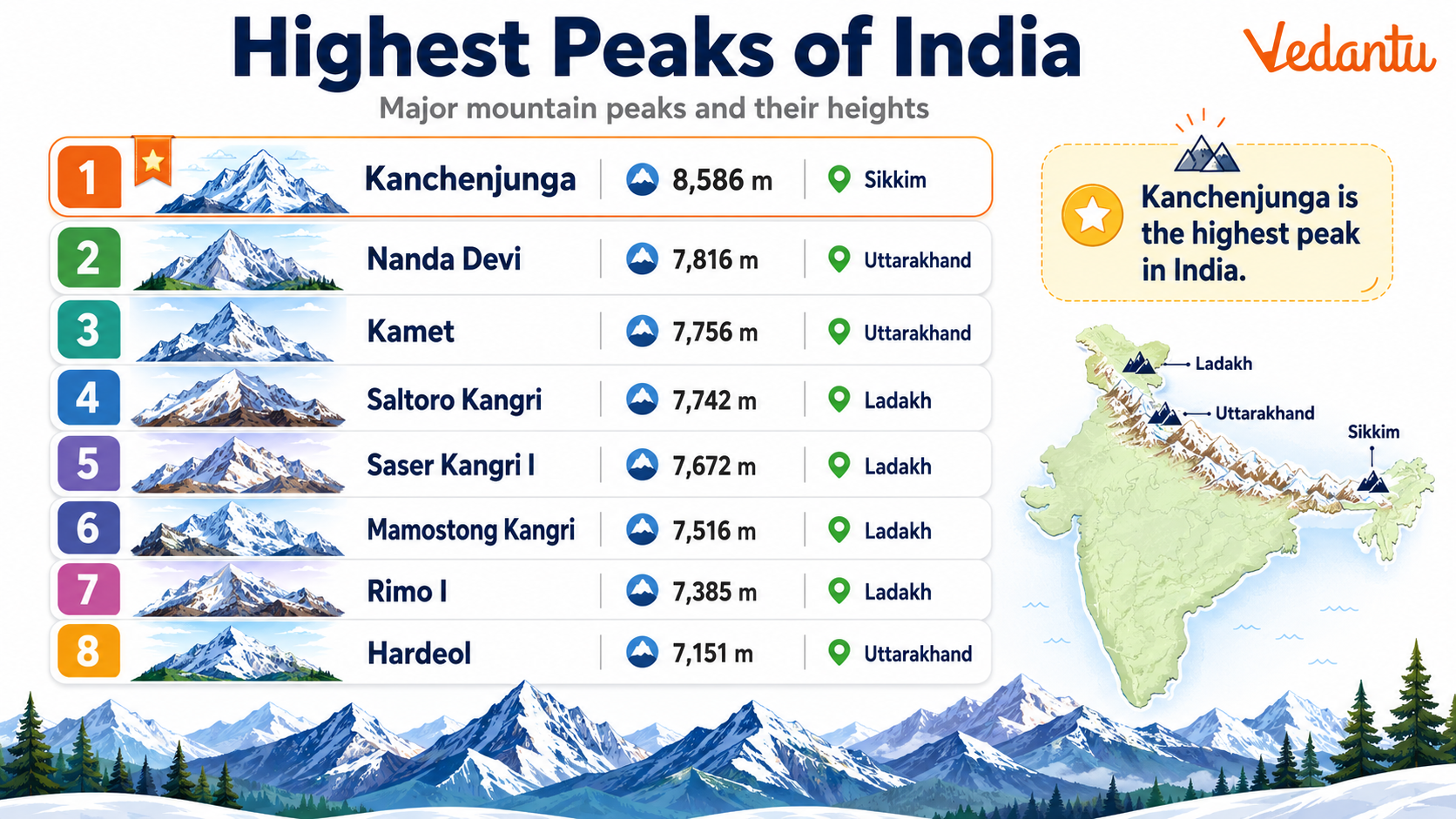
Top 10 Highest Peaks of India
| Peak | Height (meters) | Location |
|---|---|---|
| K2 (Godwin Austen) | 8611 | Karakoram Range, Ladakh |
| Kanchenjunga | 8586 | Sikkim - Nepal Border |
| Nanda Devi | 7816 | Uttarakhand |
| Kamet | 7756 | Uttarakhand |
| Saltoro Kangri | 7742 | Karakoram Range, Ladakh |
| Saser Kangri | 7672 | Ladakh |
| Mamostong Kangri | 7516 | Ladakh |
| Rimo I | 7385 | Karakoram Range |
| Hardeol | 7151 | Uttarakhand |
| Chaukhamba I | 7138 | Uttarakhand |
K2 is the highest peak in India and the second highest peak in the world. Kanchenjunga is the highest peak located entirely within India when considering accessible territory. Most of these peaks are situated in the northern Himalayan and Karakoram regions.
Major Mountain Ranges Containing the Highest Peaks
1. Karakoram Range
The Karakoram Range lies in the northernmost part of India in the Union Territory of Ladakh. It contains some of the tallest and most rugged peaks in the country.
- K2 - Highest peak of India
- Saltoro Kangri
- Saser Kangri
- Rimo Peaks
2. Greater Himalayas
The Greater Himalayas contain many of India’s prominent peaks, especially in Uttarakhand and Sikkim. These mountains are known for glaciers, river origins, and biodiversity.
- Kanchenjunga
- Nanda Devi
- Kamet
- Chaukhamba
State-wise Highest Peaks in India
| State / UT | Highest Peak | Height (meters) |
|---|---|---|
| Ladakh | K2 | 8611 |
| Sikkim | Kanchenjunga | 8586 |
| Uttarakhand | Nanda Devi | 7816 |
| Himachal Pradesh | Reo Purgyil | 6816 |
| Jammu and Kashmir | Nanga Parbat | 8126 |
Knowing state-wise highest peaks is important for competitive exams. Many exam questions focus on matching peaks with states or identifying the highest peak of a particular region.
Important Facts About the Highest Peaks of India
- K2 is also known as Mount Godwin Austen.
- Kanchenjunga is the third highest mountain in the world.
- Nanda Devi was the highest known mountain in the world before Everest was discovered.
- Most of India's highest peaks are located in tectonically active zones.
- These peaks are the source of major Himalayan glaciers and rivers.
Importance of Studying the Highest Peaks of India
The highest peaks of India are important for understanding physical geography, climate patterns, river systems, and biodiversity. They influence monsoon winds and act as natural barriers. From an examination perspective, questions are frequently asked about the highest peak of India, state-wise peaks, and mountain ranges. For general awareness, these peaks symbolize natural heritage and adventure tourism in India.
Preparation Tips for Competitive Exams
- Memorize the top 10 highest peaks in descending order of height.
- Practice state-wise highest peak questions.
- Understand the difference between Karakoram and Himalayan peaks.
- Revise alternate names such as K2 - Godwin Austen.
A clear understanding of the Highest Peaks of India strengthens geographical knowledge and helps in scoring well in competitive examinations. Regular revision of peak names, heights, and locations ensures better retention and accuracy during exams.
FAQs on Highest Peaks of India: Complete Guide for Students
1. Which is the highest peak of India?
Kangchenjunga is the highest peak of India with a height of 8,586 meters.
- Located in the Himalayas on the India–Nepal border
- It is the third highest mountain in the world
- Situated in the state of Sikkim
- Part of the Eastern Himalayan Range
2. Which are the top 5 highest peaks of India?
The top 5 highest peaks of India are located mainly in the Himalayan range.
- Kangchenjunga – 8,586 m
- Nanda Devi – 7,816 m
- Kamet – 7,756 m
- Saltoro Kangri – 7,742 m
- Saser Kangri – 7,672 m
3. Where is Nanda Devi located?
Nanda Devi is located in the state of Uttarakhand in the Garhwal Himalayas.
- Height: 7,816 meters
- Second highest peak entirely within India
- Part of the Nanda Devi Biosphere Reserve
- Recognized as a UNESCO World Heritage Site
4. Which is the highest peak in South India?
Anamudi is the highest peak in South India with an elevation of 2,695 meters.
- Located in Kerala
- Part of the Western Ghats
- Situated inside Eravikulam National Park
- Highest point outside the Himalayan region
5. Which is the highest peak in the Western Ghats?
Anamudi is the highest peak of the Western Ghats.
- Height: 2,695 meters
- Located in Idukki district, Kerala
- Known for rich biodiversity
- Popular trekking and eco-tourism destination
6. Which Indian state has the highest number of high mountain peaks?
Jammu & Kashmir (including Ladakh) has the highest number of major high-altitude peaks in India.
- Includes Saltoro Kangri and Saser Kangri
- Part of the Karakoram Range
- Features several peaks above 7,000 meters
- Strategically and geographically important region
7. What is the difference between Kangchenjunga and Mount Everest?
Kangchenjunga is the highest peak of India, while Mount Everest is the highest peak in the world.
- Kangchenjunga: 8,586 m (India–Nepal border)
- Mount Everest: 8,848.86 m (Nepal–China border)
- Everest ranks 1st globally
- Kangchenjunga ranks 3rd globally
8. Which is the highest peak in the Eastern Himalayas?
Kangchenjunga is the highest peak in the Eastern Himalayas.
- Height: 8,586 meters
- Located in Sikkim
- Considered sacred by local communities
- Part of the Great Himalayan Range
9. Which is the highest peak entirely within Indian territory?
Nanda Devi is the highest peak located entirely within Indian territory.
- Height: 7,816 meters
- Located in Uttarakhand
- Earlier considered the highest Indian peak before territorial changes
- Surrounded by protected biosphere reserve
10. Why are the Himalayan peaks important for India?
The Himalayan peaks are important for India due to their geographical, climatic, and strategic significance.
- Source of major rivers like the Ganga and Brahmaputra
- Act as a natural barrier against cold winds
- Support biodiversity and tourism
- Important for defense and border security
