






Important Bones, Joints and Muscles GK Quiz Questions with Answers
Bones, joints, and muscles form the basic framework of the human body and are essential for movement, protection, and support. Questions related to the skeletal and muscular systems are frequently asked in school exams, competitive exams, and medical entrance tests like NEET. Understanding how bones connect through joints and how muscles help in movement is important for both academic success and general awareness. This page provides well-structured GK questions and answers on bones, joints, and muscles to help students revise key concepts effectively.
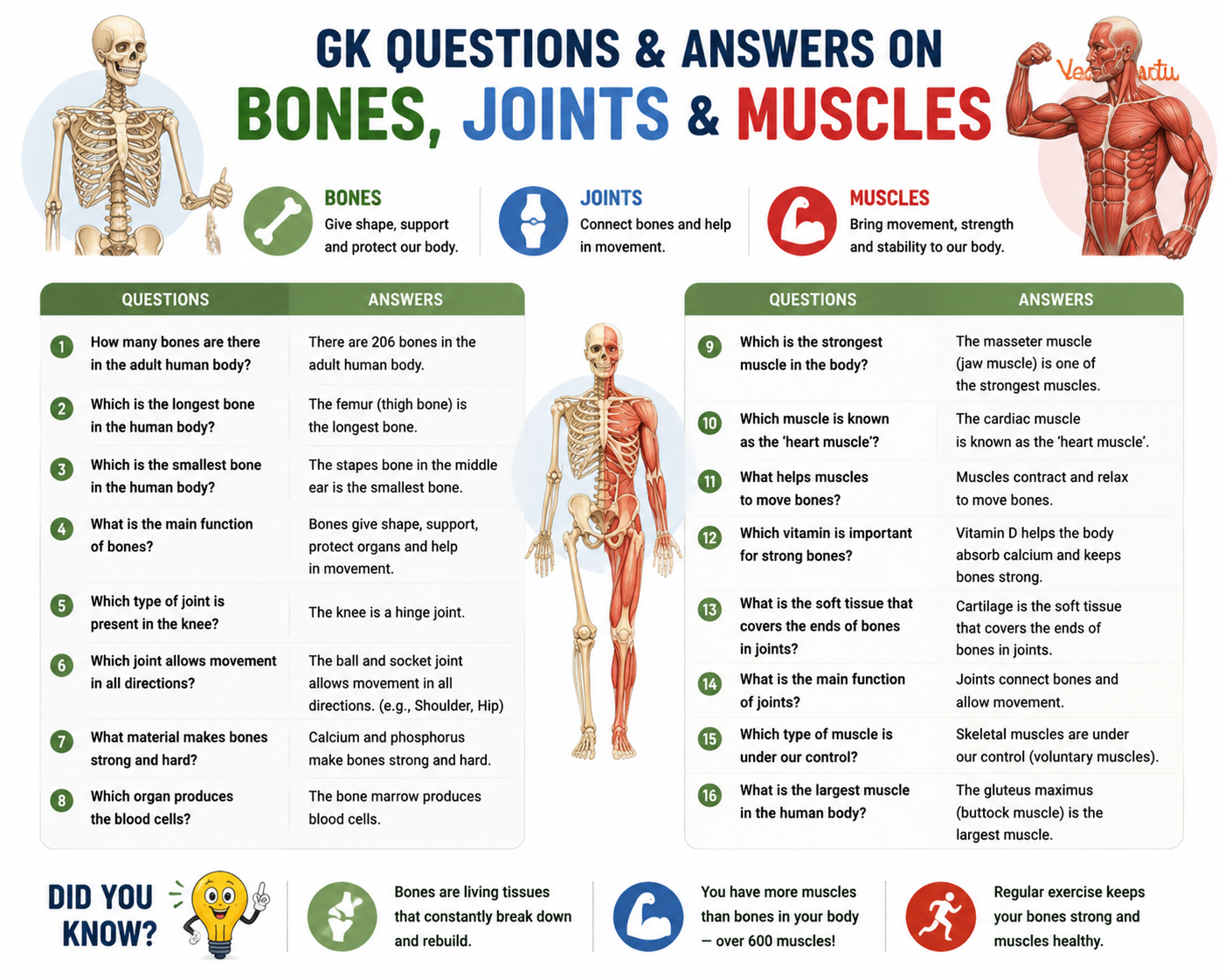
Overview of Bones, Joints, and Muscles
Bones
Bones form the skeletal system of the body. An adult human has 206 bones. Bones provide structure, protect internal organs, store minerals like calcium and phosphorus, and help in the formation of blood cells in the bone marrow.
Joints
Joints are the points where two or more bones meet. They allow movement and provide flexibility to the body. Different types of joints allow different types of movements.
Muscles
Muscles are soft tissues that help in movement by contracting and relaxing. They work in coordination with bones and joints. The human body contains more than 600 muscles.
Types of Bones in the Human Body
Classification of Bones
| Type of Bone | Example | Function |
|---|---|---|
| Long Bones | Femur, Humerus | Support weight and enable movement |
| Flat Bones | Skull, Ribs | Protect internal organs |
| Short Bones | Wrist, Ankle bones | Provide stability and limited movement |
In addition to these, irregular bones such as vertebrae and sesamoid bones such as the patella are also important parts of the skeletal system.
Types of Joints
Major Types of Joints
| Type of Joint | Example | Movement Allowed |
|---|---|---|
| Ball and Socket | Shoulder, Hip | Movement in all directions |
| Hinge Joint | Elbow, Knee | Back and forth movement |
| Pivot Joint | Neck | Rotational movement |
Other joints include gliding joints in the wrist and fixed joints in the skull. The type of joint determines the range and direction of movement.
Types of Muscles
Classification of Muscles
| Type of Muscle | Location | Control |
|---|---|---|
| Skeletal Muscle | Attached to bones | Voluntary |
| Smooth Muscle | Internal organs | Involuntary |
| Cardiac Muscle | Heart | Involuntary |
Skeletal muscles help in body movement, smooth muscles control movements inside organs like the stomach, and cardiac muscle continuously pumps blood throughout the body.
GK Questions and Answers on Bones, Joints, and Muscles
Basic Level Questions
- How many bones are present in an adult human body? - 206 bones.
- Which is the longest bone in the human body? - Femur.
- Which bone protects the brain? - Skull.
- What type of joint is found in the shoulder? - Ball and socket joint.
- Which muscle is found only in the heart? - Cardiac muscle.
Intermediate Level Questions
- Which mineral is mainly stored in bones? - Calcium.
- Which joint allows rotational movement of the head? - Pivot joint.
- What is the function of bone marrow? - Production of blood cells.
- Name the smallest bone in the human body. - Stapes.
- What connects muscles to bones? - Tendons.
Advanced and Exam-Oriented Questions
- What is the structural and functional unit of muscle? - Muscle fiber.
- Which type of joint is present between the vertebrae? - Slightly movable or gliding joint.
- What is the role of ligaments? - They connect bones to other bones.
- Which protein is responsible for muscle contraction? - Actin and myosin.
- What condition is caused by decreased bone density? - Osteoporosis.
Importance for NEET and Competitive Exams
Bones, joints, and muscles are important topics in Biology for NEET and other medical entrance exams. Questions are commonly asked about the number of bones, types of joints, muscle contraction mechanism, and disorders related to the skeletal and muscular systems. Understanding diagrams, classifications, and functions is essential for scoring well.
- Revise diagrams of the human skeleton regularly.
- Understand differences between voluntary and involuntary muscles.
- Memorize types of joints with examples.
- Practice multiple choice questions for better retention.
Conclusion
Bones, joints, and muscles together form the musculoskeletal system, which is essential for movement, protection, and overall body support. A clear understanding of their structure, types, and functions helps students perform well in school exams and competitive tests like NEET. Regular revision of key facts, tables, and practice questions can significantly improve conceptual clarity and exam performance.
FAQs on GK Questions on Bones, Joints & Muscles with Answers
1. What are bones and what is their function in the human body?
Bones are the hard structures that form the skeletal system and provide shape, support, and protection to the body.
- The adult human body has 206 bones.
- Bones protect vital organs like the brain (skull), heart and lungs (rib cage).
- They help in movement by working with muscles.
- Bones produce blood cells in the bone marrow.
- They store important minerals like calcium and phosphorus.
This question is commonly asked in GK, biology basics, and competitive exams under topics like human skeleton, skeletal system functions, and body structure.
2. How many bones are there in the adult human body?
An adult human body has 206 bones in total.
- Babies are born with about 270 bones.
- Some bones fuse together as a person grows.
- The skeleton is divided into axial skeleton (skull, spine, ribs) and appendicular skeleton (arms and legs).
This is a frequently asked GK question related to human anatomy, number of bones, and skeletal system facts.
3. What are joints and why are they important?
Joints are the points where two or more bones meet and allow movement of the body.
- They connect bones together.
- Joints enable movements like bending, rotating, and stretching.
- Major types include hinge joint, ball-and-socket joint, pivot joint, and fixed joint.
- Examples: knee (hinge joint), shoulder (ball-and-socket joint).
Questions about types of joints, joint functions, and examples are common in school exams and GK quizzes.
4. What are the different types of joints in the human body?
The human body has several types of joints based on movement and structure.
- Hinge joints – allow back-and-forth movement (knee, elbow).
- Ball-and-socket joints – allow movement in all directions (shoulder, hip).
- Pivot joints – allow rotational movement (neck).
- Fixed joints – do not allow movement (skull).
- Gliding joints – allow limited sliding movement (wrist, ankle).
This is an important GK topic under human joints, skeletal movement, and anatomy basics.
5. What are muscles and what is their function?
Muscles are soft tissues that contract and relax to produce movement in the body.
- They work together with bones and joints.
- There are over 600 muscles in the human body.
- Muscles help in walking, breathing, blinking, and digestion.
- They maintain posture and body balance.
This GK question relates to muscular system, body movement, and muscle functions.
6. What are the three types of muscles in the human body?
The human body has three main types of muscles based on structure and function.
- Skeletal muscles – attached to bones and help in voluntary movement.
- Smooth muscles – found in internal organs like stomach and intestines (involuntary).
- Cardiac muscles – found only in the heart and pump blood.
This topic is commonly searched as types of muscles, voluntary and involuntary muscles, and muscular system GK questions.
7. How do bones, joints, and muscles work together?
Bones, joints, and muscles work together to allow smooth and controlled body movement.
- Bones provide structure and support.
- Joints connect bones and allow movement.
- Muscles contract and pull bones to create motion.
- Example: When you bend your arm, the biceps muscle contracts and moves the forearm at the elbow joint.
This is a key concept in human movement, musculoskeletal system, and anatomy GK.
8. Which is the longest and strongest bone in the human body?
The femur (thigh bone) is the longest and strongest bone in the human body.
- It is located in the upper leg.
- It supports the weight of the entire body.
- It connects the hip joint to the knee joint.
This is a popular GK and competitive exam question related to largest bone, strongest bone, and human skeletal facts.
9. Which is the smallest bone in the human body?
The stapes is the smallest bone in the human body.
- It is located in the middle ear.
- It helps in transmitting sound vibrations to the inner ear.
- It is part of the three tiny ear bones called ossicles (malleus, incus, stapes).
This fact is frequently asked in GK quizzes under smallest bone, ear bones, and human anatomy trivia.
10. What is the role of calcium in bones and muscles?
Calcium is an essential mineral that strengthens bones and supports muscle function.
- It makes bones and teeth strong.
- Helps in proper muscle contraction.
- Prevents diseases like osteoporosis (weak bones).
- Found in foods like milk, cheese, leafy vegetables.
This is an important GK topic related to bone health, mineral functions, nutrition, and muscular system care.
