






Four Labour Codes in India: Key Changes, Features and Impact on Workers
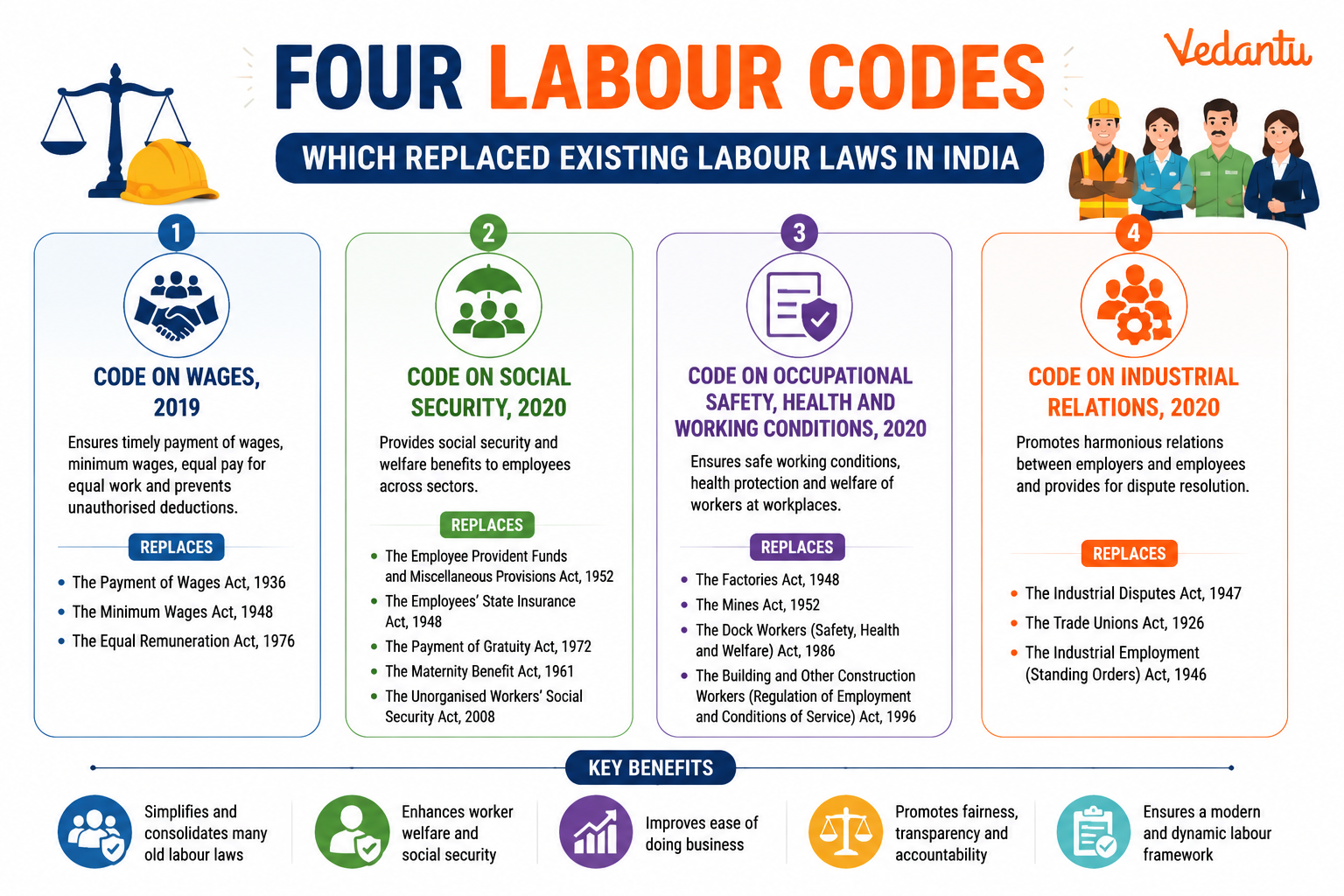
The Four Labour Codes are a major reform initiative by the Government of India to simplify and modernize the country’s complex labour law framework. Earlier, more than 29 central labour laws regulated wages, industrial relations, social security, and workplace safety. To improve ease of doing business, ensure uniformity, and strengthen worker protection, these laws were consolidated into four comprehensive Labour Codes between 2019 and 2020. These codes aim to balance the interests of employers and employees while promoting economic growth and formalization of the workforce.
Background and Need for Labour Law Reforms
India’s labour laws were historically fragmented and often overlapping. Multiple definitions of terms such as wages, worker, and establishment created confusion. Compliance was complex for employers, and enforcement was difficult for authorities. With rapid industrialization and the rise of the gig economy, there was a need for uniform definitions, digitized compliance, and broader social security coverage.
- Simplification of 29 central labour laws into 4 codes
- Uniform definitions across all codes
- Improved transparency and digitization of compliance
- Extension of social security to unorganized and gig workers
The Four Labour Codes
Overview of the Four Labour Codes
| Name of Labour Code | Year | Main Focus Area |
|---|---|---|
| Code on Wages | 2019 | Wages and Bonus Regulation |
| Industrial Relations Code | 2020 | Trade Unions and Dispute Resolution |
| Code on Social Security | 2020 | Social Security Benefits |
| Occupational Safety, Health and Working Conditions Code | 2020 | Workplace Safety and Welfare |
Each code consolidates multiple earlier laws into a single framework, making compliance easier while expanding worker coverage.
1. Code on Wages, 2019
The Code on Wages replaces four laws related to minimum wages, payment of wages, bonus, and equal remuneration. It introduces a universal minimum wage concept applicable to all employees across organized and unorganized sectors.
- Applies to all employees irrespective of wage ceiling
- Provision for a national floor wage fixed by the central government
- Timely payment of wages ensured
- Gender equality in remuneration
2. Industrial Relations Code, 2020
This code consolidates laws relating to trade unions, industrial disputes, and standing orders. It aims to promote harmonious relations between employers and workers while simplifying dispute resolution mechanisms.
- Recognition of negotiating unions
- Provision for fixed term employment
- Requirement of government approval for layoffs in larger establishments
- Establishment of Industrial Tribunals for dispute resolution
3. Code on Social Security, 2020
The Code on Social Security integrates laws related to provident fund, employee state insurance, maternity benefits, and gratuity. A significant feature is the inclusion of gig workers and platform workers under social security schemes.
- Coverage for gig and platform workers
- Provision for social security funds
- Maternity and disability benefits
- Gratuity for fixed term employees
4. Occupational Safety, Health and Working Conditions Code, 2020
This code merges 13 laws related to safety, health, and working conditions in factories, mines, plantations, and other establishments. It focuses on ensuring safe and humane working conditions.
- Single registration for establishments
- Annual health checkups for workers
- Safety standards for factories and hazardous industries
- Special provisions for women working at night with safety measures
Significance of the Four Labour Codes
The Four Labour Codes represent one of the most comprehensive labour reforms in independent India. They aim to create a transparent and accountable system that benefits both workers and employers. By reducing compliance burden and promoting digital record keeping, the codes encourage formalization of employment and economic efficiency.
- Simplified legal framework
- Improved worker protection and welfare
- Encouragement to investment and industrial growth
- Promotion of formal employment
Challenges and Criticism
While the reforms aim to modernize labour regulation, they have also faced criticism from trade unions and worker groups. Concerns include dilution of worker rights, increased threshold limits for layoffs, and implementation delays by states. Effective enforcement and awareness are crucial for achieving the intended benefits.
Conclusion
The Four Labour Codes which replaced existing labour laws mark a significant transformation in India’s labour governance system. By consolidating numerous laws into four comprehensive codes, the government seeks to create a balanced framework that ensures worker welfare while supporting economic development. Understanding these codes is essential for competitive exams, policy studies, and general awareness, as they shape the future of employment and industrial relations in India.
FAQs on Four Labour Codes That Replaced Earlier Labour Law System in India
1. What are the four Labour Codes in India?
The Four Labour Codes are consolidated laws that replaced 29 existing central labour laws in India to simplify and modernize labour regulations.
• Code on Wages, 2019
• Industrial Relations Code, 2020
• Occupational Safety, Health and Working Conditions Code, 2020
• Code on Social Security, 2020
These labour reforms aim to improve ease of doing business, ensure worker protection, and promote formal employment.
2. Why were the existing labour laws replaced by the new Labour Codes?
The old labour laws were replaced to simplify complex regulations and improve compliance.
• Earlier, there were 29 central labour laws with overlapping provisions
• Difficult compliance for industries and employers
• Need for transparency and digitization
• To promote labour reforms in India and economic growth
The new codes unify laws under four broad categories for better implementation and governance.
3. What is the Code on Wages, 2019?
The Code on Wages, 2019 regulates wages and ensures minimum wage protection for all employees.
• Replaced laws like Minimum Wages Act, 1948 and Payment of Wages Act, 1936
• Introduces a concept of national floor wage
• Ensures timely payment of wages
• Covers both organized and unorganized sectors
It standardizes wage definitions across India to prevent exploitation.
4. What does the Industrial Relations Code, 2020 deal with?
The Industrial Relations Code, 2020 governs trade unions, strikes, and dispute resolution.
• Replaces the Industrial Disputes Act, 1947
• Defines rules for strikes and lockouts
• Provides for recognition of trade unions
• Introduces provisions for fixed-term employment
It aims to balance the rights of employers and workers while reducing industrial disputes.
5. What is the Occupational Safety, Health and Working Conditions Code, 2020?
The OSH Code, 2020 ensures safe and healthy working conditions across establishments.
• Merges 13 labour laws related to workplace safety
• Applies to factories, mines, docks, and construction sites
• Mandates appointment letters for workers
• Provides annual health check-ups in certain sectors
This code strengthens workplace safety standards and employee welfare.
6. What is covered under the Code on Social Security, 2020?
The Code on Social Security, 2020 expands social security benefits to more workers.
• Replaces laws like Employees’ Provident Fund Act and ESI Act
• Covers gig workers and platform workers
• Provides maternity benefits and gratuity
• Encourages social security schemes for unorganized workers
It aims to create a universal social security system in India.
7. How many labour laws were merged into the four Labour Codes?
A total of 29 central labour laws were merged into four simplified Labour Codes.
• 4 laws under Code on Wages
• 3 laws under Industrial Relations Code
• 13 laws under OSH Code
• 9 laws under Social Security Code
This consolidation reduces legal complexity and improves compliance mechanisms.
8. When were the four Labour Codes passed by Parliament?
The four Labour Codes were passed between 2019 and 2020 by the Indian Parliament.
• Code on Wages – 2019
• Remaining three codes – 2020
• Passed during Parliament sessions amid labour reform debates
They represent one of the biggest labour law reforms in India since independence.
9. How do the new Labour Codes benefit workers?
The new Labour Codes aim to improve worker protection and welfare.
• Universal minimum wage concept
• Social security for gig and platform workers
• Improved safety standards
• Faster dispute resolution mechanisms
These reforms enhance labour rights, transparency, and financial security for employees.
10. How do the Labour Codes impact employers and businesses?
The Labour Codes simplify compliance procedures for employers and industries.
• Single registration and licensing system
• Digitized compliance and inspections
• Clear definitions of wages and employment
• Greater flexibility in hiring under fixed-term employment
They promote ease of doing business while maintaining worker safeguards under Indian labour law.
