






List of India’s External Affairs Ministers with Tenure and Key Contributions
The Foreign Ministers of India, officially known as the Ministers of External Affairs, play a crucial role in shaping India’s foreign policy and maintaining diplomatic relations with other nations. The Ministry of External Affairs is responsible for managing international relations, negotiating treaties, representing India at global forums, and protecting Indian interests abroad. Since independence in 1947, India has had several distinguished leaders who have contributed significantly to strengthening the country’s global presence. This topic is important for students preparing for competitive exams such as UPSC, SSC, Banking, and other General Knowledge based examinations.
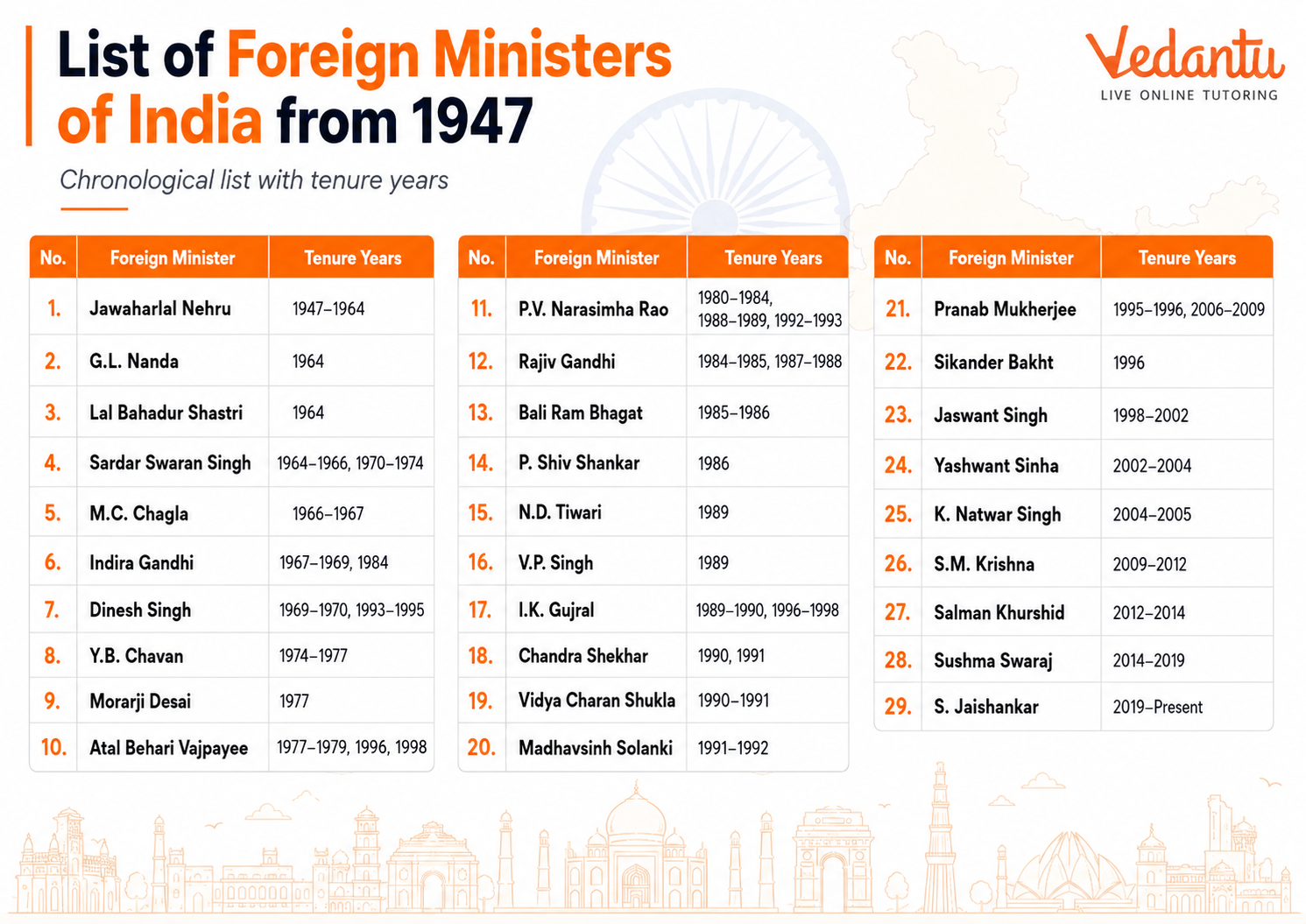
Role of the Foreign Minister of India
The Foreign Minister heads the Ministry of External Affairs and is a key member of the Union Cabinet. The minister advises the Prime Minister on matters related to international diplomacy and foreign policy decisions.
- Formulating and implementing India’s foreign policy
- Representing India in international organizations such as the United Nations
- Handling diplomatic negotiations and treaties
- Managing relations with neighboring and global countries
- Ensuring safety and welfare of Indian citizens abroad
List of Foreign Ministers of India (1947 to Present)
| Name | Tenure | Prime Minister |
|---|---|---|
| Jawaharlal Nehru | 1947 - 1964 | Self |
| Lal Bahadur Shastri | 1964 - 1966 | Self |
| Indira Gandhi | 1966 - 1977, 1980 - 1984 | Self |
| Atal Bihari Vajpayee | 1977 - 1979 | Morarji Desai |
| P. V. Narasimha Rao | 1984 - 1985 | Rajiv Gandhi |
| Madhavsinh Solanki | 1991 - 1992 | P. V. Narasimha Rao |
| Pranab Mukherjee | 1995 - 1996, 2006 - 2009 | Narasimha Rao, Manmohan Singh |
| Jaswant Singh | 1998 - 2002 | Atal Bihari Vajpayee |
| Sushma Swaraj | 2014 - 2019 | Narendra Modi |
| Subrahmanyam Jaishankar | 2019 - Present | Narendra Modi |
Note: In several periods, the Prime Minister also held the charge of the Ministry of External Affairs. The above table highlights major full time Foreign Ministers since independence.
First Foreign Minister of India
Jawaharlal Nehru was the first Foreign Minister of India. He served from 15 August 1947 until his death in 1964. Nehru played a significant role in shaping India’s foreign policy based on principles such as Non Alignment, Panchsheel, and peaceful coexistence. His leadership laid the foundation of India’s diplomatic relations during the early years of independence.
Current Foreign Minister of India
Dr. Subrahmanyam Jaishankar is the current Minister of External Affairs of India. He assumed office on 30 May 2019. A former Foreign Secretary and career diplomat, he has been instrumental in strengthening India’s global partnerships, enhancing strategic relations, and promoting India’s interests on international platforms.
Important Contributions of Foreign Ministers
Promotion of Non Alignment Policy
India adopted the Non Alignment Movement during the Cold War to remain independent from major power blocs. This policy helped India maintain strategic autonomy in global affairs.
Strengthening Neighborhood Relations
Foreign Ministers have consistently focused on maintaining strong diplomatic ties with neighboring countries such as Nepal, Bhutan, Bangladesh, Sri Lanka, and Maldives under the Neighborhood First policy.
Strategic Global Partnerships
India has developed strong relations with major powers like the United States, Russia, France, Japan, and Australia. Agreements related to defense, trade, climate change, and technology have strengthened India’s global standing.
Appointment and Eligibility
The Foreign Minister is appointed by the President of India on the advice of the Prime Minister. The minister must be a member of either House of Parliament. If not already a member, the person must get elected or nominated within six months of appointment.
Importance for Competitive Exams
Questions related to Foreign Ministers of India are frequently asked in competitive examinations. Students should remember the following key points:
- First Foreign Minister of India
- Current Foreign Minister of India
- Longest serving Foreign Minister
- Major foreign policy initiatives
- Important international agreements signed during specific tenures
Conclusion
The Foreign Ministers of India have played a vital role in shaping the country’s global image and diplomatic relations. From Jawaharlal Nehru’s foundational policies to the modern diplomatic strategies under Dr. S. Jaishankar, the Ministry of External Affairs continues to safeguard India’s national interests. Understanding this topic is essential for building strong General Knowledge and performing well in competitive examinations.
FAQs on Foreign Ministers of India from 1947 to Present
1. Who was the first Foreign Minister of India?
The first Foreign Minister of India was Jawaharlal Nehru, who also served as the first Prime Minister of independent India.
• Served as External Affairs Minister from 1947 to 1964
• Played a key role in shaping India’s Non-Aligned Movement (NAM)
• Promoted peaceful coexistence and Panchsheel Agreement
This is an important topic in Indian Polity GK, Indian Foreign Policy, and competitive exams.
2. Who is the current External Affairs Minister of India?
The current External Affairs Minister of India is Dr. S. Jaishankar (as of 2026).
• Assumed office in 2019
• Former Foreign Secretary of India
• Focuses on India’s global diplomacy, strategic partnerships, and neighborhood policy
This question is frequently asked in current affairs, UPSC, and SSC GK exams.
3. What are the main functions of the Foreign Minister of India?
The Foreign Minister of India manages the country’s foreign relations and international diplomacy.
• Heads the Ministry of External Affairs (MEA)
• Represents India in international forums like the UN and G20
• Oversees foreign policy decisions
• Handles treaties, diplomatic missions, and global negotiations
This is a key concept under Indian Government structure and External Affairs.
4. How is the Foreign Minister of India appointed?
The Foreign Minister is appointed by the President of India on the advice of the Prime Minister.
• Must be a member of Lok Sabha or Rajya Sabha
• Part of the Union Council of Ministers
• Responsible to the Parliament of India
This process is defined under the Indian Constitution and is important for polity exams.
5. Which Foreign Minister served the longest tenure in India?
The longest-serving Foreign Minister of India was Jawaharlal Nehru.
• Held the portfolio for nearly 17 years (1947–1964)
• Established the foundation of India’s foreign policy
• Advocated Non-Alignment and peaceful diplomacy
This is a common People Also Ask (PAA) question in Indian political history.
6. Who was the first woman Foreign Minister of India?
The first woman to hold the position of External Affairs Minister was Sushma Swaraj.
• Served from 2014 to 2019
• Known for active engagement through digital diplomacy and social media
• Played a key role in helping Indian citizens abroad
This is an important fact in Indian women leaders GK and modern political history.
7. What is the Ministry of External Affairs (MEA)?
The Ministry of External Affairs (MEA) is the government department responsible for managing India’s foreign relations.
• Headed by the Foreign Minister of India
• Manages embassies, consulates, and high commissions
• Handles international treaties and diplomatic affairs
This topic is relevant under Indian Government ministries and foreign affairs structure.
8. What role does the Foreign Minister play in international organizations?
The Foreign Minister represents India in major international organizations and global summits.
• Participates in United Nations (UN) meetings
• Engages in G20, BRICS, and SAARC summits
• Negotiates international agreements and partnerships
This is important for understanding India’s global diplomacy and international relations.
9. Where can I find the list of all Foreign Ministers of India?
The complete list of Foreign Ministers of India can be found in official government records and history books.
• Starts with Jawaharlal Nehru (1947)
• Includes leaders like Atal Bihari Vajpayee, Pranab Mukherjee, Sushma Swaraj, and S. Jaishankar
• Updated by the Ministry of External Affairs
This list is frequently searched for UPSC, SSC, and state PSC exams.
10. Why is the Foreign Minister important in Indian politics?
The Foreign Minister of India is crucial for maintaining India’s global image and diplomatic relations.
• Shapes foreign policy and strategic alliances
• Protects the interests of Indian citizens abroad
• Strengthens economic, defense, and cultural ties with other nations
This makes the position vital in Indian political system, international relations, and competitive exam GK topics.
