






Key Differences Between El Nino and La Nina Climate Patterns
El Nino and La Nina are opposite phases of a natural climate phenomenon known as the El Nino Southern Oscillation - ENSO. These events occur in the Pacific Ocean and significantly influence global weather patterns, rainfall distribution, temperature, agriculture, and even economies. Understanding the difference between El Nino and La Nina is important for students, competitive exam aspirants, and anyone interested in climate science and environmental studies. This topic is frequently asked in geography and general knowledge examinations.
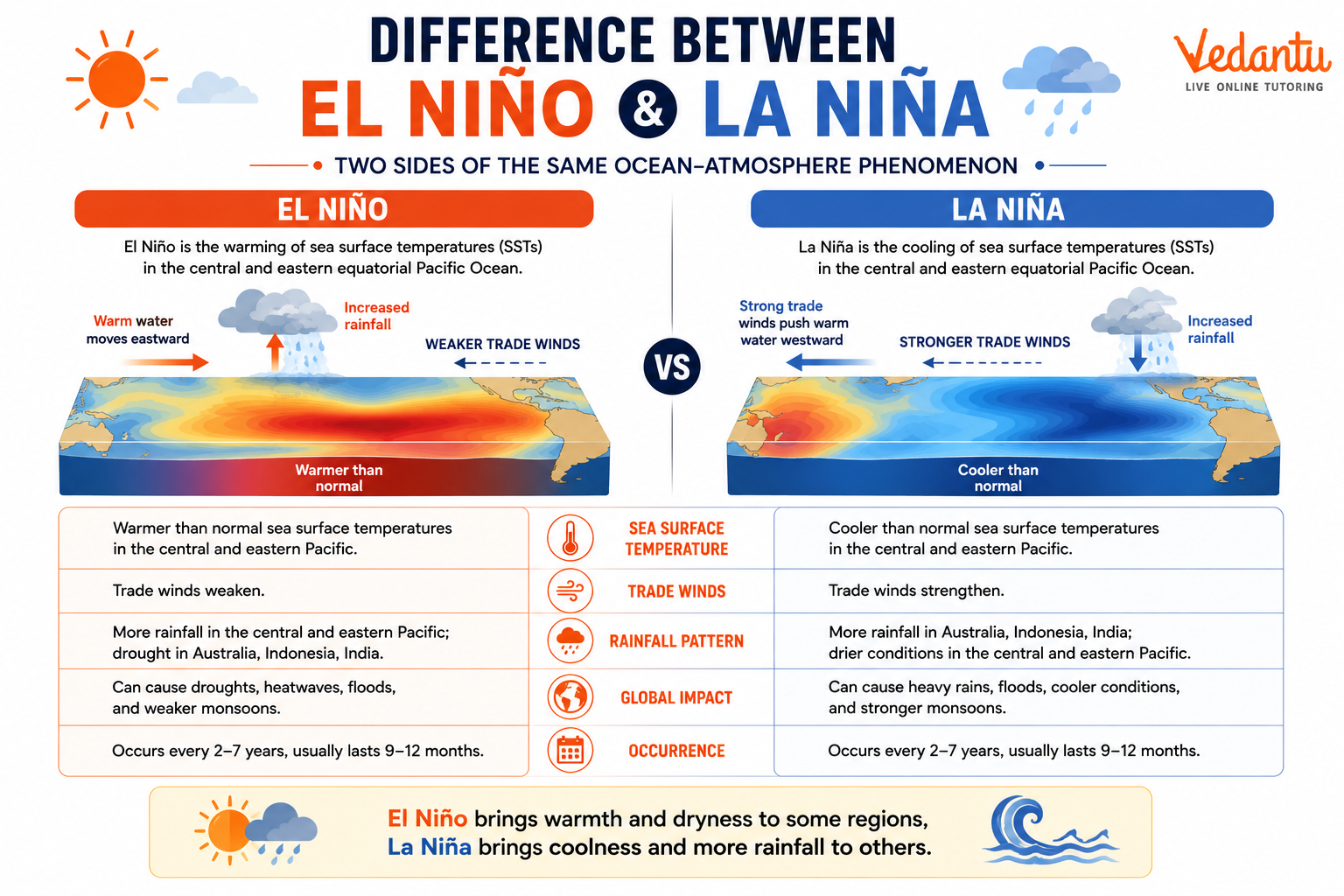
What is El Nino?
El Nino is the warm phase of the ENSO cycle. It occurs when the surface temperature of the central and eastern Pacific Ocean becomes unusually warm. This warming weakens the trade winds and alters atmospheric pressure patterns, leading to significant climatic changes across the globe.
Key Features of El Nino
- Unusual warming of surface waters in the central and eastern Pacific Ocean.
- Weakening or reversal of trade winds.
- Reduced rainfall in countries like India and Australia.
- Increased rainfall in parts of South America.
- Higher global average temperatures.
What is La Nina?
La Nina is the cool phase of the ENSO cycle. It occurs when the surface temperature of the central and eastern Pacific Ocean becomes cooler than normal. During La Nina, trade winds strengthen, and the normal weather patterns become more intense.
Key Features of La Nina
- Unusual cooling of surface waters in the central and eastern Pacific Ocean.
- Strengthening of trade winds.
- Above normal rainfall in India and Australia.
- Drier conditions in western South America.
- Slight decrease in global average temperatures.
Difference Between El Nino and La Nina
| Basis of Comparison | El Nino | La Nina |
|---|---|---|
| Ocean Temperature | Warmer than normal | Cooler than normal |
| Trade Winds | Weak or reversed | Stronger than normal |
| Impact on Indian Monsoon | Usually weak monsoon | Usually strong monsoon |
| Global Temperature | Increases | Decreases slightly |
| Rainfall in South America | Heavy rainfall | Dry conditions |
The table clearly highlights that El Nino and La Nina are opposite climatic events. While El Nino brings warming and weaker winds, La Nina causes cooling and stronger winds, leading to contrasting global weather effects.
Causes of El Nino and La Nina
Both El Nino and La Nina are caused by interactions between the ocean and the atmosphere in the tropical Pacific region. Changes in sea surface temperature, atmospheric pressure differences, and wind patterns collectively trigger these events.
- Variations in trade wind strength.
- Changes in atmospheric pressure known as the Southern Oscillation.
- Ocean-atmosphere heat exchange imbalance.
Impacts on India and the World
El Nino and La Nina significantly influence agriculture, water resources, and disaster management planning across the world.
Impact of El Nino
- Drought conditions in India due to weak monsoon.
- Forest fires in Australia and Indonesia.
- Flooding in Peru and Ecuador.
- Rise in global temperatures.
Impact of La Nina
- Good monsoon rainfall in India.
- Flooding in Australia and Southeast Asia.
- Colder winters in some regions.
- Enhanced agricultural production in some areas.
Why This Topic is Important for Exams
The difference between El Nino and La Nina is an important topic in geography, environmental science, and current affairs. It is commonly asked in school exams, NEET, UPSC, SSC, and other competitive examinations. Questions may focus on definitions, features, impacts, or comparative analysis.
- Understand the ENSO cycle clearly.
- Memorize key differences using comparison tables.
- Focus on impacts on the Indian monsoon.
- Revise recent examples from current affairs.
Conclusion
El Nino and La Nina are opposite climatic phenomena that play a major role in shaping global weather patterns. El Nino is associated with warming of the Pacific Ocean and weak monsoon in India, while La Nina is linked with cooling and stronger monsoon conditions. A clear understanding of their causes, features, and impacts helps students grasp important climate concepts and prepare effectively for competitive examinations.
FAQs on Difference Between El Nino and La Nina in Simple Terms
1. What is the main difference between El Niño and La Niña?
El Niño and La Niña are opposite climate patterns in the Pacific Ocean that affect global weather.
• El Niño refers to the warming of sea surface temperatures in the central and eastern Pacific Ocean.
• La Niña refers to the cooling of sea surface temperatures in the same region.
• El Niño often causes droughts in Asia and heavy rains in South America.
• La Niña typically brings heavy rainfall to Asia and Australia.
These events are part of the ENSO (El Niño–Southern Oscillation) cycle, a major factor in global climate change and weather patterns.
2. What causes El Niño and La Niña events?
El Niño and La Niña are caused by changes in trade winds and ocean temperatures in the Pacific Ocean.
• Weakening of trade winds leads to El Niño conditions.
• Strengthening of trade winds leads to La Niña conditions.
• Changes in atmospheric pressure (Southern Oscillation) influence ocean currents.
• Warm or cold water spreads across the equatorial Pacific.
These shifts disrupt normal weather systems and are closely linked to climate variability and global weather anomalies.
3. How does El Niño affect India?
El Niño generally weakens the Indian monsoon and can cause drought conditions.
• Reduced southwest monsoon rainfall.
• Higher chances of drought in many regions.
• Increase in temperatures and heatwaves.
• Impact on agriculture and crop production.
El Niño years are closely monitored because they significantly affect Indian agriculture, food security, and the economy.
4. How does La Niña impact global weather?
La Niña strengthens normal weather patterns and often causes extreme rainfall in many regions.
• Heavy rainfall in India, Australia, and Southeast Asia.
• Increased chances of floods.
• Cooler global temperatures.
• More active Atlantic hurricane season.
La Niña is associated with cool ocean currents and intensified trade winds, influencing worldwide climate systems.
5. What is ENSO in simple terms?
ENSO (El Niño–Southern Oscillation) is a climate cycle that includes El Niño, La Niña, and neutral phases.
• It occurs in the tropical Pacific Ocean.
• Has three phases: El Niño (warm), La Niña (cool), Neutral.
• Affects global rainfall, temperature, and storms.
• Occurs every 2–7 years.
ENSO is one of the most important drivers of global climate patterns and weather forecasting.
6. How long do El Niño and La Niña events last?
El Niño and La Niña events usually last 9 to 12 months but can sometimes continue for longer.
• Typically develop in mid-year.
• Peak during winter months.
• Some events may last up to 2 years.
• Frequency: every 2–7 years.
The duration affects the intensity of climate disruptions, monsoon patterns, and global weather extremes.
7. Which is more dangerous: El Niño or La Niña?
Both El Niño and La Niña can be dangerous depending on the region and intensity.
• El Niño can cause droughts, wildfires, and food shortages.
• La Niña can cause floods, cyclones, and heavy rainfall.
• Economic losses depend on agricultural and disaster impacts.
The severity depends on the strength of the ENSO phase and regional vulnerability.
8. How do El Niño and La Niña affect agriculture?
El Niño and La Niña significantly influence crop production through rainfall and temperature changes.
• El Niño may cause drought and crop failure.
• La Niña may lead to floods and waterlogging.
• Changes in growing seasons and irrigation needs.
• Impact on global food prices.
Farmers closely monitor monsoon forecasts, ENSO updates, and seasonal climate predictions for planning.
9. How are El Niño and La Niña monitored?
Scientists monitor El Niño and La Niña using satellites, ocean buoys, and climate models.
• Measurement of sea surface temperature (SST).
• Monitoring trade winds and atmospheric pressure.
• Use of climate forecasting models.
• Data from organizations like NOAA and meteorological departments.
Early detection helps in predicting extreme weather events and disaster preparedness.
10. What are some historical examples of strong El Niño and La Niña events?
Some El Niño and La Niña events have caused major global climate disruptions.
• 1997–98 El Niño: Severe floods and droughts worldwide.
• 2015–16 El Niño: One of the strongest on record.
• 2010–11 La Niña: Heavy floods in Australia and Asia.
• 2020–22 La Niña: Extended cooling phase affecting global climate.
These events highlight the powerful role of ENSO cycles in shaping global weather and climate change trends.
