






Key Differences Between Ancient Handwritten Texts and Stone Inscriptions
The Difference Between Manuscript and Inscription is an important topic in history and general knowledge. Both are ancient sources of information that help historians understand past civilizations, cultures, religions, and political systems. Although they may appear similar because both contain written records, they differ in material, method of writing, purpose, and preservation. Understanding this difference is useful for students, competitive exam aspirants, and anyone interested in historical studies.
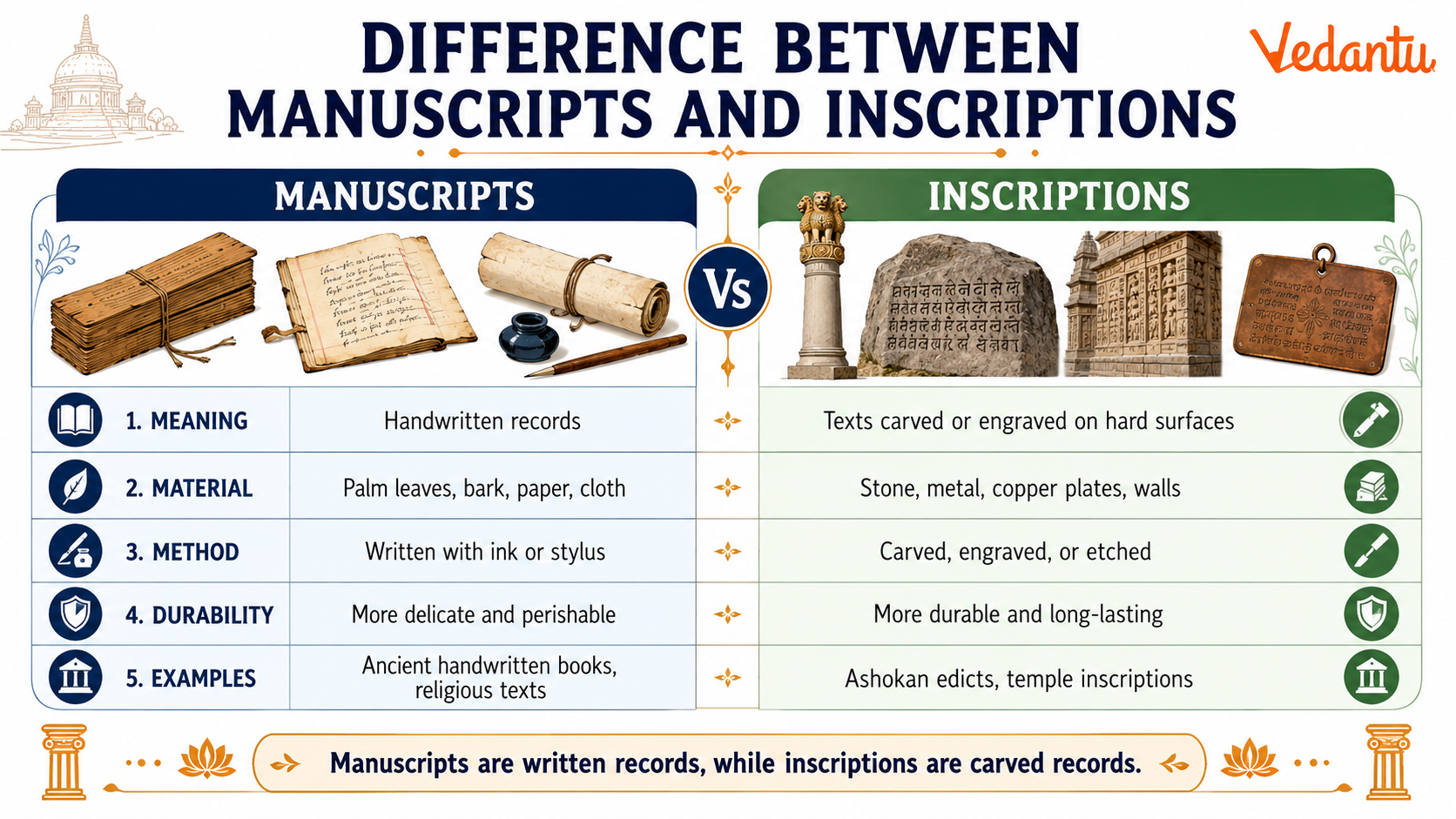
What is a Manuscript?
A manuscript is a handwritten document created before the invention of printing technology. The word manuscript comes from the Latin words manu meaning hand and scriptus meaning written. Manuscripts were written on materials such as palm leaves, parchment, paper, bark, and vellum.
Features of Manuscripts
- Written by hand using ink and pen.
- Usually created for literary, religious, administrative, or scholarly purposes.
- Made on materials like paper, palm leaves, or parchment.
- Portable and can be stored in libraries or archives.
- Often copied by scribes to preserve knowledge.
Examples of Manuscripts
- Ancient religious texts like the Vedas and Bible manuscripts.
- Medieval scientific writings and philosophical works.
- Royal records written on palm leaves in ancient India.
What is an Inscription?
An inscription is a written message carved or engraved on hard surfaces such as stone, metal, wood, or clay. Inscriptions were created to record important events, royal orders, religious messages, or public announcements. They were meant to be permanent and visible to the public.
Features of Inscriptions
- Carved, engraved, or etched on durable materials.
- More permanent and long lasting than manuscripts.
- Often displayed in public places like temples, pillars, and monuments.
- Used mainly for official, political, or religious declarations.
- Difficult to alter once created.
Examples of Inscriptions
- Ashokan Rock Edicts carved on pillars and rocks.
- Temple inscriptions recording donations.
- Ancient Roman inscriptions on monuments.
Difference Between Manuscript and Inscription
| Basis of Comparison | Manuscript | Inscription |
|---|---|---|
| Material Used | Paper, palm leaves, parchment | Stone, metal, wood, clay |
| Method | Handwritten with ink | Carved or engraved |
| Durability | Less durable | Highly durable |
| Purpose | Literary and scholarly works | Public and official records |
| Portability | Portable | Usually fixed in one place |
The table clearly shows that manuscripts are handwritten documents created mainly for preserving knowledge, while inscriptions are permanent records carved on hard surfaces for public communication. Both are valuable historical sources but differ in form, function, and durability.
Importance in Historical Studies
Both manuscripts and inscriptions play a vital role in understanding history. They help historians reconstruct political events, economic systems, cultural practices, and religious beliefs of past societies.
- Manuscripts provide detailed literary and intellectual knowledge.
- Inscriptions give authentic evidence of rulers, dates, and administrative systems.
- Both serve as primary sources for historical research.
Key Points to Remember
- A manuscript is handwritten, while an inscription is engraved.
- Manuscripts are generally less durable than inscriptions.
- Inscriptions are often meant for public display and official purposes.
- Both are important sources of historical information.
Conclusion
The difference between manuscript and inscription lies mainly in their material, method of creation, durability, and purpose. Manuscripts are handwritten documents preserved for knowledge and literature, while inscriptions are carved records meant for permanence and public communication. Understanding this distinction helps students grasp how historical information has been recorded and preserved over time, making it a valuable concept in general knowledge and history studies.
FAQs on Difference Between Manuscripts and Inscriptions in English
1. What is the difference between a manuscript and an inscription?
The difference between manuscript and inscription lies in the material used and the method of writing.
- A manuscript is a handwritten document written on materials like paper, parchment, or palm leaves.
- An inscription is text engraved or carved on hard surfaces such as stone, metal, or pillars.
- Manuscripts are usually portable, while inscriptions are permanent records.
- Both are important historical sources used in studying ancient civilizations.
2. What is a manuscript?
A manuscript is a handwritten document created before the invention of printing.
- Derived from the Latin term "manu scriptus" meaning “written by hand”.
- Written on palm leaves, parchment, birch bark, or paper.
- Contains texts related to religion, literature, science, and administration.
- Examples include ancient religious texts and medieval handwritten books.
3. What is an inscription?
An inscription is text that is engraved, carved, or etched on hard surfaces for permanent record.
- Found on rocks, pillars, temples, coins, and metal plates.
- Used by rulers to record laws, achievements, donations, and religious messages.
- Example: Ashoka’s Rock Edicts.
- Studied under the branch of history called Epigraphy.
4. Why are manuscripts and inscriptions important historical sources?
Both manuscripts and inscriptions are valuable primary sources that help historians understand the past.
- Provide information about political history, culture, religion, and society.
- Help decode ancient languages and scripts like Brahmi and Kharosthi.
- Offer authentic evidence of administrative systems and royal orders.
- Support archaeological and literary research.
5. What materials were used to create manuscripts and inscriptions?
The materials used in manuscripts and inscriptions differed based on purpose and durability.
- Manuscripts: palm leaves, parchment, birch bark, handmade paper.
- Inscriptions: stone slabs, copper plates, pillars, temple walls.
- Manuscripts were easier to preserve indoors, while inscriptions were designed for long-term public display.
6. Who studies manuscripts and inscriptions?
Specialists called palaeographers and epigraphists study manuscripts and inscriptions.
- Palaeography deals with ancient handwriting and manuscripts.
- Epigraphy focuses on studying inscriptions carved on solid materials.
- Historians and archaeologists use these studies to reconstruct ancient history and civilization.
7. What are some examples of famous inscriptions in history?
Several famous historical inscriptions provide insight into ancient governance and culture.
- Ashoka’s Edicts in India.
- Rosetta Stone in Egypt.
- Hammurabi’s Code in Mesopotamia.
- These inscriptions helped scholars understand ancient laws, languages, and empires.
8. How were manuscripts preserved in ancient times?
Ancient manuscripts were preserved carefully to protect them from damage.
- Stored in temples, monasteries, and libraries.
- Wrapped in cloth and treated with natural oils.
- Copied repeatedly by scribes to prevent loss of information.
- Despite care, many were destroyed due to climate, insects, and wars.
9. Are manuscripts older than inscriptions?
Inscriptions are generally older and more durable than manuscripts due to the materials used.
- Early civilizations carved messages on stone and metal.
- Manuscripts became common later with the availability of writing materials like paper and palm leaves.
- However, both forms coexisted in many ancient societies.
10. What are the key differences between manuscript and inscription for exams?
For competitive exams and GK preparation, remember the key differences between manuscript and inscription.
- Writing Style: Handwritten (manuscript) vs Carved/Engraved (inscription).
- Material: Paper/Palm leaves vs Stone/Metal.
- Durability: Less durable vs More permanent.
- Field of Study: Palaeography vs Epigraphy.
- Purpose: Literary/religious texts vs Public records and royal orders.
