






Key Differences in Hindu vs Jain Ramayana: Story, Characters, and Beliefs
The Difference Between Hindu And Jain Ramayana is an important topic in Indian General Knowledge, mythology, and religious studies. While both traditions narrate the story of Lord Rama, their philosophical foundations, character portrayals, and moral interpretations differ significantly. The Hindu Ramayana, primarily attributed to Valmiki, presents Rama as an incarnation of Lord Vishnu and emphasizes dharma and devotion. In contrast, the Jain Ramayana adapts the story according to Jain principles such as non-violence, karma, and renunciation. Understanding these differences helps students and competitive exam aspirants appreciate the diversity of Indian religious thought.
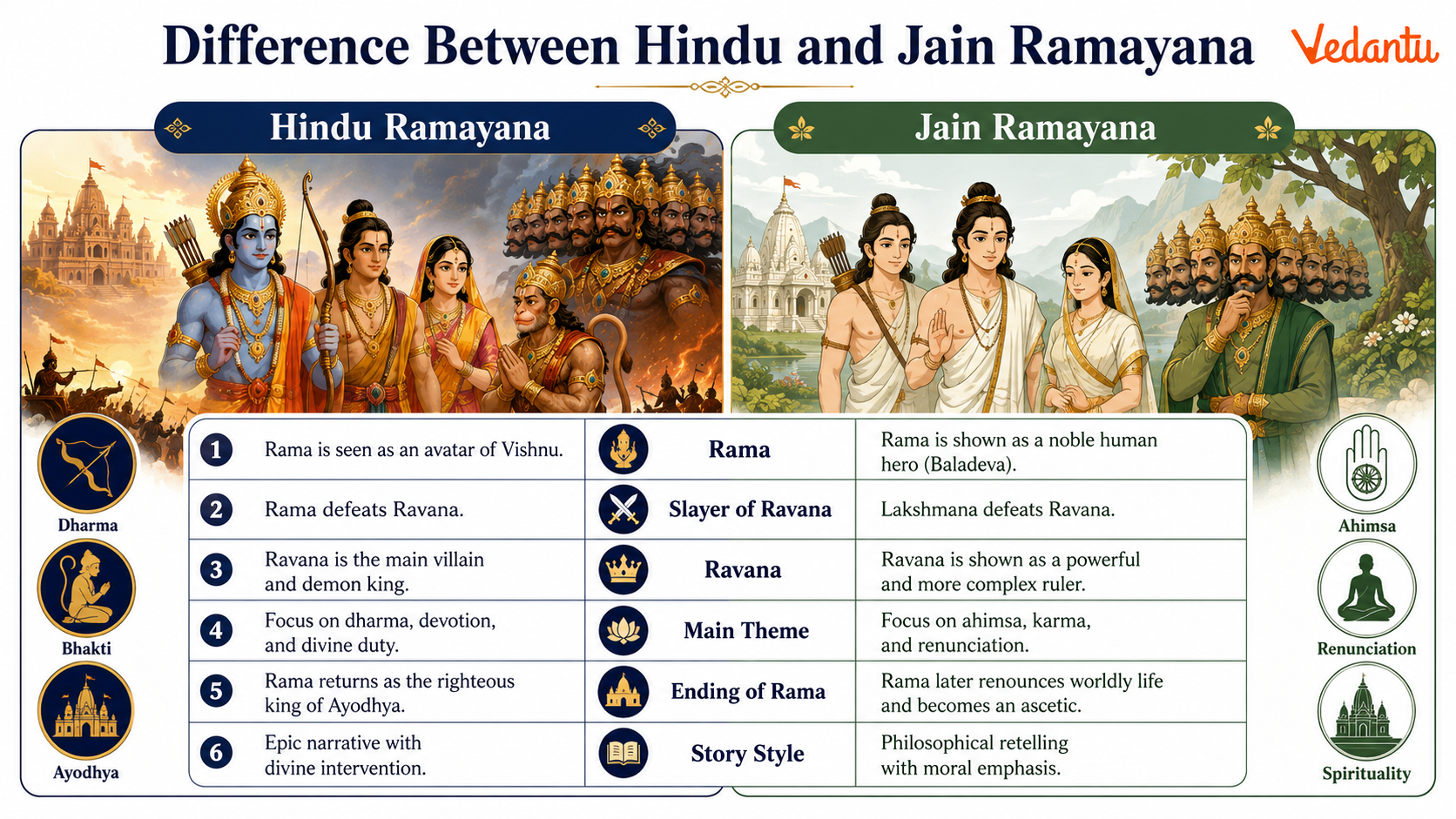
Overview of Hindu Ramayana
The Hindu Ramayana is traditionally attributed to Sage Valmiki and is one of the two great epics of India. It narrates the life of Lord Rama, his exile, the abduction of Sita by Ravana, and the eventual victory of good over evil. Rama is worshipped as the seventh incarnation of Lord Vishnu.
Key Features of Hindu Ramayana
- Rama is considered an avatar of Vishnu.
- Strong emphasis on dharma, duty, and righteousness.
- Ravana is portrayed as the primary villain who is killed by Rama.
- The epic highlights devotion, loyalty, and moral values.
- Major versions include Valmiki Ramayana and Tulsidas Ramcharitmanas.
Overview of Jain Ramayana
The Jain Ramayana, especially the Paumachariya written by Vimalasuri, presents a different interpretation of the same story. It reshapes the narrative according to Jain philosophy, focusing on non-violence and karma. In this version, Rama is not considered a god but a noble human being who follows the path of righteousness and later becomes a Jain monk.
Key Features of Jain Ramayana
- Rama is depicted as a Baladeva, a great but non-violent hero.
- Lakshmana kills Ravana instead of Rama.
- Strong emphasis on ahimsa or non-violence.
- Ravana is portrayed as a tragic and learned figure.
- Rama eventually renounces worldly life and attains liberation.
Difference Between Hindu And Jain Ramayana
| Aspect | Hindu Ramayana | Jain Ramayana |
|---|---|---|
| Status of Rama | Incarnation of Vishnu | Noble human and Baladeva |
| Killing of Ravana | Rama kills Ravana | Lakshmana kills Ravana |
| Philosophy | Focus on dharma and devotion | Focus on non-violence and karma |
| End of Rama's Life | Returns to Ayodhya and rules | Renounces life and becomes a monk |
| View of Ravana | Main villain | Complex and learned character |
The table above highlights the major philosophical and narrative differences between the two versions. While the storyline remains broadly similar, the interpretation and moral lessons vary according to religious beliefs.
Philosophical Differences
The Hindu Ramayana is rooted in the concept of divine intervention and the restoration of cosmic order. Rama represents ideal kingship and obedience to duty. In contrast, the Jain Ramayana avoids divine incarnation and instead focuses on moral discipline and the law of karma. The Jain version reflects the core principles of Jainism such as renunciation, self-control, and liberation from the cycle of rebirth.
Importance for General Knowledge and Competitive Exams
Questions about the Difference Between Hindu And Jain Ramayana are often asked in competitive exams, state PSC exams, and cultural studies sections. Understanding these differences helps in:
- Recognizing religious diversity in India.
- Understanding comparative mythology.
- Preparing for objective and descriptive exam questions.
- Enhancing cultural and historical awareness.
Conclusion
The Difference Between Hindu And Jain Ramayana lies mainly in theology, character roles, and moral emphasis. While the Hindu version presents Rama as a divine incarnation who defeats evil, the Jain version portrays him as a virtuous human who ultimately embraces renunciation. Both versions enrich Indian literary and religious traditions and reflect the pluralistic nature of Indian culture. A clear understanding of these differences is essential for students, exam aspirants, and anyone interested in Indian epics and religious philosophy.
FAQs on Difference Between Hindu and Jain Ramayana Stories Explained
1. What is the main difference between Hindu and Jain Ramayana?
The main difference between the Hindu Ramayana and Jain Ramayana lies in their religious interpretation and portrayal of characters.
• In the Hindu Ramayana (mainly by Valmiki), Rama is an incarnation of Lord Vishnu.
• In the Jain Ramayana (like Paumachariya by Vimalasuri), Rama is a Baladeva (non-violent hero) and not a god.
• Jain versions focus on non-violence (Ahimsa) and Jain philosophy.
• The character roles and ending events differ significantly.
2. Who wrote the Hindu and Jain versions of Ramayana?
The Hindu Ramayana was written by Sage Valmiki, while the Jain Ramayana was composed by Jain scholars.
• Valmiki wrote the original Hindu epic Ramayana in Sanskrit.
• The Jain version was written by Vimalasuri as Paumachariya in Prakrit.
• Other Jain authors later created alternative retellings.
• Both texts reflect their respective religious traditions and beliefs.
3. How is Rama portrayed differently in Jain Ramayana?
In the Jain Ramayana, Rama is portrayed as a noble human hero rather than a divine incarnation.
• Rama is a Baladeva, a non-violent hero in Jain tradition.
• He does not kill Ravana; Lakshmana performs the killing.
• Rama later becomes a Jain monk and attains liberation.
• The focus is on self-discipline and non-violence.
4. Who kills Ravana in Jain Ramayana?
In the Jain Ramayana, Lakshmana kills Ravana instead of Rama.
• Lakshmana is depicted as a Vasudeva (warrior hero).
• Jain philosophy avoids portraying Rama as violent.
• Ravana is shown as a tragic but learned ruler.
• This change reflects Jain teachings of Ahimsa (non-violence).
5. How is Ravana depicted in Hindu and Jain Ramayana?
Ravana's character differs significantly in Hindu and Jain versions of Ramayana.
• In the Hindu Ramayana, Ravana is a powerful demon king and main antagonist.
• In the Jain Ramayana, Ravana is a learned, noble, and tragic figure.
• Jain texts portray him as a devotee and scholar with human weaknesses.
• His character is less demonized compared to Hindu tradition.
6. What is the religious message in Hindu and Jain Ramayana?
The religious message of each Ramayana reflects its respective faith.
• The Hindu Ramayana promotes Dharma (righteousness) and devotion to God.
• The Jain Ramayana emphasizes Ahimsa, karma, and renunciation.
• Hindu texts highlight divine intervention.
• Jain texts stress spiritual liberation through self-control.
7. What is Paumachariya in Jain literature?
Paumachariya is the Jain version of the Ramayana written by Vimalasuri.
• Composed in Prakrit language.
• Presents Rama as a Jain hero.
• Reinterprets events according to Jain beliefs.
• It is one of the earliest Jain retellings of the Ramayana story.
8. Did Rama attain Moksha in Jain Ramayana?
Yes, in the Jain Ramayana, Rama ultimately attains Moksha (liberation).
• After fulfilling his worldly duties, Rama becomes a Jain ascetic.
• He practices strict penance and renunciation.
• He achieves Kevala Jnana (omniscience) and liberation.
• This reflects Jain spiritual ideals.
9. Are the events of exile the same in Hindu and Jain Ramayana?
The exile episode exists in both versions but differs in interpretation and details.
• In the Hindu Ramayana, exile is linked to palace intrigue and destiny.
• In the Jain Ramayana, events are adapted to align with Jain ethics.
• Supernatural elements are reduced in Jain texts.
• The focus shifts from divine drama to moral lessons.
10. Why are there multiple versions of the Ramayana?
There are multiple versions of the Ramayana because different religions, regions, and cultures retold the epic in their own way.
• The story spread across India and Southeast Asia.
• Hindu, Jain, and Buddhist traditions created adaptations.
• Each version reflects local beliefs, values, and philosophy.
• This diversity makes the Ramayana a living and evolving epic tradition.
