






Mamluk (Slave) Rulers of the Delhi Sultanate: Timeline and Achievements
The Delhi Sultanate Slave Dynasty, also known as the Mamluk Dynasty, was the first ruling dynasty of the Delhi Sultanate in India. It ruled from 1206 to 1290 AD and laid the foundation of Muslim rule in northern India. The dynasty was established by Qutb-ud-din Aibak, a former slave of Muhammad Ghori. The term "Slave Dynasty" refers to the fact that many of its rulers were originally slaves who rose to power through merit and military skill. This period is important in Indian history as it marked the beginning of centralized Islamic rule in India and introduced new administrative systems, architecture, and cultural influences.
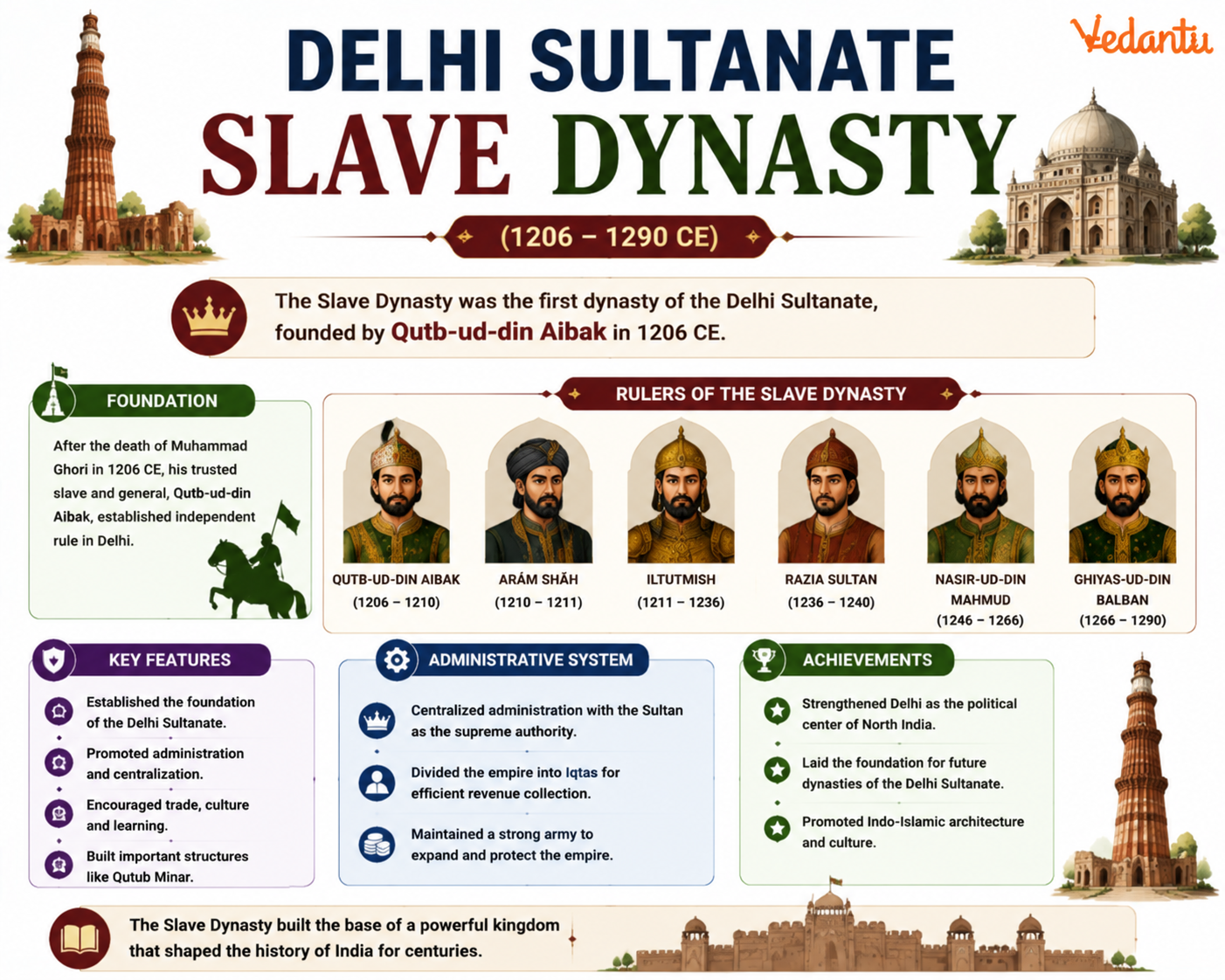
Origin of the Slave Dynasty
After the death of Muhammad Ghori in 1206 AD, his territories in India were taken over by his trusted slave and general Qutb-ud-din Aibak. Since Ghori had no children, his empire was divided among his capable generals. Aibak established independent rule in Delhi and founded the Slave Dynasty.
- Founded in 1206 AD
- Also called the Mamluk Dynasty
- First dynasty of the Delhi Sultanate
- Capital - Delhi
Rulers of the Slave Dynasty
Major Rulers of the Slave Dynasty
| Ruler | Reign Period | Important Contributions |
|---|---|---|
| Qutb-ud-din Aibak | 1206 - 1210 AD | Founded the dynasty, began Qutub Minar |
| Iltutmish | 1211 - 1236 AD | Consolidated empire, introduced Iqta system |
| Razia Sultan | 1236 - 1240 AD | First and only woman ruler of Delhi Sultanate |
| Balban | 1266 - 1287 AD | Strengthened monarchy and administration |
These rulers played a crucial role in stabilizing and expanding the Delhi Sultanate. Among them, Iltutmish and Balban are considered the most powerful and capable administrators.
Important Features of the Slave Dynasty
1. Administrative System
The rulers established a centralized administrative system. Iltutmish introduced the Iqta system, where land was granted to officials in return for military services.
- Iqta system for revenue collection
- Strong central authority
- Well-organized military structure
2. Military Strength
The Slave Dynasty rulers maintained a powerful army to defend their territories against Mongol invasions and internal rebellions. Balban especially focused on strengthening the army and suppressing revolts.
3. Architecture
The period saw the beginning of Indo-Islamic architecture in India. Many important monuments were constructed during this time.
- Qutub Minar in Delhi
- Quwwat-ul-Islam Mosque
- Tomb of Iltutmish
Role of Important Rulers
Qutb-ud-din Aibak
He was known as "Lakh Baksh" because of his generosity. Although his reign was short, he laid the foundation of Muslim rule in India.
Iltutmish
He completed the Qutub Minar and secured recognition from the Abbasid Caliph, which strengthened his legitimacy. He also organized the nobility into a group called Chahalgani or Group of Forty.
Razia Sultan
Razia tried to rule independently without the control of nobles. However, she faced opposition from Turkish nobles and was eventually removed from power.
Balban
Balban believed in the theory of kingship and strengthened the position of the Sultan. He introduced strict court discipline and crushed internal rebellions effectively.
Causes of Decline
The Slave Dynasty declined due to weak successors and internal conflicts among nobles. After Balban's death, the central authority weakened significantly.
- Weak rulers after Balban
- Nobles' interference in administration
- Internal revolts and instability
In 1290 AD, Jalal-ud-din Khilji overthrew the last ruler of the Slave Dynasty and established the Khilji Dynasty.
Significance of the Slave Dynasty
The Slave Dynasty was significant because it laid the political and administrative foundation of the Delhi Sultanate. It introduced new governance methods, military organization, and architectural styles that influenced later dynasties. It also marked the beginning of a new phase in Indian medieval history.
- Established stable Muslim rule in North India
- Developed centralized administration
- Promoted Indo-Islamic culture and architecture
Conclusion
The Delhi Sultanate Slave Dynasty played a foundational role in shaping medieval Indian history. Despite internal conflicts and political challenges, its rulers built a strong administrative and military system that ensured the survival and expansion of the Sultanate. Understanding this dynasty is essential for students and competitive exam aspirants as it marks the beginning of a major political transformation in India.
FAQs on Delhi Sultanate: The Slave Dynasty Overview, Rulers and Impact
1. What was the Slave Dynasty in the Delhi Sultanate?
The Slave Dynasty (1206–1290 CE) was the first ruling dynasty of the Delhi Sultanate, founded by former slaves who rose to power.
• Established by Qutb-ud-din Aibak in 1206 CE
• Also known as the Mamluk Dynasty ("Mamluk" means slave)
• Marked the beginning of Muslim rule in North India
• Important rulers: Iltutmish, Razia Sultan, Balban
This period laid the foundation of centralized administration and Indo-Islamic culture in medieval India.
2. Who founded the Slave Dynasty?
The Slave Dynasty was founded by Qutb-ud-din Aibak in 1206 CE.
• Former slave and general of Muhammad Ghori
• Declared himself Sultan after Ghori’s death
• Started construction of the Qutub Minar
• Ruled from Lahore and Delhi
His reign marked the beginning of the Delhi Sultanate in Indian history.
3. Why is Iltutmish considered the real founder of the Delhi Sultanate?
Iltutmish is considered the real consolidator of the Delhi Sultanate because he strengthened and stabilized the empire.
• Ruled from 1211–1236 CE
• Defeated rival claimants and Mongol threats
• Introduced the Iqtadari system
• Received recognition from the Caliph of Baghdad
His administrative reforms made the Sultanate politically secure and organized.
4. Who was Razia Sultan and why is she important?
Razia Sultan was the first and only female ruler of the Delhi Sultanate.
• Daughter of Iltutmish
• Ruled from 1236–1240 CE
• Tried to reduce the power of Turkish nobles (Chahalgani)
• Promoted merit over nobility
Her reign is significant for breaking gender barriers in medieval Indian history.
5. What was the Iqtadari System during the Slave Dynasty?
The Iqtadari System was a land revenue and administrative system introduced by Iltutmish.
• Land was divided into Iqtas
• Officers called Iqtadars collected revenue
• Revenue used to maintain army and administration
• Strengthened central control
This system became a key feature of the Delhi Sultanate administration.
6. Who was Ghiyas-ud-din Balban and what were his policies?
Ghiyas-ud-din Balban was a powerful ruler of the Slave Dynasty known for strengthening monarchy.
• Ruled from 1266–1287 CE
• Followed the policy of "Blood and Iron"
• Introduced strict court discipline (Sijda and Paibos)
• Suppressed revolts and Mongol invasions
He enhanced the prestige and authority of the Sultan.
7. What were the main achievements of the Slave Dynasty?
The Slave Dynasty laid the administrative and architectural foundation of the Delhi Sultanate.
• Establishment of centralized rule in Delhi
• Introduction of the Iqtadari system
• Construction of Qutub Minar and Quwwat-ul-Islam Mosque
• Defense against Mongol invasions
These achievements shaped medieval Indian political and cultural history.
8. Why is it called the Mamluk or Slave Dynasty?
It is called the Mamluk (Slave) Dynasty because its rulers were originally slaves who rose to power.
• "Mamluk" means owned slave
• Rulers like Aibak, Iltutmish, and Balban were former slaves
• They gained military and administrative training
• Rose to become Sultans through merit and loyalty
This unique origin makes the dynasty historically significant.
9. How did the Slave Dynasty come to an end?
The Slave Dynasty ended in 1290 CE due to internal weakness and noble conspiracies.
• Weak successors after Balban
• Growing power struggles among nobles
• Overthrow by Jalal-ud-din Khalji
• Beginning of the Khalji Dynasty
This marked the transition to the next phase of the Delhi Sultanate.
10. What is the historical significance of the Slave Dynasty in India?
The Slave Dynasty is historically significant as it established Muslim rule and administrative systems in North India.
• Beginning of the Delhi Sultanate period
• Development of Indo-Islamic architecture
• Strengthening of centralized governance
• Cultural interaction between Persian and Indian traditions
It played a crucial role in shaping medieval Indian history and later Sultanate dynasties.
