






Types and Impact of Debt on India’s Central Government
Debt on the Indian Government refers to the total amount of money borrowed by the Central Government of India to meet its expenditure requirements. When government spending exceeds its revenue, it results in a fiscal deficit, which is financed through borrowing. Government debt plays a crucial role in economic development, infrastructure building, welfare schemes, and crisis management. However, excessive debt can create financial stress on the economy. Understanding government debt is important for students, competitive exam aspirants, and general readers as it is a key topic in Indian Economy and General Knowledge.
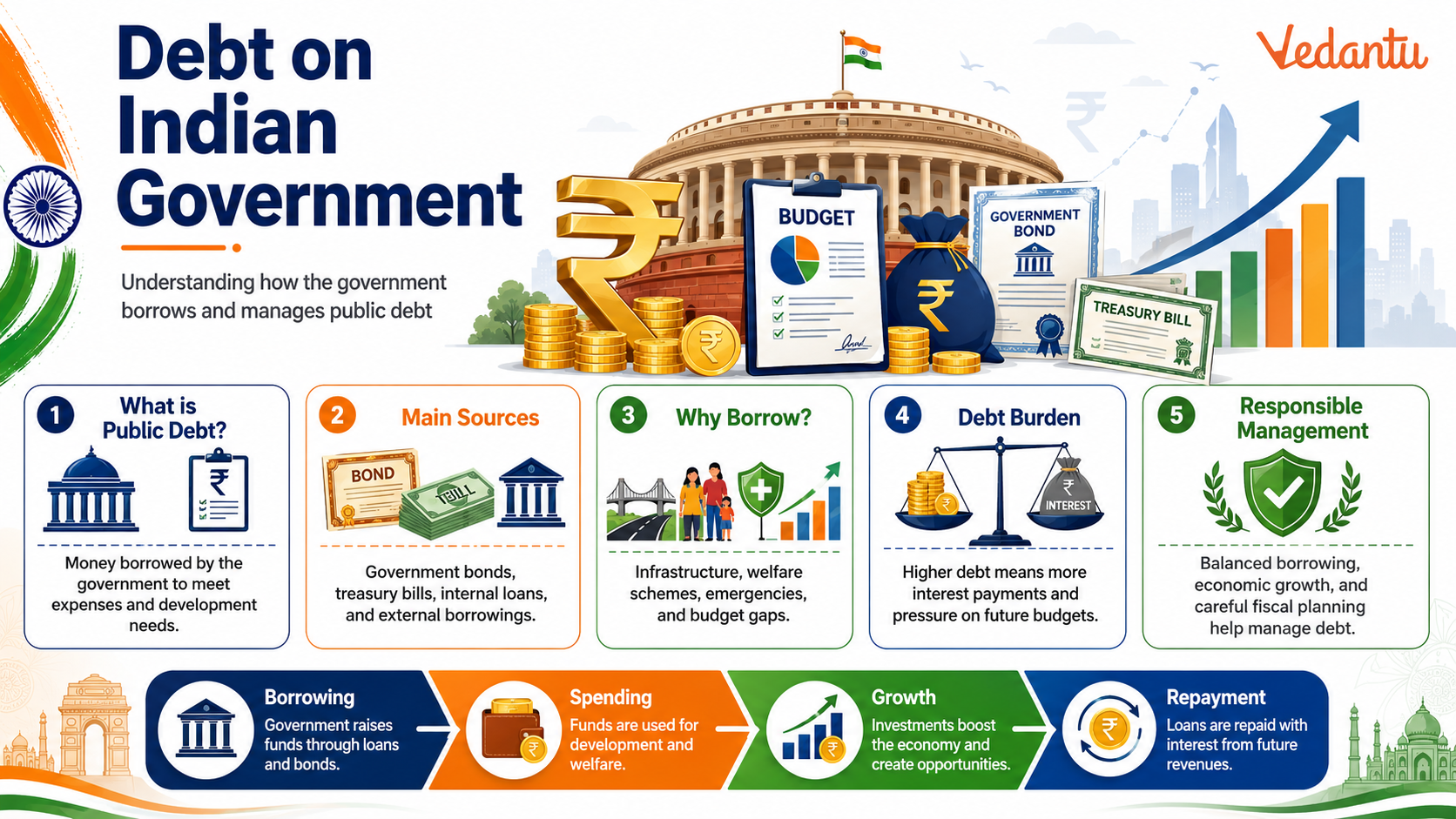
Meaning of Government Debt
Government debt, also known as public debt, is the total outstanding liabilities of the government. It includes all borrowings raised by the government through internal and external sources to finance its budget deficit and other financial obligations.
Why Does the Government Borrow?
- To finance fiscal deficit when expenditure exceeds revenue.
- To fund infrastructure projects such as roads, railways, and ports.
- To support social welfare schemes and subsidies.
- To manage economic crises like pandemics or global recessions.
- To refinance existing debt obligations.
Types of Government Debt in India
Government debt in India can be broadly classified into internal debt and external debt based on the source of borrowing.
Classification of Indian Government Debt
| Type of Debt | Source | Examples |
|---|---|---|
| Internal Debt | Borrowed within the country | Government bonds, Treasury bills |
| External Debt | Borrowed from foreign sources | Loans from World Bank, IMF |
Internal debt forms the major portion of India's total public debt. It is considered safer because it is borrowed in domestic currency. External debt is generally a smaller share and is borrowed in foreign currencies, which exposes the country to exchange rate risks.
Components of Public Debt
- Market Loans - Long term bonds issued by the government.
- Treasury Bills - Short term borrowing instruments.
- External Loans - Borrowings from international organizations.
- Small Savings and Provident Funds - Public savings mobilized by the government.
Debt to GDP Ratio
Debt to GDP ratio is an important indicator that measures the total government debt as a percentage of Gross Domestic Product. It shows the country's ability to repay its debt. A high ratio indicates greater financial risk, while a moderate and stable ratio suggests better debt sustainability.
In India, the Debt to GDP ratio increased significantly during the COVID 19 pandemic due to higher government spending and lower revenue collection. Managing this ratio is a key responsibility of fiscal policy.
Impact of Government Debt
Positive Effects
- Supports economic growth through infrastructure development.
- Provides funds during emergencies.
- Helps in maintaining welfare and social security programs.
Negative Effects
- High interest payments increase revenue expenditure.
- Crowding out of private investment.
- Risk of inflation if borrowing is excessive.
- Burden on future generations.
Management of Government Debt
The Reserve Bank of India manages the public debt of the Central Government. The government follows fiscal responsibility measures to ensure sustainable debt levels.
Measures for Debt Control
- Reducing fiscal deficit through better tax collection.
- Rationalizing subsidies and expenditure.
- Promoting economic growth to increase GDP.
- Following fiscal discipline under the FRBM Act.
FRBM Act and Debt
The Fiscal Responsibility and Budget Management Act aims to ensure fiscal discipline, reduce fiscal deficit, and maintain sustainable debt levels. It sets targets for fiscal deficit and debt to GDP ratio to promote long term macroeconomic stability in India.
Recent Trends in Indian Government Debt
In recent years, India's public debt has increased due to higher public spending on infrastructure, welfare schemes, and pandemic related relief measures. However, the government focuses on maintaining debt sustainability by improving tax revenue, promoting economic growth, and managing borrowing efficiently. Internal debt continues to form the majority share of total debt.
Importance for Competitive Exams
- Frequently asked in UPSC, SSC, Banking, and State PSC exams.
- Important for understanding Budget and Economic Survey.
- Helps in answering questions related to fiscal policy and macroeconomics.
Conclusion
Debt on the Indian Government is a vital component of the country's fiscal framework. While borrowing is necessary for development and economic stability, maintaining sustainable debt levels is equally important. Proper management through fiscal discipline, economic growth, and effective policy measures ensures that government debt supports long term national development without creating financial instability. A clear understanding of this topic helps students grasp key economic concepts and prepares them effectively for competitive examinations.
FAQs on Debt on the Indian Government Explained for Students
1. What is debt on the Indian Government?
Debt on the Indian Government refers to the total amount of money borrowed by the Central Government to meet its financial needs and budget deficits. It includes:
• Internal Debt – Borrowings within India (government bonds, treasury bills)
• External Debt – Loans from foreign governments and international institutions
• Public Debt – Total liabilities owed by the government
This borrowing helps finance infrastructure, welfare schemes, defence, and development projects. (PAA: What is public debt? PAS: Government borrowing in India, fiscal deficit meaning)
2. What are the main types of government debt in India?
The main types of government debt in India are internal and external debt. These include:
• Internal Debt – Market loans, treasury bills, dated securities
• External Debt – Loans from World Bank, IMF, foreign countries
• Short-term Debt – Treasury Bills (T-Bills)
• Long-term Debt – Government bonds and dated securities
Internal debt forms the largest share of India’s public debt. (PAA: Types of public debt in India, PAS: Internal vs external debt)
3. Why does the Indian Government borrow money?
The Indian Government borrows money to cover fiscal deficits and fund development activities. Key reasons include:
• Meeting budget deficit
• Financing infrastructure and welfare schemes
• Managing emergencies like pandemics or natural disasters
• Supporting economic growth and public services
Borrowing ensures smooth functioning when expenditure exceeds revenue. (PAA: Why does government borrow? PAS: Fiscal deficit and public debt relationship)
4. What is the difference between internal debt and external debt?
Internal debt is borrowed within the country, while external debt is borrowed from foreign sources.
• Internal Debt – Raised through government securities, treasury bills, bonds (borrowed from citizens and institutions)
• External Debt – Loans from foreign governments, IMF, World Bank
India relies more on internal debt to reduce foreign dependency and currency risk. (PAA: Internal vs external borrowing, PAS: Foreign debt meaning)
5. What is fiscal deficit and how is it related to government debt?
Fiscal deficit occurs when government expenditure exceeds its revenue, leading to borrowing.
• Fiscal Deficit = Total Expenditure – Total Revenue (excluding borrowings)
• It increases public debt
• Persistent deficits lead to higher interest payments
Thus, fiscal deficit directly contributes to rising government debt in India. (PAA: Meaning of fiscal deficit, PAS: Budget deficit vs fiscal deficit)
6. Who manages the public debt in India?
The Reserve Bank of India (RBI) manages public debt on behalf of the Government of India.
• Issues government bonds and treasury bills
• Conducts auctions of securities
• Manages interest payments and repayments
This process is governed under the Public Debt Act, 1944. (PAA: Role of RBI in public debt, PAS: Who issues government bonds in India)
7. What is the current trend of India’s public debt?
India’s public debt has increased in recent years due to higher government spending and economic challenges.
• Increased borrowing during COVID-19 pandemic
• Higher expenditure on welfare and infrastructure
• Debt-to-GDP ratio fluctuates based on economic growth
Monitoring the debt-to-GDP ratio helps assess sustainability. (PAA: India debt-to-GDP ratio, PAS: Is India’s public debt high?)
8. What is debt-to-GDP ratio?
Debt-to-GDP ratio measures a country’s total debt compared to its Gross Domestic Product (GDP).
• Indicates ability to repay debt
• Higher ratio means greater debt burden
• Used to assess fiscal sustainability
A stable or declining ratio is considered healthy for economic stability. (PAA: What is debt-to-GDP ratio in India? PAS: Importance of GDP ratio)
9. What are the effects of high government debt?
High government debt can impact economic growth and financial stability.
• Increased interest payments
• Risk of inflation
• Reduced funds for development
• Possible credit rating downgrade
However, productive borrowing for infrastructure can boost long-term growth. (PAA: Impact of public debt, PAS: Advantages and disadvantages of government borrowing)
10. What is public debt under the Indian Constitution?
Public debt is recognized under Article 292 of the Indian Constitution.
• Allows the Central Government to borrow upon the security of the Consolidated Fund of India
• Borrowing limits may be fixed by Parliament
• States borrow under Article 293
This constitutional provision ensures legal regulation of government borrowing in India. (PAA: Article 292 and 293 explained, PAS: Constitutional provisions for public debt)
