






Causes, Key Events, and Impact of the 1930 Civil Disobedience Movement
The Civil Disobedience Movement was one of the most significant phases of India’s struggle for independence from British rule. Launched by Mahatma Gandhi in 1930, the movement aimed at defying British laws openly and peacefully to demand complete independence or Purna Swaraj. It marked a shift from petitions and protests to direct mass action. The movement mobilized millions of Indians including peasants, women, students, and workers, making it a nationwide struggle against colonial authority.
Background of the Civil Disobedience Movement
The Civil Disobedience Movement emerged after the failure of constitutional reforms and growing dissatisfaction with British policies. The Simon Commission of 1927 did not include any Indian member, leading to widespread protests. In 1929, the Indian National Congress declared Purna Swaraj as its ultimate goal during the Lahore Session under the presidency of Jawaharlal Nehru. January 26, 1930, was celebrated as Independence Day, setting the stage for mass civil disobedience.
Main Causes
- Rejection of the Simon Commission due to lack of Indian representation.
- Failure of constitutional reforms to grant dominion status to India.
- Economic hardships caused by heavy taxation and the Great Depression.
- Demand for complete independence instead of limited self governance.
Launch of the Movement - The Salt Satyagraha
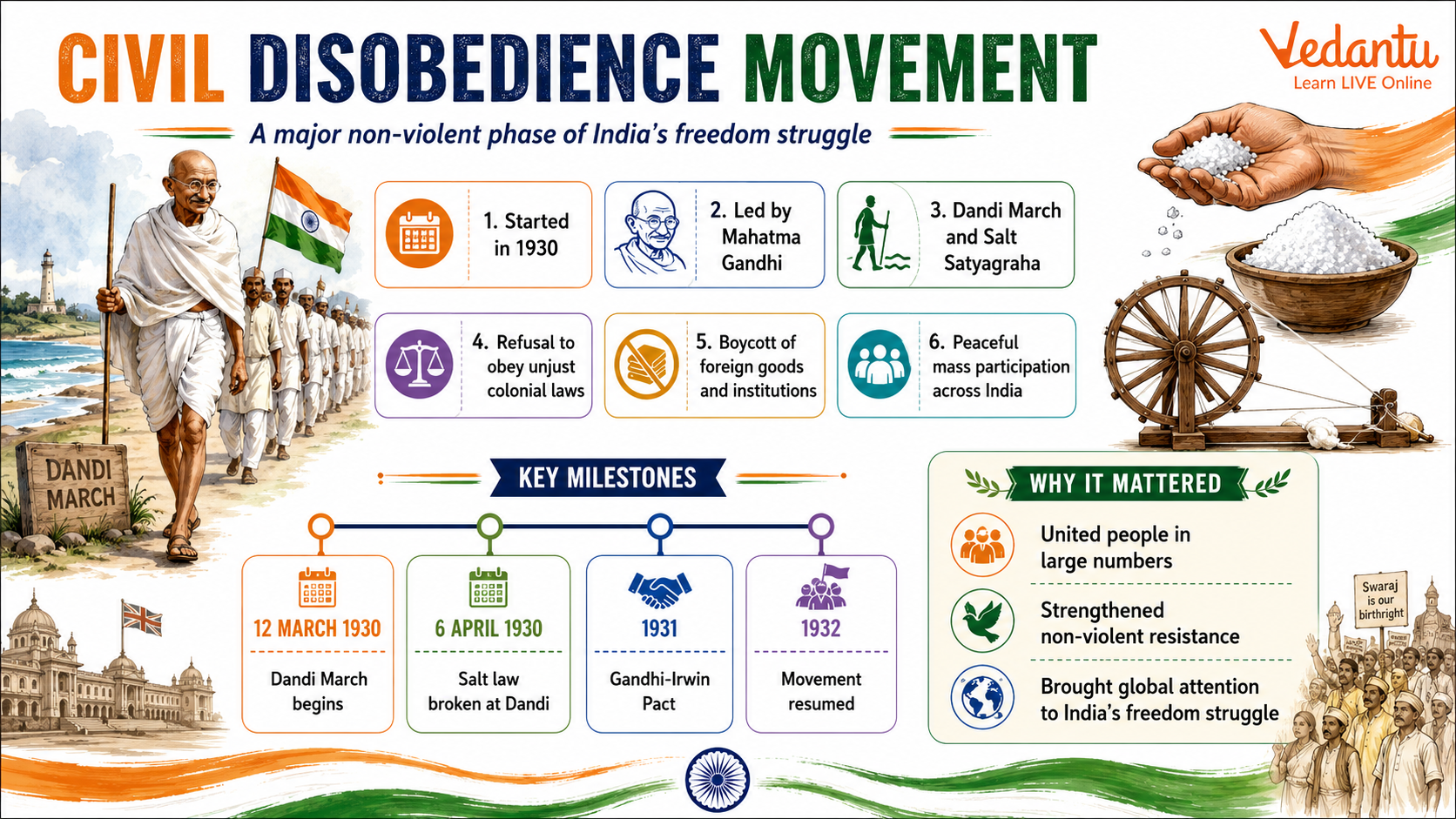
The movement officially began with the historic Salt March or Dandi March on March 12, 1930. Mahatma Gandhi started the march from Sabarmati Ashram to Dandi, covering about 240 miles in 24 days. On April 6, 1930, he broke the British salt law by making salt from seawater. This symbolic act inspired millions across the country to defy British laws.
Why Salt Was Chosen
- Salt was an essential commodity used by all Indians.
- The British monopoly on salt production affected the poor the most.
- It was a simple yet powerful symbol of colonial injustice.
Major Features of the Movement
- Violation of salt laws across coastal regions.
- Boycott of foreign goods and promotion of khadi.
- Refusal to pay taxes including land revenue and chowkidari tax.
- Mass participation of women led by leaders like Sarojini Naidu.
- Peaceful protests despite police repression and arrests.
Key Events of the Civil Disobedience Movement
| Year | Event | Significance |
|---|---|---|
| 1930 | Dandi March | Start of Civil Disobedience Movement |
| 1931 | Gandhi Irwin Pact | Temporary suspension of the movement |
| 1932 | Restart of Movement | Resumed after failure of Round Table Conference |
The Gandhi Irwin Pact in 1931 led to the temporary suspension of the movement and allowed Gandhi to attend the Second Round Table Conference in London. However, when negotiations failed, the movement was resumed in 1932. It was finally withdrawn in 1934.
Impact and Significance
The Civil Disobedience Movement had a profound impact on the Indian freedom struggle. It transformed the national movement into a mass movement involving people from all sections of society. The British government realized that it could no longer ignore Indian demands for self rule.
- Strengthened the demand for complete independence.
- Increased political awareness among rural and urban populations.
- Enhanced the role of women in the freedom struggle.
- Exposed the repressive nature of British rule to the world.
Limitations of the Movement
Despite its success, the movement had certain limitations. Not all sections of society actively participated. Some revolutionary groups and political organizations had different approaches toward independence. The movement also faced severe repression including arrests of major leaders.
- Limited participation from certain regions.
- Harsh suppression by British authorities.
- Failure of Round Table Conferences to achieve major concessions.
Conclusion
The Civil Disobedience Movement was a landmark event in India’s independence struggle. By adopting non violent resistance and mass participation, it demonstrated the power of collective action against injustice. Though it did not immediately achieve independence, it laid a strong foundation for future movements and brought India closer to freedom in 1947. Understanding this movement is essential for students preparing for competitive exams as it highlights the evolution of India’s national movement and the leadership of Mahatma Gandhi.
FAQs on Civil Disobedience Movement in India (1930–34): Complete Student Guide
1. What was the Civil Disobedience Movement?
The Civil Disobedience Movement was a mass protest launched by Mahatma Gandhi in 1930 against British rule in India.
• It aimed at openly violating unjust British laws.
• It began with the historic Dandi March (Salt March).
• It demanded Purna Swaraj (Complete Independence).
• It involved non-payment of taxes and boycott of foreign goods.
This movement became a major phase of the Indian National Movement and strengthened the freedom struggle.
2. When did the Civil Disobedience Movement start and end?
The Civil Disobedience Movement started on 12 March 1930 and officially ended in 1934.
• It began with Gandhi’s Salt March to Dandi.
• First phase: 1930–1931 (suspended after the Gandhi-Irwin Pact).
• Second phase: 1932–1934 after failure of the Round Table Conferences.
• It was withdrawn in 1934 due to repression and strategic shifts.
These years marked intense nationalist activity against British colonial policies.
3. What were the main causes of the Civil Disobedience Movement?
The main causes of the Civil Disobedience Movement were political dissatisfaction and economic hardships under British rule.
• Rejection of the Simon Commission (1928).
• Demand for Complete Independence at the Lahore Session (1929).
• Heavy taxes, especially the Salt Tax.
• Failure of constitutional reforms.
• Economic depression affecting peasants and workers.
These issues triggered mass resistance and civil disobedience across India.
4. What was the importance of the Dandi March in the Civil Disobedience Movement?
The Dandi March symbolized the beginning of open defiance against British laws.
• Led by Mahatma Gandhi from Sabarmati Ashram to Dandi.
• Covered about 240 miles in 24 days.
• Gandhi broke the Salt Law on 6 April 1930.
• Inspired millions to make salt and defy colonial laws.
The Salt March became an international symbol of non-violent resistance (Satyagraha).
5. What were the main features of the Civil Disobedience Movement?
The Civil Disobedience Movement was marked by mass participation and non-violent protest.
• Violation of the Salt Law.
• Boycott of foreign goods and British institutions.
• Refusal to pay taxes.
• Resignation from government jobs.
• Participation of women, peasants, and students.
It expanded the base of the Indian freedom struggle across regions and communities.
6. What was the Gandhi-Irwin Pact?
The Gandhi-Irwin Pact (1931) was an agreement between Mahatma Gandhi and Viceroy Lord Irwin to suspend the movement temporarily.
• Civil Disobedience Movement was called off.
• Political prisoners were released (except violent offenders).
• Indians were allowed to make salt in coastal areas.
• Gandhi agreed to attend the Second Round Table Conference in London.
This pact marked a temporary compromise between the British government and the Indian National Congress.
7. How did the Civil Disobedience Movement differ from the Non-Cooperation Movement?
The Civil Disobedience Movement involved active law-breaking, unlike the Non-Cooperation Movement.
• Non-Cooperation Movement (1920): Boycott of British institutions only.
• Civil Disobedience Movement (1930): Open violation of laws like the Salt Act.
• Wider participation of women in Civil Disobedience.
• Greater focus on Purna Swaraj.
Both were led by Gandhi and based on non-violence and Satyagraha.
8. What was the role of women in the Civil Disobedience Movement?
Women played a significant and active role in the Civil Disobedience Movement.
• Leaders like Sarojini Naidu led salt satyagrahas.
• Women participated in picketing liquor and foreign cloth shops.
• Many courted arrest and went to jail.
• It marked large-scale female participation in politics for the first time.
This strengthened the social base of the Indian nationalist movement.
9. What were the effects of the Civil Disobedience Movement?
The Civil Disobedience Movement had significant political and social impacts.
• Strengthened the demand for Complete Independence.
• Increased mass participation across India.
• Exposed the repressive nature of British rule.
• Elevated Gandhi as a global leader of non-violence.
Though it did not achieve immediate independence, it intensified the freedom struggle.
10. Why was the Civil Disobedience Movement withdrawn?
The Civil Disobedience Movement was withdrawn in 1934 due to political and strategic reasons.
• Harsh British repression and arrests.
• Limited success of the Round Table Conferences.
• Internal differences within the Congress.
• Gandhi’s decision to shift focus to constructive programs.
Despite its withdrawal, it remained a landmark phase in India’s national movement for independence.
