






How the ASEAN regional bloc supports Southeast Asia’s growth and cooperation
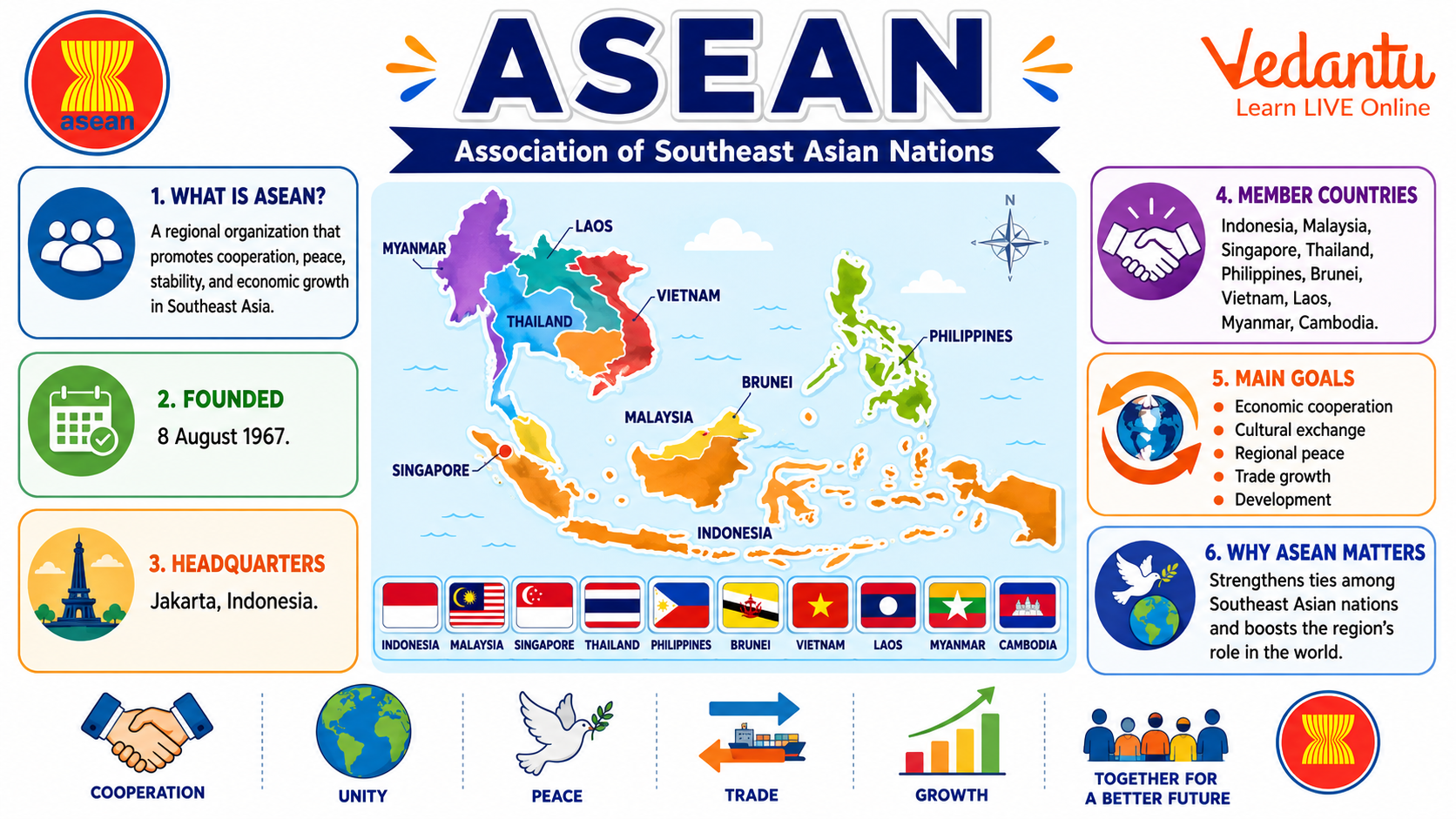
ASEAN, which stands for the Association of Southeast Asian Nations, is a regional intergovernmental organization formed to promote political and economic cooperation among countries in Southeast Asia. Established in 1967, ASEAN plays a vital role in maintaining regional peace, stability, and economic growth. It is an important topic in General Knowledge, especially for students preparing for competitive exams such as UPSC, SSC, Banking, and other government examinations. Understanding ASEAN helps in grasping regional geopolitics, trade relations, and international diplomacy in Asia.
Formation and Background of ASEAN
ASEAN was officially established on 8 August 1967 in Bangkok, Thailand, with the signing of the ASEAN Declaration, also known as the Bangkok Declaration. The founding members aimed to accelerate economic growth, social progress, and cultural development in the Southeast Asian region while promoting regional peace and stability.
Founding Members
- Indonesia
- Malaysia
- Philippines
- Singapore
- Thailand
Objectives of Formation
- Promote economic growth and regional integration
- Ensure political stability and regional peace
- Encourage collaboration in education, culture, and technology
- Resolve regional disputes peacefully
Current Member Countries of ASEAN
Over time, ASEAN expanded from five to ten member countries. These nations together represent a significant economic and strategic bloc in Asia.
ASEAN Member Countries and Year of Joining
| Country | Year of Joining | Capital |
|---|---|---|
| Indonesia | 1967 | Jakarta |
| Malaysia | 1967 | Kuala Lumpur |
| Philippines | 1967 | Manila |
| Singapore | 1967 | Singapore |
| Thailand | 1967 | Bangkok |
| Brunei | 1984 | Bandar Seri Begawan |
| Vietnam | 1995 | Hanoi |
| Laos | 1997 | Vientiane |
| Myanmar | 1997 | Naypyidaw |
| Cambodia | 1999 | Phnom Penh |
ASEAN also engages with dialogue partners such as India, China, Japan, the United States, and the European Union, strengthening its global influence.
Headquarters and Organizational Structure
The headquarters of ASEAN is located in Jakarta, Indonesia. The organization functions through various councils and committees that manage political, economic, and socio cultural cooperation.
Key Organs of ASEAN
- ASEAN Summit - Supreme decision making body comprising heads of state or government
- ASEAN Coordinating Council - Prepares summit meetings
- ASEAN Secretariat - Administrative body led by the Secretary General
- ASEAN Community Councils - Focus on political security, economic, and socio cultural pillars
ASEAN Community Pillars
In 2015, ASEAN formally established the ASEAN Community based on three main pillars to promote deeper integration among member states.
- ASEAN Political Security Community - Ensures peace, stability, and rule of law in the region
- ASEAN Economic Community - Promotes free movement of goods, services, investment, and skilled labor
- ASEAN Socio Cultural Community - Focuses on social development, education, environment, and cultural exchange
Importance of ASEAN in Global Affairs
ASEAN is strategically located between the Indian and Pacific Oceans. The region is vital for global trade routes, especially through the Strait of Malacca. ASEAN countries collectively form one of the largest economic blocs in the world, with a rapidly growing population and expanding markets.
- Acts as a bridge between major powers like China, India, Japan, and the United States
- Promotes regional free trade agreements
- Enhances maritime security cooperation
- Supports sustainable development initiatives
India and ASEAN Relations
India is a key dialogue partner of ASEAN and actively participates in ASEAN led forums such as the East Asia Summit and ASEAN Regional Forum. The India ASEAN Free Trade Agreement strengthens economic ties, while the Act East Policy emphasizes strategic and cultural engagement with Southeast Asia.
Key Facts About ASEAN
- Established on 8 August 1967
- Headquarters in Jakarta, Indonesia
- Ten member countries
- ASEAN Day is celebrated on 8 August
- Motto - One Vision, One Identity, One Community
Conclusion
ASEAN is one of the most influential regional organizations in the world, fostering cooperation among Southeast Asian nations in political, economic, and socio cultural domains. Its strategic location, growing economic power, and diplomatic relevance make it an important topic for General Knowledge and competitive examinations. A clear understanding of ASEAN helps students grasp regional dynamics and international relations in the Indo Pacific region.
FAQs on ASEAN – Meaning, History and Key Objectives Explained
1. What is ASEAN?
ASEAN (Association of Southeast Asian Nations) is a regional intergovernmental organization that promotes economic, political, and cultural cooperation in Southeast Asia.
• Established on 8 August 1967 in Bangkok, Thailand
• Founded by Indonesia, Malaysia, Philippines, Singapore, and Thailand
• Aims to promote regional stability, economic growth, and peace
• Headquarters located in Jakarta, Indonesia
It is often searched as “What is ASEAN?”, “ASEAN full form,” and “purpose of ASEAN.”
2. What are the objectives of ASEAN?
The main objective of ASEAN is to accelerate economic growth and maintain peace in Southeast Asia.
• Promote economic cooperation and trade
• Ensure regional peace and political stability
• Encourage social and cultural development
• Strengthen collaboration in education, technology, and research
These goals are commonly asked in exams under “aims of ASEAN” and “functions of ASEAN.”
3. Which countries are members of ASEAN?
ASEAN currently has 10 member countries in Southeast Asia.
• Indonesia
• Malaysia
• Philippines
• Singapore
• Thailand
• Brunei (joined 1984)
• Vietnam (1995)
• Laos (1997)
• Myanmar (1997)
• Cambodia (1999)
This question is popular in GK and competitive exams as “ASEAN member countries list.”
4. When and why was ASEAN formed?
ASEAN was formed in 1967 to promote regional peace and counter political instability during the Cold War era.
• Signed through the Bangkok Declaration
• Aimed to prevent conflicts and external interference
• Encouraged economic cooperation among Southeast Asian nations
It is frequently searched as “Bangkok Declaration ASEAN” and “history of ASEAN formation.”
5. What is the ASEAN Secretariat?
The ASEAN Secretariat is the central administrative body that coordinates ASEAN’s activities and policies.
• Located in Jakarta, Indonesia
• Headed by the Secretary-General of ASEAN
• Implements decisions taken at ASEAN Summits
• Facilitates communication among member states
It plays a key role in ASEAN governance and regional integration.
6. What is the ASEAN Summit?
The ASEAN Summit is the highest decision-making meeting of ASEAN leaders held annually.
• Attended by Heads of State or Government
• Discusses economic, political, and security issues
• Strengthens ties with dialogue partners like India, USA, China, and Japan
It is commonly asked in exams under “ASEAN meetings” and “ASEAN leadership summit.”
7. What is the ASEAN Free Trade Area (AFTA)?
The ASEAN Free Trade Area (AFTA) is an agreement to reduce tariffs and promote free trade among ASEAN countries.
• Established in 1992
• Reduces import duties and trade barriers
• Encourages regional economic integration
• Enhances ASEAN’s global competitiveness
Often searched as “AFTA meaning” and “ASEAN trade agreement.”
8. What is India’s relationship with ASEAN?
India shares a strong economic and strategic partnership with ASEAN under its Act East Policy.
• Became a Sectoral Dialogue Partner in 1992
• Upgraded to Strategic Partnership in 2012
• Engages in ASEAN-India Free Trade Agreement (FTA)
• Cooperates in security, connectivity, and maritime affairs
This is important for GK under “India and ASEAN relations.”
9. What is the ASEAN Charter?
The ASEAN Charter, adopted in 2007, gives ASEAN a legal and institutional framework.
• Came into force in 2008
• Granted ASEAN legal personality
• Defined organizational structure and decision-making process
• Strengthened commitment to democracy and rule of law
It is frequently asked as “importance of ASEAN Charter” in competitive exams.
10. Why is ASEAN important globally?
ASEAN is globally important because it is a major economic and strategic hub in the Indo-Pacific region.
• Represents a market of over 650 million people
• One of the world’s fastest-growing economic regions
• Key player in Indo-Pacific geopolitics
• Maintains dialogue partnerships with global powers like USA, China, India, EU, and Japan
It is widely searched as “importance of ASEAN” and “ASEAN role in world politics.”
