






How AQI Levels Affect Health and Daily Activities
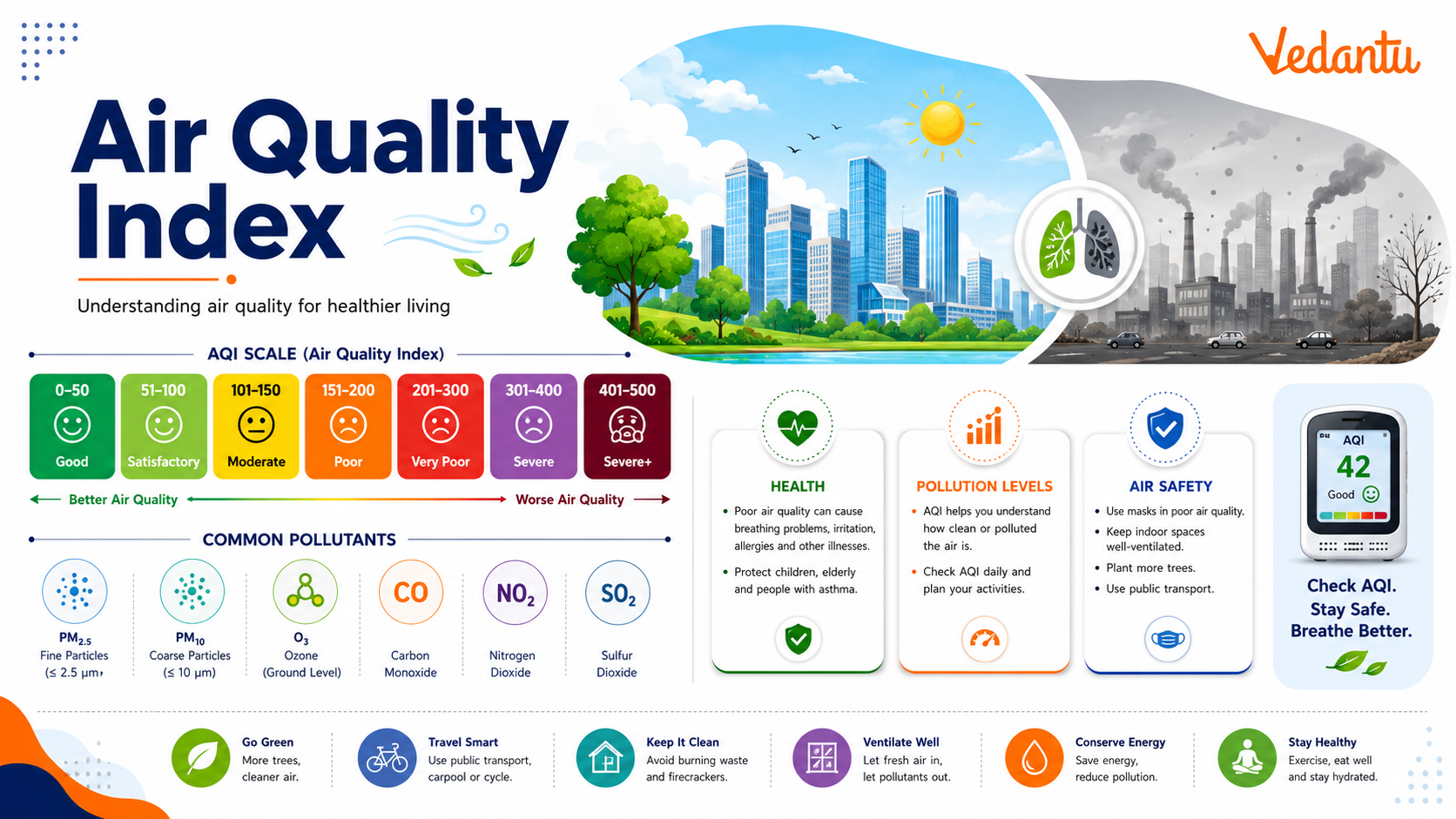
The Air Quality Index - AQI is a standardized system used to measure and report the quality of air in a specific area. It helps people understand how clean or polluted the air is and what associated health effects might be a concern. The AQI converts complex air pollution data into a simple number scale, making it easier for students, policymakers, and the general public to assess environmental conditions. Monitoring AQI is essential for protecting public health, planning urban development, and preparing for environmental and competitive examinations like NEET.
What is Air Quality Index - AQI?
The Air Quality Index is a numerical scale that indicates the level of air pollution in a particular location at a given time. It is based on the concentration of major air pollutants. Higher AQI values represent greater levels of air pollution and increased health risks.
In India, the AQI is managed by the Central Pollution Control Board - CPCB under the National Air Quality Monitoring Programme.
Major Pollutants Considered in AQI
The AQI is calculated based on the concentration of specific air pollutants that have significant impacts on human health and the environment.
- Particulate Matter PM10 - particles with diameter less than 10 micrometers
- Particulate Matter PM2.5 - particles with diameter less than 2.5 micrometers
- Nitrogen Dioxide - NO2
- Sulfur Dioxide - SO2
- Carbon Monoxide - CO
- Ozone - O3
- Ammonia - NH3
- Lead - Pb
Air Quality Index Categories in India
| AQI Range | Category | Health Impact |
|---|---|---|
| 0 - 50 | Good | Minimal impact |
| 51 - 100 | Satisfactory | Minor breathing discomfort to sensitive people |
| 101 - 200 | Moderate | Breathing discomfort to people with lung or heart disease |
| 201 - 300 | Poor | Breathing discomfort to most people on prolonged exposure |
| 301 - 400 | Very Poor | Respiratory illness on prolonged exposure |
| 401 - 500 | Severe | Serious health effects even on healthy people |
These categories help authorities issue health advisories and take preventive measures such as restricting vehicular movement or closing schools during severe pollution conditions.
How is AQI Calculated?
AQI is calculated by measuring the concentration of individual pollutants over a specific averaging time. Each pollutant has a sub-index value. The highest sub-index among all pollutants becomes the overall AQI for that location.
- Measure pollutant concentration through monitoring stations.
- Convert concentration into sub-index value using standard formula.
- Identify the maximum sub-index.
- Report the highest value as the AQI.
Health Effects of Poor Air Quality
Air pollution directly affects the respiratory and cardiovascular systems. Children, elderly individuals, and people with pre-existing health conditions are more vulnerable.
- Asthma and bronchitis
- Chronic obstructive pulmonary disease - COPD
- Heart diseases
- Eye irritation and throat discomfort
- Reduced lung function in children
Importance of AQI for NEET Preparation
The concept of Air Quality Index is important for NEET under Environmental Chemistry, Ecology, and Public Health topics. Questions may focus on pollutants, health impacts, and environmental monitoring systems.
Key Points to Remember
- PM2.5 is more harmful than PM10 due to its smaller size and deeper lung penetration.
- Higher AQI value means higher pollution level.
- CPCB manages AQI in India.
- Severe AQI levels can lead to emergency public health measures.
Measures to Improve Air Quality
Improving air quality requires coordinated efforts from government, industries, and individuals.
- Promoting public transport and electric vehicles
- Controlling industrial emissions
- Avoiding burning of crop residue and waste
- Increasing green cover and afforestation
- Using clean and renewable energy sources
Conclusion
The Air Quality Index is an essential environmental indicator that translates scientific data into actionable public information. It helps individuals make informed decisions about outdoor activities and enables authorities to implement pollution control strategies. For students and competitive exam aspirants, understanding AQI provides clarity on environmental health, pollution control measures, and sustainable development goals. A clear understanding of AQI strengthens both general awareness and exam preparedness.
FAQs on Air Quality Index (AQI): Meaning, Scale, and Impact
1. What is the Air Quality Index (AQI)?
The Air Quality Index (AQI) is a standardized system used to measure and report the quality of air in a specific area. It indicates how polluted the air is and how it may affect human health.
• Measures levels of major air pollutants like PM2.5, PM10, CO, SO₂, NO₂, and O₃
• Converts complex pollution data into a simple numerical scale
• Helps people understand health risks associated with air pollution
• Used by environmental agencies worldwide for air quality monitoring
2. How is the Air Quality Index calculated?
The AQI calculation is based on the concentration of major air pollutants measured over a specific time period. The highest pollutant concentration determines the final AQI value.
• Pollutants monitored: PM2.5, PM10, Carbon Monoxide (CO), Nitrogen Dioxide (NO₂), Sulfur Dioxide (SO₂), Ozone (O₃)
• Data collected from air quality monitoring stations
• Converted into a scale (usually 0–500)
• Higher AQI = Higher level of air pollution and health concern
3. What are the different AQI categories?
The AQI categories classify air quality into different levels based on health impact.
• 0–50 (Good): Minimal or no health risk
• 51–100 (Satisfactory/Moderate): Acceptable air quality
• 101–200 (Unhealthy for Sensitive Groups): Risk for children, elderly, and asthma patients
• 201–300 (Poor): Breathing discomfort possible
• 301–400 (Very Poor): Serious health effects
• 401–500 (Severe/Hazardous): Emergency conditions, affects entire population
4. What does PM2.5 and PM10 mean in AQI?
PM2.5 and PM10 are tiny particulate matter (PM) pollutants suspended in the air that significantly affect the AQI.
• PM2.5: Particles smaller than 2.5 micrometers; can enter lungs and bloodstream
• PM10: Particles smaller than 10 micrometers; cause respiratory irritation
• Major sources: vehicle emissions, construction dust, industrial smoke
• High PM levels increase risk of asthma, lung disease, and heart problems
5. Why is the Air Quality Index important?
The importance of AQI lies in its role in protecting public health and spreading awareness about pollution levels.
• Informs people about daily air pollution levels
• Helps sensitive groups take preventive measures
• Assists governments in implementing pollution control policies
• Encourages environmental protection and sustainable practices
6. What are the health effects of high AQI?
A high AQI indicates unhealthy air that can cause short-term and long-term health problems.
• Eye irritation and throat discomfort
• Breathing difficulty and coughing
• Worsening of asthma and bronchitis
• Increased risk of cardiovascular diseases
• Long-term exposure may reduce lung function
7. Which country first introduced the Air Quality Index?
The concept of the Air Quality Index was first developed in the United States by the Environmental Protection Agency (EPA).
• Introduced to simplify air pollution data
• Managed by the US Environmental Protection Agency (EPA)
• Later adopted by countries like India, China, and the UK
• Now a global standard for air pollution measurement
8. What is the AQI scale in India?
The AQI in India follows a scale of 0 to 500, developed by the Central Pollution Control Board (CPCB).
• 0–50: Good
• 51–100: Satisfactory
• 101–200: Moderate
• 201–300: Poor
• 301–400: Very Poor
• 401–500: Severe
• Covers 8 major pollutants under the National Air Quality Index (NAQI)
9. How can we reduce Air Quality Index levels?
Reducing the AQI level requires collective action from individuals, industries, and governments.
• Use public transport or carpooling
• Promote renewable energy sources
• Reduce industrial emissions
• Avoid burning waste and crackers
• Increase plantation and green cover
• Follow government pollution control measures
10. What precautions should be taken when AQI is high?
When the AQI is high, taking preventive steps can minimize health risks.
• Avoid outdoor activities during peak pollution hours
• Wear N95 or anti-pollution masks
• Use indoor air purifiers
• Keep windows closed in highly polluted areas
• Stay hydrated and monitor daily AQI updates
