






Types of Agriculture Systems Around the World and How They Work
Agriculture systems and practices around the world vary widely based on climate, soil type, culture, technology, and economic development. Agriculture is the backbone of food security and plays a vital role in employment, trade, and rural development. From subsistence farming in developing countries to highly mechanized commercial farming in developed nations, each agricultural system reflects adaptation to local environmental and socio-economic conditions. Understanding global agricultural practices is important for students, competitive exam aspirants, and anyone interested in geography, economics, and environmental studies.
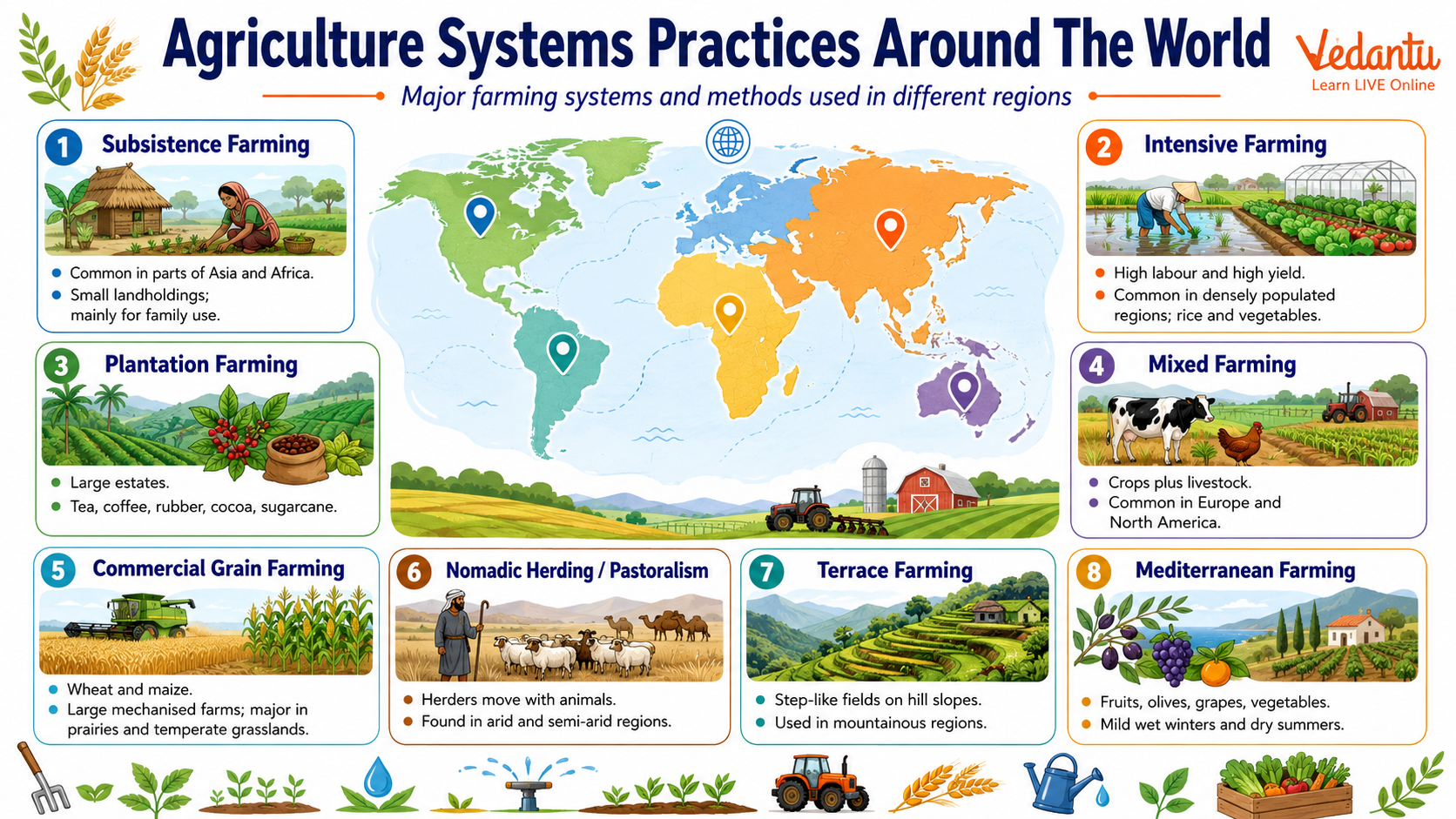
What is an Agricultural System?
An agricultural system refers to the method and structure used for crop cultivation and livestock rearing in a particular region. It includes land ownership patterns, farming techniques, labor use, irrigation methods, technology adoption, and market orientation. Agricultural systems are shaped by physical factors such as climate and soil, as well as human factors like population density and government policies.
Major Types of Agricultural Systems Around the World
1. Subsistence Farming
Subsistence farming is practiced mainly in developing countries of Asia, Africa, and Latin America. Farmers grow crops primarily for their own consumption with little or no surplus for sale.
- Small land holdings
- Use of traditional tools and family labor
- Low productivity
- Common crops - rice, wheat, maize
2. Commercial Farming
Commercial farming is practiced in developed regions such as North America, Europe, and Australia. Crops and livestock are produced mainly for sale in national and international markets.
- Large land holdings
- High use of machinery and technology
- High productivity and profit oriented
- Examples - wheat farming in USA, dairy farming in Denmark
3. Plantation Agriculture
Plantation agriculture involves large-scale cultivation of a single cash crop for export. It is common in tropical regions.
- Single crop specialization
- Capital intensive
- Uses hired labor
- Examples - tea in India, coffee in Brazil, rubber in Malaysia
4. Mixed Farming
Mixed farming combines crop cultivation and livestock rearing on the same farm. It helps in efficient resource utilization and risk reduction.
- Common in Europe and North America
- Crop residues used as animal feed
- Animal manure used as fertilizer
5. Shifting Cultivation
Shifting cultivation is a primitive agricultural practice in tropical forest regions. A piece of land is cleared, cultivated for a few years, and then left fallow to regain fertility.
- Slash and burn method
- Practiced in parts of Africa, South East Asia, and South America
- Low yield and environmentally sensitive
Comparison of Major Agricultural Systems
| Type of Farming | Main Purpose | Region of Practice |
|---|---|---|
| Subsistence Farming | Self consumption | Asia, Africa |
| Commercial Farming | Market sale | USA, Europe |
| Plantation Farming | Export crops | Tropical regions |
The table highlights the key differences between major agricultural systems in terms of purpose and geographic distribution. Each system is adapted to specific environmental and economic conditions.
Modern Agricultural Practices
With advancements in science and technology, agriculture has evolved significantly. Modern practices aim to increase productivity while maintaining sustainability.
- Use of high yielding variety seeds
- Irrigation systems such as drip and sprinkler irrigation
- Mechanization with tractors and harvesters
- Use of fertilizers and pesticides
- Precision farming using GPS and data analysis
Sustainable Agriculture Practices
Sustainable agriculture focuses on meeting present food needs without compromising future generations. It promotes environmental protection and resource conservation.
- Organic farming without synthetic chemicals
- Crop rotation to maintain soil fertility
- Agroforestry systems
- Integrated pest management
Factors Influencing Agricultural Systems
Several factors determine the type of agriculture practiced in a region.
- Climate - temperature, rainfall, growing season
- Soil type and fertility
- Availability of water resources
- Population density
- Government policies and subsidies
- Level of technology and capital investment
Importance of Studying Global Agriculture Systems
Understanding agriculture systems around the world helps in analyzing global food production, trade patterns, rural livelihoods, and environmental challenges. It is an important topic in geography and general knowledge examinations. Knowledge of global farming practices also helps in understanding climate change impacts, food security issues, and sustainable development goals.
Agriculture systems and practices around the world reflect the diversity of human adaptation to nature. From traditional subsistence farming to advanced precision agriculture, each system plays a vital role in feeding the global population. A clear understanding of these systems provides valuable insights into economic development, environmental sustainability, and global cooperation in food production.
FAQs on Agriculture Systems and Practices Around the World Explained for Students
1. What are the major agricultural systems practiced around the world?
The major agricultural systems around the world vary based on climate, soil, and economic development.
Key types of agriculture systems include:
• Subsistence farming – crops grown mainly for family consumption
• Commercial farming – large-scale production for market sale
• Intensive farming – high input, high yield per hectare
• Extensive farming – large land areas with low inputs
• Plantation agriculture – single cash crop like tea, coffee, rubber
• Mixed farming – combination of crops and livestock
These global farming systems reflect differences in technology, labor use, and economic goals.
2. What is subsistence farming and where is it commonly practiced?
Subsistence farming is a type of agriculture where farmers grow food mainly for their own consumption rather than for sale.
It is commonly practiced in:
• South Asia
• Sub-Saharan Africa
• Parts of Latin America
Features include small landholdings, traditional tools, and dependence on rainfall. It is also known as traditional farming or self-sufficient agriculture, often linked to rural livelihoods and food security.
3. What is commercial agriculture?
Commercial agriculture is large-scale farming focused on producing crops and livestock for market sale and profit.
Main characteristics include:
• Use of modern machinery and technology
• High investment in fertilizers and irrigation
• Large farm sizes
• Production of cash crops like wheat, maize, cotton
This system is dominant in countries like the USA, Canada, Australia, and parts of Europe, and is closely related to agribusiness and export farming.
4. What is plantation agriculture?
Plantation agriculture is a form of commercial farming where a single cash crop is grown on large estates for export.
Common plantation crops include:
• Tea
• Coffee
• Rubber
• Sugarcane
• Oil palm
It is mainly found in tropical regions of Asia, Africa, and Latin America and requires significant labor and capital investment.
5. What is the difference between intensive and extensive farming?
The main difference lies in the level of input and land use per unit area.
Intensive farming:
• High labor and capital input
• Small land area
• High yield per hectare
• Common in India, China, Japan
Extensive farming:
• Large land area
• Low labor and input use
• Lower yield per hectare
• Common in USA, Australia, Russia
Both systems are important in global agricultural production and food supply.
6. What is mixed farming?
Mixed farming is an agricultural system that combines crop cultivation with livestock rearing.
Its benefits include:
• Better use of farm resources
• Diversified income sources
• Natural manure from animals for crops
• Reduced farming risk
This system is widely practiced in Europe, North America, and parts of Asia and supports sustainable agriculture practices.
7. What role does climate play in agricultural systems?
Climate plays a crucial role in determining the type of crops grown and farming methods used.
Climate influences:
• Temperature – affects crop growth cycles
• Rainfall – determines irrigation needs
• Growing season length
• Risk of droughts or floods
For example, rice farming thrives in tropical monsoon regions, while wheat farming is common in temperate zones.
8. What is shifting cultivation?
Shifting cultivation is a traditional farming method where land is cleared, cultivated for a few years, and then abandoned to regain fertility.
Key features:
• Also called slash-and-burn agriculture
• Practiced in tropical rainforest regions
• Uses simple tools
• Involves crop rotation on different plots
It is common in parts of Amazon Basin, Central Africa, and Southeast Asia.
9. What is sustainable agriculture?
Sustainable agriculture is a farming system that meets present food needs without harming future generations.
Main principles include:
• Soil conservation
• Water management
• Organic farming practices
• Reduced chemical use
• Crop rotation and biodiversity
It supports environmental protection, food security, and long-term productivity in global agriculture systems.
10. How has technology transformed agriculture worldwide?
Modern agricultural technology has significantly increased productivity and efficiency worldwide.
Major innovations include:
• Tractors and mechanization
• High-yielding variety (HYV) seeds
• Drip irrigation
• Genetically modified (GM) crops
• Precision farming and satellite monitoring
These advancements, often linked to the Green Revolution, have improved global food production and agricultural sustainability.
