






How the Fifteenth Finance Commission Allocates Funds Between Centre and States
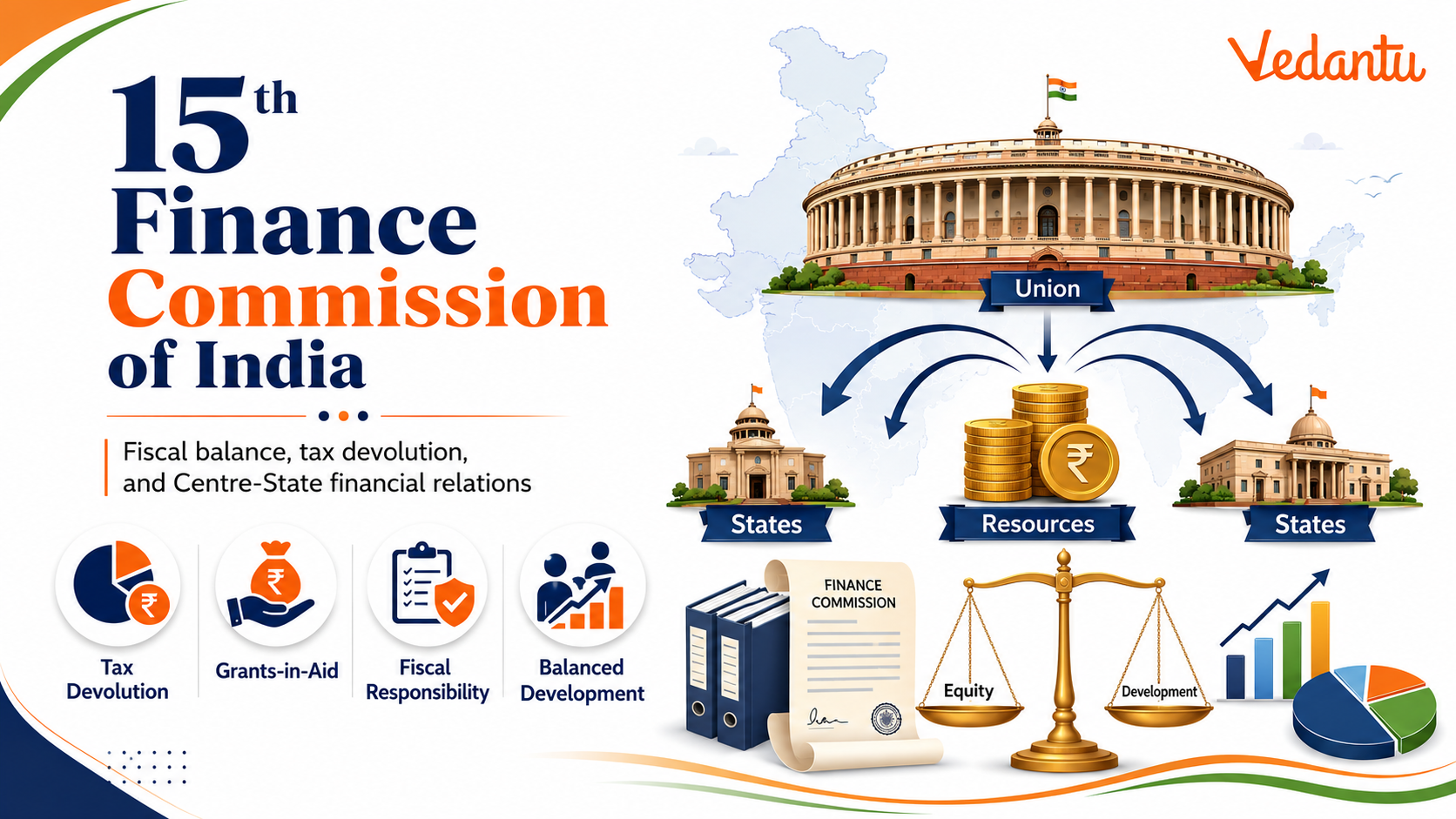
The 15th Finance Commission is a constitutional body in India constituted to recommend the distribution of financial resources between the Central Government and the State Governments. Established under Article 280 of the Indian Constitution, it plays a crucial role in maintaining fiscal federalism in the country. The 15th Finance Commission was particularly significant because it made recommendations during a period of major structural reforms such as the implementation of the Goods and Services Tax - GST and the reorganization of Jammu and Kashmir. Its recommendations cover the period from 2020 to 2025 and aim to ensure balanced regional development and financial stability.
Constitutional Background
The Finance Commission is a constitutional body constituted by the President of India every five years under Article 280 of the Constitution. Its primary function is to recommend how tax revenues collected by the Centre should be distributed between the Centre and the States, and among the States themselves.
- Established under Article 280 of the Indian Constitution
- Appointed by the President of India
- Constituted every five years
- Recommends tax devolution and grants-in-aid to states
15th Finance Commission - Overview
Key Details of the 15th Finance Commission
| Feature | Details | Period Covered |
|---|---|---|
| Chairman | N. K. Singh | 2020 - 2025 |
| Constitution Year | 2017 | First Report 2020 - 21 |
| Main Focus | Fiscal Federalism and Stability | Final Report 2021 - 2025 |
The 15th Finance Commission was constituted in November 2017 under the chairmanship of N. K. Singh. It submitted its first report for the financial year 2020 - 21 and a final report covering 2021 - 2025.
Major Recommendations of the 15th Finance Commission
1. Vertical Devolution
Vertical devolution refers to the share of central taxes distributed between the Centre and the States. The 15th Finance Commission recommended that 41 percent of the divisible pool of central taxes be devolved to the States. This was reduced from 42 percent recommended by the 14th Finance Commission due to the formation of the Union Territories of Jammu and Kashmir and Ladakh.
2. Horizontal Devolution Criteria
Horizontal devolution refers to the distribution of funds among different States. The Commission used specific criteria and assigned weightage to ensure fairness and equity.
Criteria for Horizontal Distribution
| Criteria | Weightage | Purpose |
|---|---|---|
| Income Distance | 45% | Reduce regional disparities |
| Population 2011 | 15% | Reflect current demographic trends |
| Area | 15% | Account for administrative costs |
| Forest and Ecology | 10% | Promote environmental sustainability |
| Demographic Performance | 12.5% | Reward population control efforts |
| Tax Effort | 2.5% | Encourage revenue generation |
The above criteria ensured that both equity and efficiency were considered while distributing funds among states.
3. Grants-in-Aid
The Commission recommended several types of grants-in-aid under Article 275 of the Constitution to support specific sectors and states.
- Revenue deficit grants to states facing fiscal gaps
- Local body grants for rural and urban bodies
- Disaster risk management grants
- Sector-specific grants for health, agriculture, and judiciary
4. Local Governments
The Commission allocated significant funds to Panchayati Raj Institutions and Urban Local Bodies to strengthen grassroots governance. It emphasized transparency, online auditing, and improved service delivery.
5. Defence and Internal Security
For the first time, the Commission proposed the creation of a non-lapsable Modernisation Fund for Defence and Internal Security to ensure sustainable funding for national security needs.
Significance of the 15th Finance Commission
- Strengthened cooperative and competitive federalism
- Balanced development across states
- Encouraged fiscal discipline and transparency
- Supported local governments and grassroots democracy
- Addressed challenges posed by GST implementation
Challenges Faced
The 15th Finance Commission operated during a challenging period marked by economic slowdown and the COVID-19 pandemic. It had to balance fiscal prudence with the need for increased public spending. Additionally, the use of 2011 population data instead of 1971 population data led to debates among states regarding fairness.
Conclusion
The 15th Finance Commission played a vital role in shaping India’s fiscal framework for the period 2020 - 2025. By recommending 41 percent tax devolution to states and introducing balanced criteria for horizontal distribution, it reinforced fiscal federalism while addressing contemporary economic challenges. Its focus on local governance, disaster management, defence funding, and fiscal sustainability makes it a crucial topic for students and competitive exam aspirants. Understanding its recommendations helps in grasping how financial relations between the Centre and States are structured in India.
FAQs on 15th Finance Commission of India: Objectives, Tenure and Recommendations
1. What is the 15th Finance Commission of India?
The 15th Finance Commission is a constitutional body constituted to recommend the distribution of financial resources between the Centre and States for the period 2020–2025. It was established under Article 280 of the Indian Constitution.
- Chairman: N.K. Singh
- Constituted in: 2017
- Submitted report for: 2020–21 (interim) and 2021–26 (final)
- Focus areas: tax devolution, grants-in-aid, fiscal consolidation, disaster management funding
It plays a key role in India’s fiscal federalism and Centre-State financial relations.
2. Who was the Chairman of the 15th Finance Commission?
N.K. Singh was the Chairman of the 15th Finance Commission. He is a former bureaucrat and Member of Parliament with expertise in economic policy.
- Appointed in: November 2017
- Oversaw recommendations on tax sharing formula
- Focused on performance-based incentives and fiscal discipline
His leadership shaped major recommendations on horizontal and vertical devolution of taxes.
3. What are the key recommendations of the 15th Finance Commission?
The 15th Finance Commission recommended 41% vertical tax devolution from the Centre to the States for 2021–26. Major recommendations include:
- 41% share of divisible tax pool to States (reduced from 42% due to J&K reorganization)
- New horizontal devolution criteria (Income distance, Population 2011, Area, Forest & Ecology, Demographic performance, Tax effort)
- Grants for local bodies worth ₹4.36 lakh crore
- Creation of a Disaster Risk Management Fund (DRMF)
- Focus on defence and internal security modernization
These recommendations strengthened India’s cooperative federalism.
4. What is meant by vertical and horizontal devolution in the 15th Finance Commission?
Vertical devolution refers to the sharing of taxes between the Centre and States, while horizontal devolution refers to distribution among States.
- Vertical Devolution: 41% of divisible pool to States
- Horizontal Criteria:
• Income Distance (45%)
• Population 2011 (15%)
• Area (15%)
• Forest & Ecology (10%)
• Demographic Performance (12.5%)
• Tax Effort (2.5%)
This formula ensures equitable distribution under India’s fiscal federal structure.
5. Why was the 15th Finance Commission important for local bodies?
The 15th Finance Commission significantly increased grants to local bodies to strengthen grassroots governance. It allocated around ₹4.36 lakh crore for 2021–26.
- Grants to Rural Local Bodies (Panchayats)
- Grants to Urban Local Bodies (Municipalities)
- Performance-based incentives for sanitation and water supply
- Support for health sector infrastructure
This enhanced the role of Panchayati Raj Institutions and urban governance.
6. What criteria were used by the 15th Finance Commission for tax distribution among states?
The 15th Finance Commission used six key criteria for horizontal tax devolution among States. These criteria aimed to balance equity and performance.
- Income Distance (measures fiscal capacity)
- Population (2011 Census)
- Area
- Forest and Ecology
- Demographic Performance
- Tax Effort
These factors ensure fair allocation based on population, development needs, and fiscal responsibility.
7. What is the tenure of the 15th Finance Commission?
The 15th Finance Commission covered the period from 2020 to 2025. It submitted:
- An Interim Report for 2020–21
- A Final Report for 2021–26
The recommendations guide Centre-State financial relations for five financial years, ensuring stability in tax sharing and grants-in-aid.
8. How did the 15th Finance Commission address defence and national security?
The 15th Finance Commission recommended a dedicated funding mechanism for defence and internal security. It proposed the creation of a Modernisation Fund for Defence and Internal Security (MFDIS).
- Focus on capital expenditure for defence
- Support for modernization of armed forces
- Emphasis on internal security infrastructure
This was a unique feature compared to previous Finance Commissions.
9. What is the role of Article 280 in the 15th Finance Commission?
Article 280 of the Indian Constitution mandates the President to constitute a Finance Commission every five years. The 15th Finance Commission was formed under this constitutional provision.
- Recommends distribution of net proceeds of taxes
- Suggests grants-in-aid to States
- Advises on measures to improve fiscal stability
Thus, Article 280 forms the constitutional basis of India’s Finance Commission system.
10. How is the 15th Finance Commission relevant for competitive exams?
The 15th Finance Commission is important for UPSC, SSC, Banking, and State PSC exams due to its role in fiscal policy and governance.
- Questions on Chairman (N.K. Singh)
- 41% tax devolution detail
- Criteria for horizontal distribution
- Grants to local bodies and disaster management funds
It is frequently asked in topics related to Indian Polity, Economy, and Fiscal Federalism.
