






Interesting Facts about Scandinavian Countries’ Culture, Nature, and Viking History
Scandinavian countries are known for their breathtaking landscapes, high standard of living, strong welfare systems, and rich cultural heritage. The term Scandinavia generally refers to three countries - Sweden, Norway, and Denmark. However, in a broader sense, it often includes Finland and Iceland as part of the Nordic region. These nations consistently rank high in global happiness, education, innovation, and environmental sustainability. In this article, we explore 10 amazing facts about Scandinavian countries that highlight their uniqueness, achievements, and global influence.
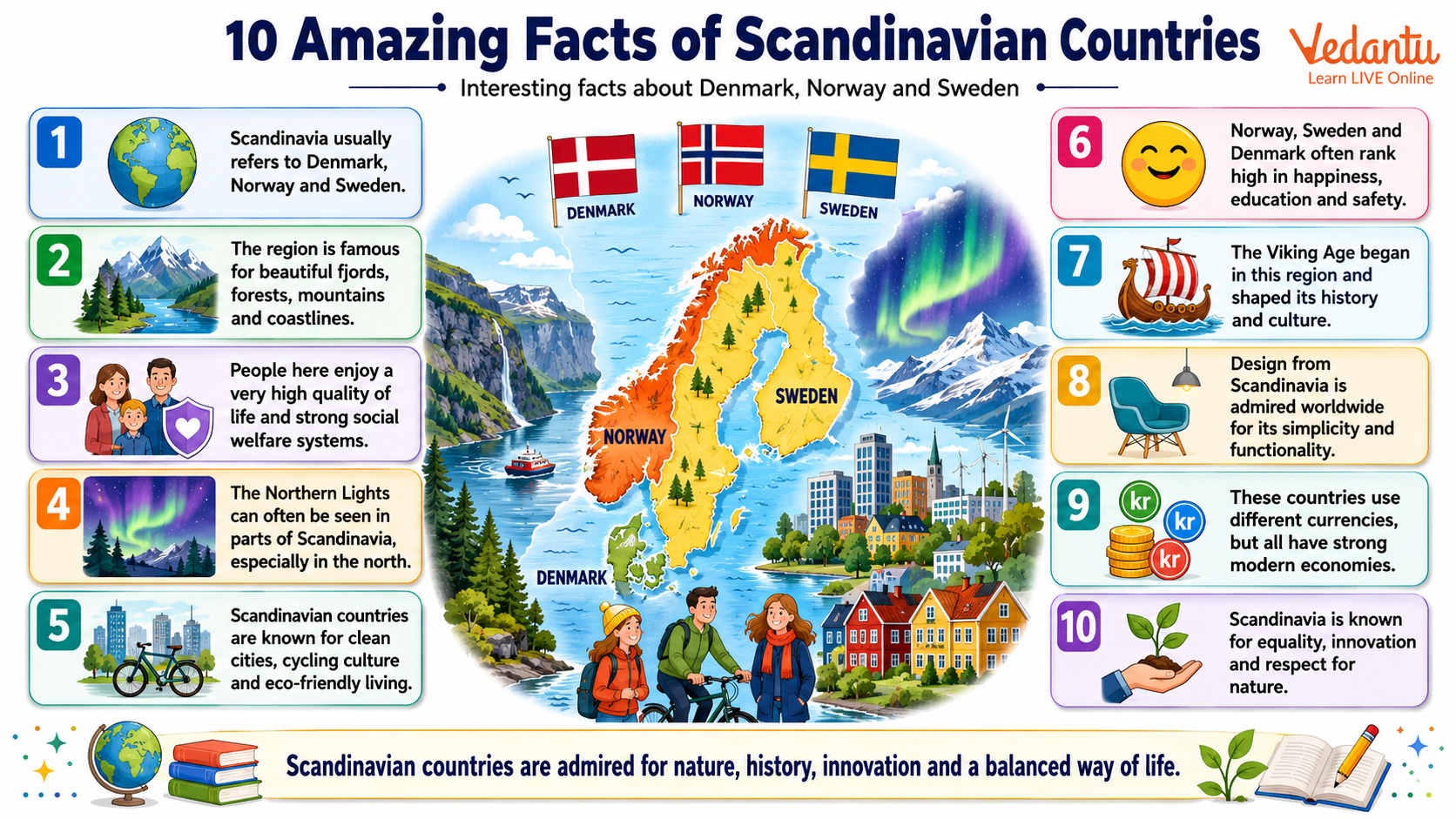
Overview of Scandinavian Countries
Basic Information About Scandinavian Nations
| Country | Capital | Population Approx. |
|---|---|---|
| Sweden | Stockholm | 10.5 Million |
| Norway | Oslo | 5.5 Million |
| Denmark | Copenhagen | 6 Million |
These countries are located in Northern Europe and share historical, cultural, and linguistic ties. They are known for cold climates, long winters, and stunning natural beauty including fjords, forests, and mountains.
10 Amazing Facts Of Scandinavian Countries
1. Happiest Countries in the World
Scandinavian nations frequently rank among the top countries in the World Happiness Report. Strong social welfare systems, work-life balance, free healthcare, and education contribute to the high satisfaction levels of citizens.
2. The Land of the Midnight Sun
In northern parts of Norway and Sweden, the sun does not set for several weeks during summer. This natural phenomenon is called the Midnight Sun. During winter, the same areas experience Polar Night, where the sun does not rise for weeks.
3. Birthplace of the Vikings
Scandinavia was the homeland of the Vikings between the 8th and 11th centuries. Vikings were skilled sailors, traders, and explorers who reached North America long before Columbus.
4. Strong Focus on Gender Equality
These countries are global leaders in gender equality. Women actively participate in politics, business, and education. Parental leave policies allow both mothers and fathers to take paid leave after childbirth.
5. High Tax but High Benefits
Scandinavian countries have relatively high tax rates. However, citizens receive benefits such as free education, universal healthcare, unemployment support, and pensions, making the system widely accepted.
6. Environmental Leadership
These nations are pioneers in renewable energy and sustainability. Norway generates most of its electricity from hydropower, while Denmark is a leader in wind energy production.
7. Innovative and Technologically Advanced
Scandinavian countries are home to globally recognized companies such as IKEA, Volvo, Spotify, LEGO, and Ericsson. They invest heavily in research, development, and digital infrastructure.
8. Unique Cultural Concepts
- Hygge - A Danish concept of coziness and comfortable living.
- Lagom - A Swedish word meaning just the right amount.
- Friluftsliv - A Norwegian idea promoting outdoor life and connection with nature.
9. Stunning Natural Landscapes
From Norway’s dramatic fjords to Sweden’s vast forests and Denmark’s beautiful coastlines, Scandinavia offers some of the most spectacular natural scenery in the world. Northern Lights are commonly visible in the Arctic regions.
10. High Quality Education System
Education in Scandinavian countries is either free or heavily subsidized, even for international students in some cases. The literacy rate is nearly 100 percent, and universities rank among the best globally.
Key Features That Make Scandinavia Unique
- Stable democratic governments
- Low corruption levels
- Strong public transport systems
- Advanced healthcare facilities
- High life expectancy
Why Scandinavian Countries Matter Globally
Scandinavian countries play an important role in global diplomacy, climate action, humanitarian aid, and peacekeeping missions. They often serve as models for sustainable development, social welfare policies, and balanced economic systems. Their approach to governance and quality of life provides valuable lessons for other nations.
Conclusion
The Scandinavian countries of Sweden, Norway, and Denmark stand out for their happiness, equality, innovation, and natural beauty. With strong social systems, rich Viking history, environmental awareness, and high living standards, these nations continue to inspire the world. Understanding these 10 amazing facts about Scandinavian countries helps students and general readers appreciate their cultural, economic, and geographical significance in today’s world.
FAQs on 10 Amazing Facts about Scandinavian Countries Every Student Should Know
1. What are the Scandinavian countries?
Scandinavian countries mainly refer to Norway, Sweden, and Denmark, known for shared history, culture, and language roots.
• Core Scandinavia: Norway, Sweden, Denmark
• Often grouped with the Nordic countries: Finland and Iceland
• Located in Northern Europe
• Share similar Viking heritage and Germanic languages
This region is famous for its high quality of life, strong welfare systems, and rich cultural traditions.
2. Why are Scandinavian countries considered the happiest in the world?
Scandinavian countries consistently rank high in the World Happiness Report due to strong social systems and work-life balance.
• Universal healthcare and education
• Strong social security and welfare policies
• High levels of trust and equality
• Excellent work-life balance
Countries like Finland, Denmark, and Norway often top global happiness rankings.
3. What is unique about the Viking history of Scandinavia?
The Viking Age (8th–11th century) is one of Scandinavia’s most fascinating historical periods.
• Vikings were skilled warriors, traders, and explorers
• Explored parts of Europe, North America, and Asia
• Famous ships: Longships
• Influenced modern culture, language, and mythology
The Viking legacy remains a key part of Scandinavian identity and heritage.
4. What are some amazing natural wonders in Scandinavian countries?
Scandinavia is famous for its breathtaking natural landscapes and environmental beauty.
• Norwegian Fjords – Deep coastal valleys
• Northern Lights (Aurora Borealis)
• Midnight Sun phenomenon
• Vast forests, glaciers, and lakes
These natural wonders make Scandinavia a top destination for eco-tourism and adventure travel.
5. What languages are spoken in Scandinavian countries?
Scandinavian languages are closely related North Germanic languages.
• Swedish in Sweden
• Norwegian in Norway
• Danish in Denmark
• Many citizens speak fluent English
These languages are mutually intelligible, meaning speakers can often understand each other easily.
6. Why are Scandinavian countries leaders in sustainability and green energy?
Scandinavian nations are global leaders in renewable energy and sustainability.
• Heavy use of hydropower and wind energy
• Strong climate change policies
• Promotion of electric vehicles (EVs)
• Focus on recycling and eco-friendly living
Countries like Norway and Sweden are pioneers in green technology and carbon neutrality goals.
7. What is the Midnight Sun phenomenon in Scandinavia?
The Midnight Sun is a natural phenomenon where the sun remains visible at midnight during summer.
• Occurs in regions above the Arctic Circle
• Seen in northern Norway, Sweden, and Finland
• Opposite effect: Polar Night in winter
This unique feature attracts tourists and is a key geographical fact about Northern Europe.
8. What makes the education system in Scandinavian countries special?
Scandinavian education systems focus on equality, creativity, and free learning.
• Free education including university level
• Emphasis on critical thinking and innovation
• Minimal exam pressure
• High global ranking in education indexes
Countries like Finland are often cited as models for modern education reforms.
9. What are some famous inventions from Scandinavian countries?
Scandinavian countries have contributed many important global inventions.
• Dynamite by Alfred Nobel (Sweden)
• Bluetooth technology (Sweden)
• LEGO (Denmark)
• Modern paper clip (Norway)
These innovations highlight Scandinavia’s strong culture of research, design, and technology.
10. Why are Scandinavian countries known for high living standards?
Scandinavian countries maintain high living standards due to strong economies and welfare systems.
• High GDP per capita
• Universal healthcare and social benefits
• Low levels of corruption
• Gender equality and social justice
Nations like Denmark, Norway, and Sweden consistently rank among the best places to live globally.
