






Why Ravana Was a Powerful King and Great Scholar in Hindu Mythology
Ravana is one of the most powerful and complex characters in Indian mythology, mainly known from the epic Ramayana. He is often remembered as the demon king of Lanka who abducted Goddess Sita, but his personality is far more layered. Ravana was a great scholar, a devotee of Lord Shiva, a skilled ruler, and a master of many sciences. Understanding Ravana is important for students preparing for competitive exams, as questions related to mythology, literature, and Indian culture are commonly asked in General Knowledge sections. Here are 10 amazing facts about Ravana that highlight his strengths, knowledge, and unique personality.
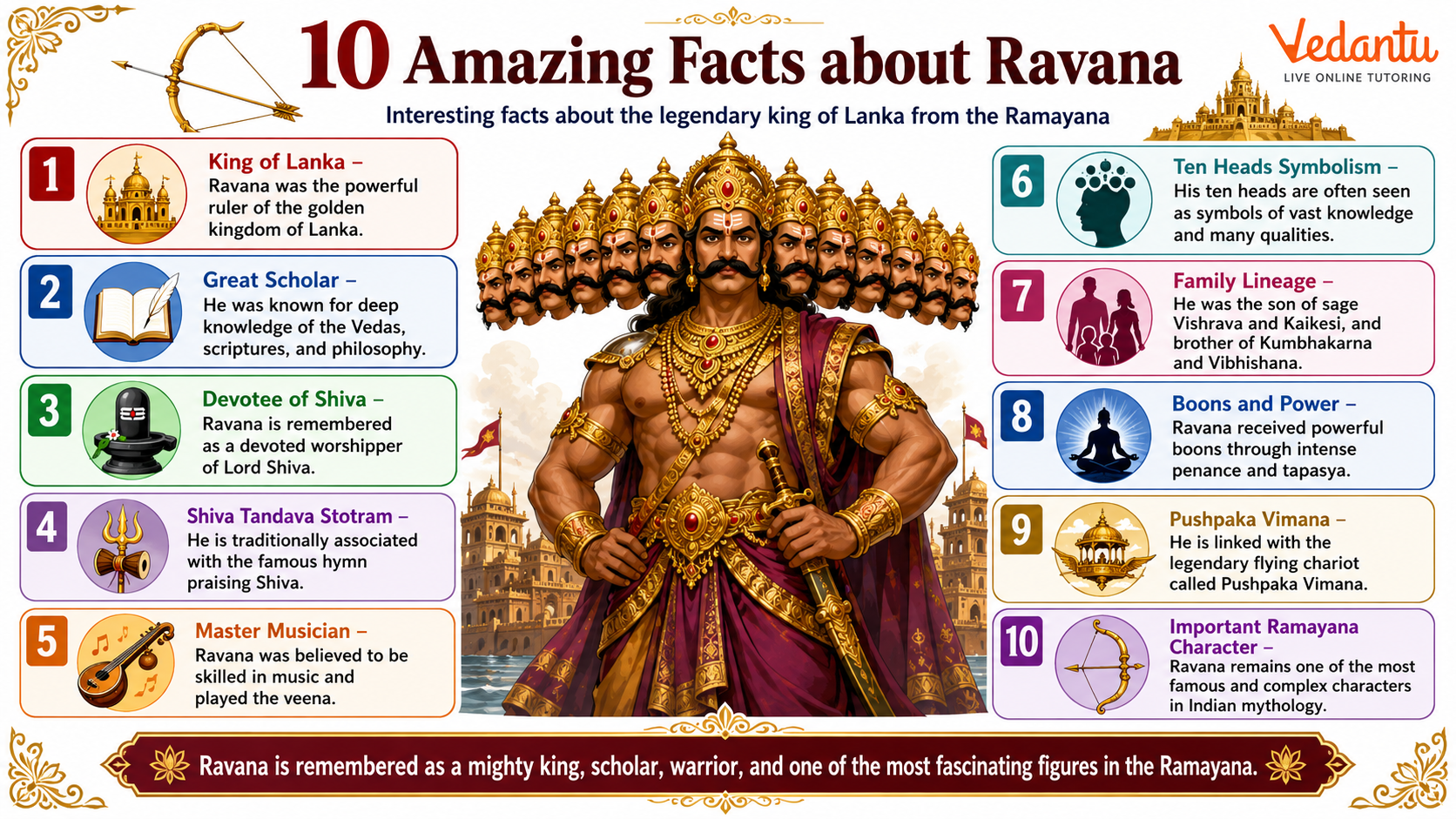
1. Ravana Had Ten Heads
Ravana is famously known as Dashanan, meaning the one with ten heads. His ten heads symbolize immense knowledge and mastery over different subjects. According to mythology, they represent the six Shastras and the four Vedas. Some interpretations also say the heads symbolize human emotions such as anger, pride, jealousy, desire, and ego.
2. He Was a Great Scholar
Ravana was highly learned in the Vedas, astrology, Ayurveda, and music. He was considered one of the most intelligent beings of his time. Many ancient texts describe him as a Brahmin scholar with deep understanding of sacred scriptures.
3. Ravana Was a Devotee of Lord Shiva
Ravana was an ardent devotee of Lord Shiva. He composed the famous Shiva Tandava Stotram, which praises Lord Shiva in poetic form. His devotion was so intense that he performed severe penance to please Shiva and gained powerful boons.
4. He Ruled the Golden City of Lanka
Ravana was the king of Lanka, described as a magnificent city made of gold. It was built by Vishwakarma, the divine architect. Under Ravana's rule, Lanka was prosperous and technologically advanced according to mythological descriptions.
5. Ravana Was a Skilled Musician
Apart from being a warrior and scholar, Ravana was also an expert musician. He is believed to have invented the Ravana Veena, a string instrument. His knowledge of music further reflects his multi-dimensional personality.
6. He Received Powerful Boons
Through intense penance, Ravana received several boons from Lord Brahma. These boons made him almost invincible against gods and celestial beings. However, he did not seek protection from humans, which later led to his defeat by Lord Rama.
7. Ravana Was a Great Warrior
Ravana was a fearless and powerful warrior. He had mastery over various divine weapons and fought many battles against gods and kings. His military strength made him one of the most feared rulers in mythology.
8. He Was Born to a Sage
Ravana was the son of Sage Vishrava and demoness Kaikesi. This made him a Brahmin by birth. His lineage explains his deep knowledge of scriptures and rituals, along with his connection to both divine and demonic traits.
9. Ravana Kidnapped Sita
The most well-known event associated with Ravana is the abduction of Goddess Sita, the wife of Lord Rama. This act led to the great war described in the Ramayana. Despite abducting her, Ravana is said to have maintained certain boundaries and did not harm her physically.
10. His Death Symbolizes Victory of Good Over Evil
Ravana was ultimately defeated and killed by Lord Rama. His death is celebrated during the festival of Dussehra, symbolizing the victory of good over evil. The burning of Ravana's effigy each year reminds people of the consequences of ego and arrogance.
Quick Facts About Ravana
| Aspect | Details | Significance |
|---|---|---|
| Father | Sage Vishrava | Brahmin lineage |
| Kingdom | Lanka | Golden and prosperous city |
| Main Epic | Ramayana | Central antagonist |
The table above summarizes key details about Ravana that are commonly asked in General Knowledge and competitive examinations.
Key Takeaways for Students
- Ravana was not just a villain but also a scholar and devotee.
- His ten heads symbolize knowledge and human emotions.
- He ruled Lanka, a symbol of wealth and power.
- His defeat represents the moral lesson that ego leads to downfall.
Conclusion
Ravana remains one of the most fascinating characters in Indian mythology. While he is remembered for his negative actions, his intelligence, devotion, and talents make him a complex personality. Learning about Ravana helps students understand the cultural, moral, and historical aspects of the Ramayana. These 10 amazing facts about Ravana provide a balanced and informative overview suitable for General Knowledge preparation and academic learning.
FAQs on 10 Amazing Facts About Ravana in the Ramayana Epic
1. Who was Ravana in Hindu mythology?
Ravana was the powerful demon king of Lanka and the main antagonist in the Ramayana.
• He was a Rakshasa king and ruler of Golden Lanka.
• Known for his 10 heads (Dashanan), symbolizing immense knowledge and power.
• A great devotee of Lord Shiva and a master of the Vedas and scriptures.
• His abduction of Sita led to the epic battle with Lord Rama.
2. Why did Ravana have 10 heads?
Ravana’s 10 heads symbolize his vast knowledge and negative human emotions.
• The heads represent the six shastras and four Vedas.
• They also symbolize emotions like anger, pride, jealousy, greed, and ego.
• Because of this, he is often called Dashanan (the ten-headed one).
• His 10 heads reflect both his wisdom and his uncontrolled desires.
3. Was Ravana a scholar and devotee of Lord Shiva?
Yes, Ravana was a great scholar and one of the biggest devotees of Lord Shiva.
• He composed the famous Shiva Tandava Stotram.
• He had deep knowledge of Ayurveda, astrology, and music.
• He performed severe penance to please Shiva.
• Despite being a villain in the Ramayana, he was respected for his intelligence and devotion.
4. What are some amazing facts about Ravana?
Ravana had many lesser-known qualities beyond being a villain in the Ramayana.
• He was the son of sage Vishrava and demoness Kaikesi.
• He ruled the magnificent Golden Lanka made of gold.
• He had mastery over the Pushpaka Vimana (flying chariot).
• He was skilled in music and played the Veena.
• He was a brilliant strategist and warrior in Hindu mythology.
5. Why did Ravana kidnap Sita?
Ravana kidnapped Sita to take revenge on Lord Rama and satisfy his ego.
• His sister Shurpanakha was insulted by Lakshmana.
• He wanted to defeat Rama and prove his superiority.
• He abducted Sita using deception with the help of Maricha.
• This act led to the great war described in the Ramayana.
6. How did Ravana die?
Ravana was killed by Lord Rama during the final battle of the Ramayana.
• The battle took place in Lanka.
• Rama used the divine weapon Brahmastra.
• Ravana’s secret of immortality was linked to his navel (amrit).
• His death symbolizes the victory of good over evil, celebrated as Dussehra.
7. Was Ravana related to Lord Kubera?
Yes, Ravana was the half-brother of Lord Kubera, the god of wealth.
• Both were sons of sage Vishrava.
• Ravana seized Lanka from Kubera.
• He also took the Pushpaka Vimana from him.
• This shows Ravana’s ambition and desire for power in Hindu mythology.
8. What does Ravana symbolize in Hindu culture?
Ravana symbolizes both great knowledge and destructive ego in Hindu culture.
• He represents intelligence without humility.
• His life teaches lessons about ego, pride, and dharma.
• Burning his effigy during Dussehra signifies the triumph of righteousness.
• He is seen as a complex character in the Ramayana epic.
9. Did Ravana have any special powers or boons?
Ravana received powerful boons from Lord Brahma that made him nearly invincible.
• He could not be killed by gods, demons, or celestial beings.
• He had immense physical strength and magical abilities.
• His knowledge of astronomy and warfare was unmatched.
• However, he underestimated humans, which led to his defeat by Lord Rama.
10. Where was Ravana’s kingdom located?
Ravana ruled the magnificent kingdom of Lanka, believed to be modern-day Sri Lanka.
• Lanka was described as a city made of gold.
• It was known for advanced architecture and wealth.
• Ravana governed it as a strong and capable ruler.
• The kingdom plays a central role in the Ramayana war.
