








HTML bold and italics tags syntax examples and use cases
Formatting text is an essential part of web design and document creation. In HTML, applying bold and italics helps highlight important words, emphasize content, and improve readability. Understanding how to apply bold and italics is a basic yet important concept in web development and computer science. These formatting tags are widely used in websites, blogs, online articles, and digital documents to make content visually clear and structured. Learning this topic helps beginners understand how text styling works in HTML and how browsers display formatted content.
Definition and Meaning
How To Apply Bold And Italics in computer science refers to the use of specific HTML tags to format text so that it appears darker or slanted when displayed in a web browser.
- Bold text makes content appear thicker and darker to highlight importance.
- Italic text slants the text to show emphasis or special meaning.
- Common HTML tags used are <b>, <strong>, <i>, and <em>.
- These tags are part of HTML formatting elements.
How It Works / Working Principle
The working of bold and italics in HTML is based on markup tags. HTML uses opening and closing tags to define how content should appear in a web browser. When the browser reads these tags, it applies the corresponding formatting style to the enclosed text.
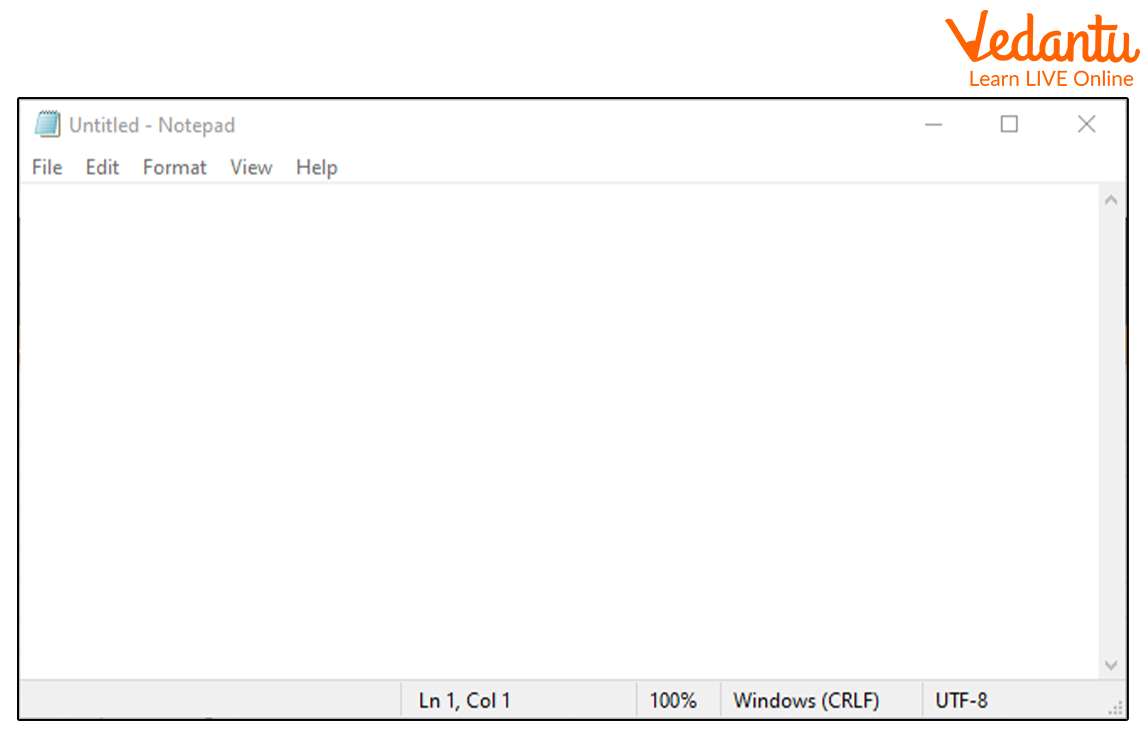
- Open a text editor such as Notepad.
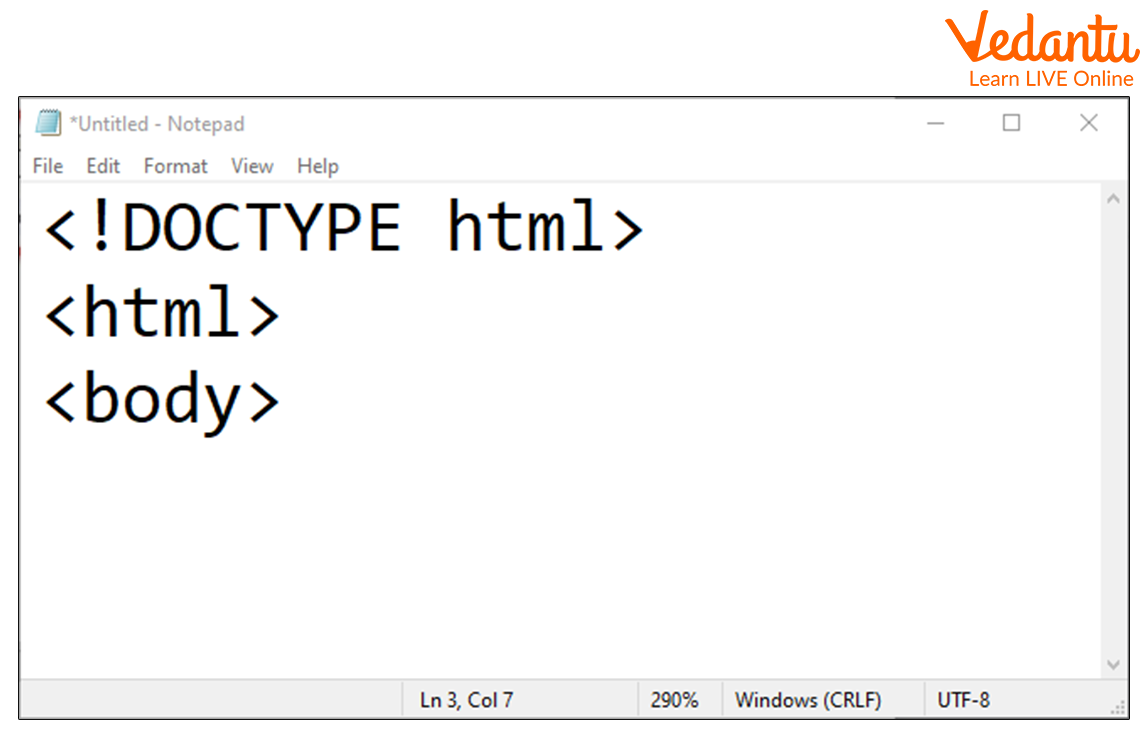
- Write basic HTML structure using <html>, <head>, and <body> tags.
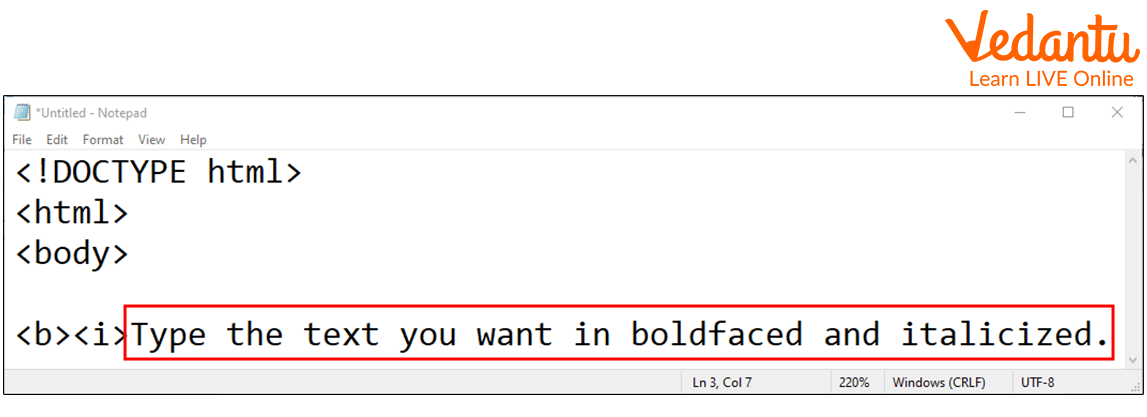
- Use <b> or <strong> to apply bold formatting.
- Use <i> or <em> to apply italic formatting.
- Save the file with .html extension.
- Open the file in a web browser to see the formatted output.
Step 1: Open Notepad
Step 2: Type HTML Structure
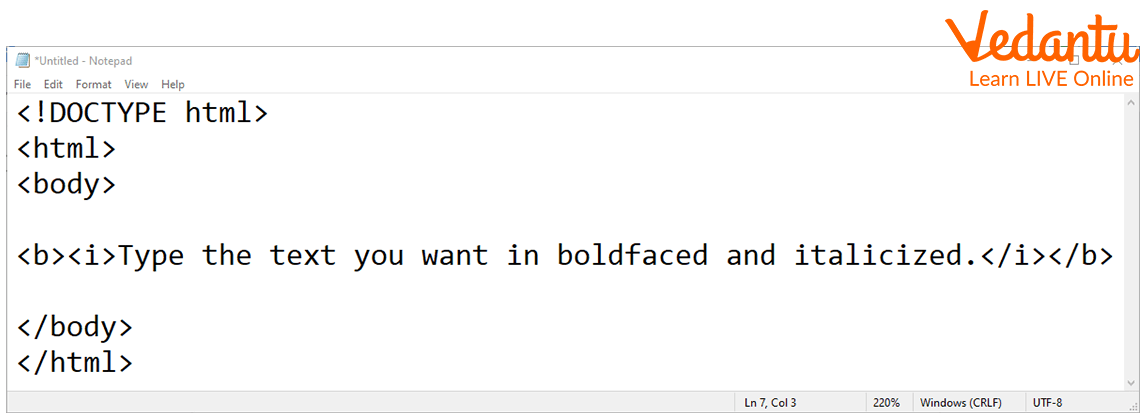
Step 3: Add Content with Formatting
Step 4: Apply Italics
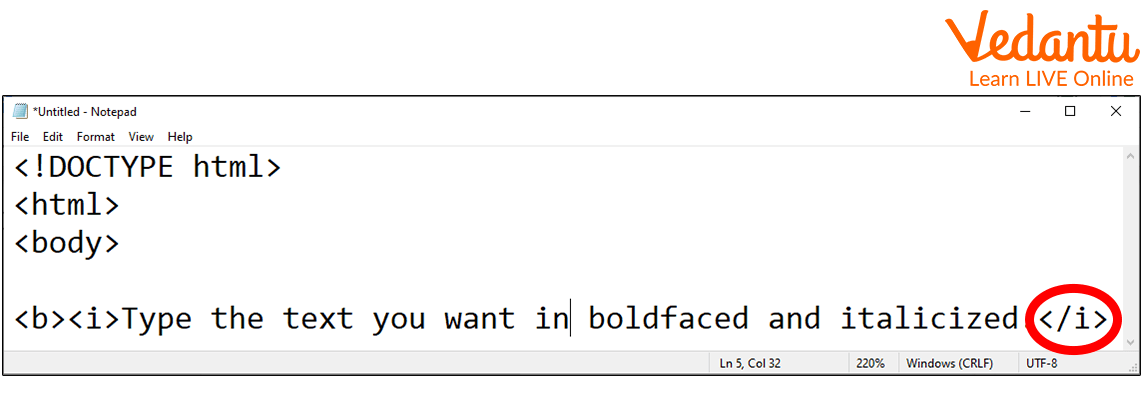
Step 5: Apply Bold
Types and Classification
In HTML, bold and italics can be applied using two main types of tags based on their purpose.
Types of Bold and Italic Tags
| Formatting | Tag | Purpose |
|---|---|---|
| Bold | <b> | Displays text in bold without extra importance |
| Bold | <strong> | Indicates important text with semantic meaning |
| Italic | <i> | Displays text in italics without extra emphasis |
| Italic | <em> | Indicates emphasized text with semantic meaning |
The <strong> and <em> tags are preferred in modern HTML because they add semantic meaning, which helps search engines and screen readers understand the importance of content.
Syntax and Example
Syntax
<b>Bold Text</b>
<strong>Important Text</strong>

<i>Italic Text</i>
<em>Emphasized Text</em>
Example Program
<html>
<head>
<title>Bold and Italics Example</title>
</head>
<body>
<p>This is <b>bold</b> text.</p>
<p>This is <i>italic</i> text.</p>
<p>This is <strong>important</strong> text.</p>
<p>This is <em>emphasized</em> text.</p>
</body>
</html>
In this example, the browser renders bold and italic text according to the tags used inside the paragraph element.
Features and Characteristics
- Easy to use HTML formatting tags.
- Improves text readability.
- Provides semantic meaning with <strong> and <em>.
- Supported by all modern web browsers.
- Enhances content presentation in web pages.
Advantages
- Highlights important keywords.
- Improves user experience and readability.
- Supports SEO when semantic tags are used.
- Simple syntax for beginners.
Disadvantages / Limitations
- Overuse can reduce readability.
- Does not provide advanced styling like CSS.
- Visual formatting alone does not ensure accessibility.
Applications and Use Cases
- Highlighting important terms in web pages.
- Emphasizing key points in educational content.
- Formatting blog posts and articles.
- Designing structured HTML documents.
- Improving accessibility using semantic tags.
Quick Facts About Bold and Italics
| Feature | Details |
|---|---|
| Category | HTML Formatting Tags |
| File Extension | .html |
| Used In | Web Development |
| Semantic Tags | <strong>, <em> |
| Purpose | Text Emphasis and Highlighting |
These tags are part of basic HTML and are essential for structuring and formatting web content effectively.
Interesting Facts About How To Apply Bold And Italics
- The <strong> tag indicates importance, not just bold appearance.
- Search engines may give more weight to text inside <strong>.
- Screen readers emphasize content inside <em> for accessibility.
- Bold and italic styling can also be done using CSS.
- These tags are among the most commonly used HTML elements.
- They are supported by all major browsers without additional configuration.
Conclusion
Understanding how to apply bold and italics is a fundamental skill in HTML and web development. These formatting techniques improve readability, highlight important information, and enhance content structure. By using semantic tags such as <strong> and <em>, developers can create accessible and SEO friendly web pages. Mastering this basic formatting concept helps beginners build a strong foundation in web technologies and computer science.


FAQs on How To Apply Bold And Italics in Web Pages
1. What does bold and italics mean in computer applications?
Bold and italics are text formatting styles used in word processing, web development, and programming documentation to emphasize content.
- Bold makes text thicker and darker.
- Italics slants text slightly to the right.
- Commonly used in MS Word, Google Docs, HTML, and Markdown.
2. How do you apply bold and italics in MS Word?
In MS Word, bold and italics can be applied using toolbar options or keyboard shortcuts.
- Select the text.
- Click B for bold or I for italics in the Home tab.
- Use shortcuts: Ctrl + B for bold and Ctrl + I for italics.
3. What is the syntax to apply bold and italics in HTML?
In HTML, bold and italics are applied using specific tags in web development.
- Bold: <strong>text</strong> or <b>text</b>
- Italics: <em>text</em> or <i>text</i>
- <strong> and <em> provide semantic meaning for SEO and accessibility.
4. How do you apply bold and italics in Markdown?
In Markdown, bold and italics are applied using asterisks or underscores for formatting text.
- Bold: **text** or __text__
- Italics: *text* or _text_
- Widely used in GitHub, documentation, and README files.
5. What is the difference between <b> and <strong> tags in HTML?
The main difference between <b> and <strong> is semantic meaning in web development.
- <b> only makes text visually bold.
- <strong> indicates important content for SEO and screen readers.
- <strong> is recommended in modern HTML5.
6. How can you apply bold and italics using CSS?
In CSS, bold and italics are applied using font properties for styling web pages.
- Bold: font-weight: bold;
- Italics: font-style: italic;
- Used in frontend development with HTML elements.
7. Why are bold and italics important in web development and documentation?
Bold and italics improve readability, structure, and user experience in digital content.
- Highlight important keywords and definitions.
- Improve SEO optimization and content hierarchy.
- Enhance clarity in technical documentation and programming guides.
8. Can bold and italics be combined together?
Yes, bold and italics can be combined to emphasize text strongly in most software and programming languages.
- In HTML: <strong><em>text</em></strong>
- In Markdown: ***text***
- Useful in presentations and web content formatting.
9. What are the advantages and disadvantages of using bold and italics?
Bold and italics improve emphasis but should be used carefully to maintain readability.
- Advantages: better highlighting, improved structure, enhanced user focus.
- Disadvantages: overuse can reduce readability and visual balance.
- Important for UI design and content presentation.
10. Are bold and italics important for exams and interviews in Computer Science?
Understanding bold and italics is useful for exams, documentation tasks, and technical interviews involving HTML, CSS, and word processing tools.
- Common in HTML and CSS syntax questions.
- Asked in web development practical exams.
- Important for preparing clean project documentation and reports.
