









How to format a Word document using styles layout and tools
Formatting Word Document is an essential skill in computer science and digital literacy that helps users present information in a clear, professional, and organized manner. In applications like Microsoft Word, formatting allows users to change the appearance of text, paragraphs, and entire documents to improve readability and visual appeal. Proper formatting enhances communication by structuring content using fonts, styles, alignment, spacing, and highlighting tools. Understanding formatting techniques is important for students, teachers, and professionals who regularly create reports, assignments, letters, and other digital documents.
Definition and Meaning
Formatting Word Document refers to the process of modifying the appearance and layout of text and paragraphs in a word processing application to make the content visually appealing and easy to read.
- Character Formatting - Changing the font style, size, color, and effects of text.
- Paragraph Formatting - Adjusting alignment, indentation, and line spacing.
- Text Highlighting - Emphasizing important text using background colors.
- Styles - Predefined formatting combinations applied to headings and text.
How It Works - Working Principle
The formatting process in a word processor works by applying specific formatting commands to selected text or paragraphs. These commands modify the underlying properties of the text without changing its actual content.
- Select the text or paragraph that needs formatting.
- Choose formatting options from the toolbar or menu such as font size, bold, alignment, or spacing.
- Apply the selected command, which updates the display properties of the text.
- Save the document to preserve formatting changes.
Formatting tools are usually found in the Home tab of Microsoft Word. They work by modifying text attributes such as font family, font size, color, alignment, and spacing.
Types and Classification
Formatting in a Word document can be classified into the following main types:
1. Character Formatting
Character formatting changes the appearance of individual characters or selected text.
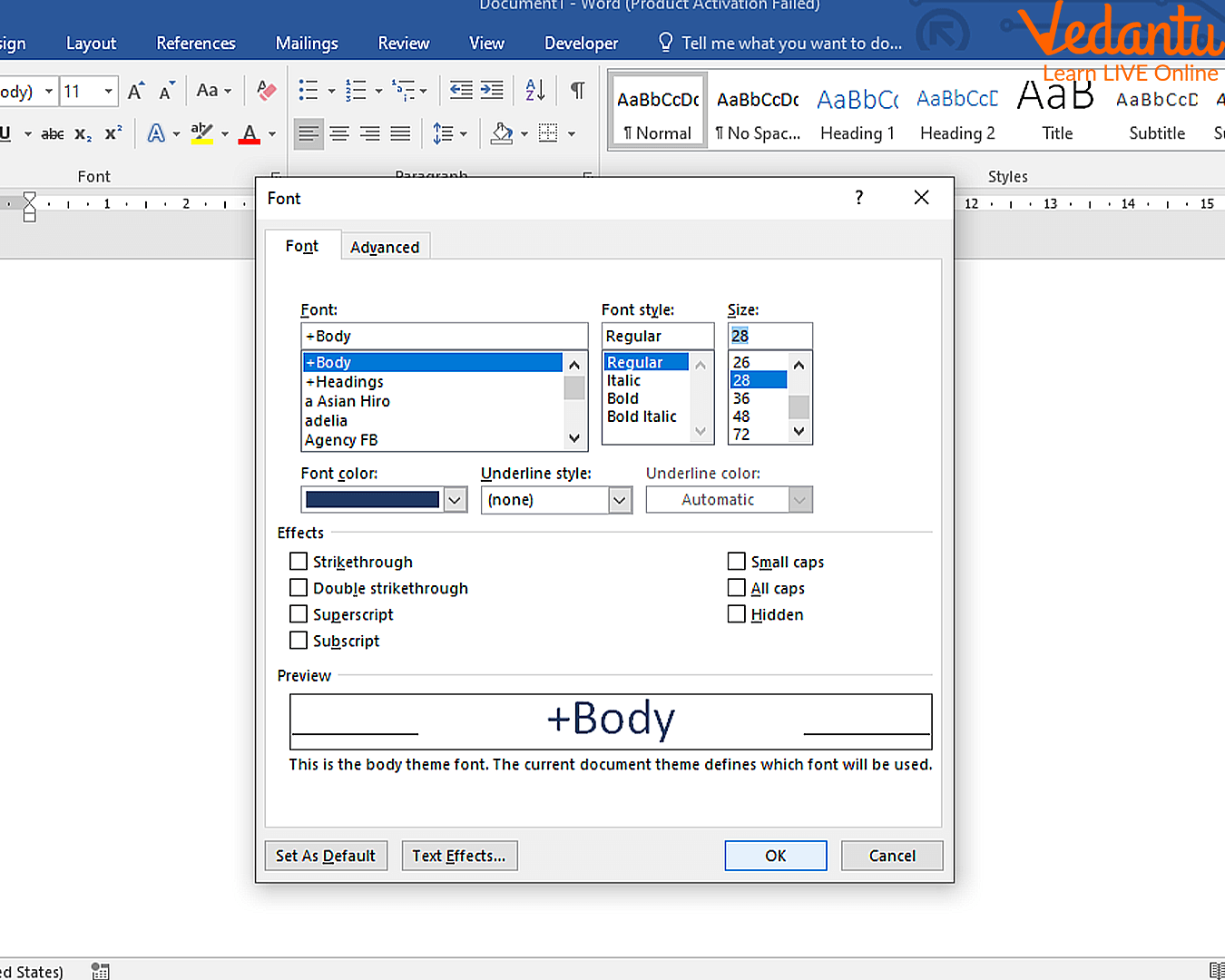
- Font type such as Arial, Times New Roman
- Font size
- Bold, Italic, Underline
- Text color
- Superscript and Subscript
2. Text Highlighting
Text highlighting is used to emphasize important words or sentences by adding background color.
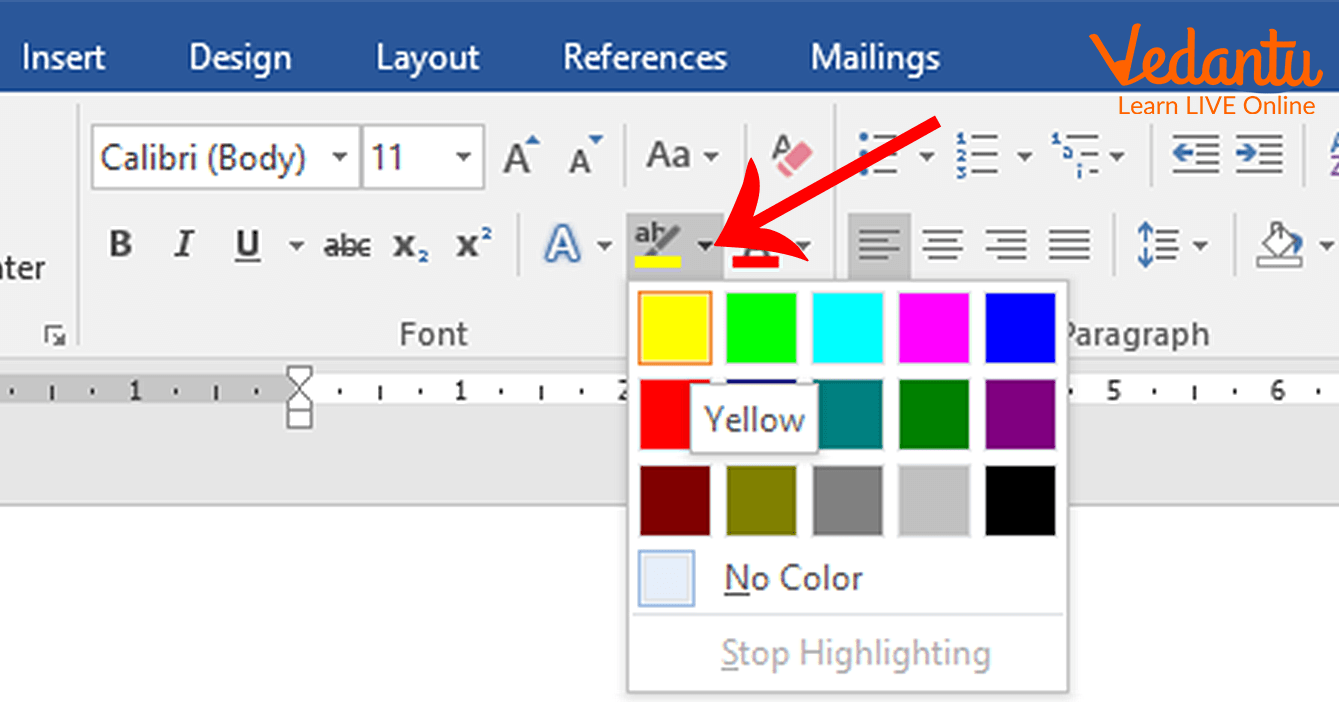
- Used for marking key points
- Helps in revision and review
- Different highlight colors available
3. Paragraph Formatting
Paragraph formatting adjusts the layout and structure of entire paragraphs.
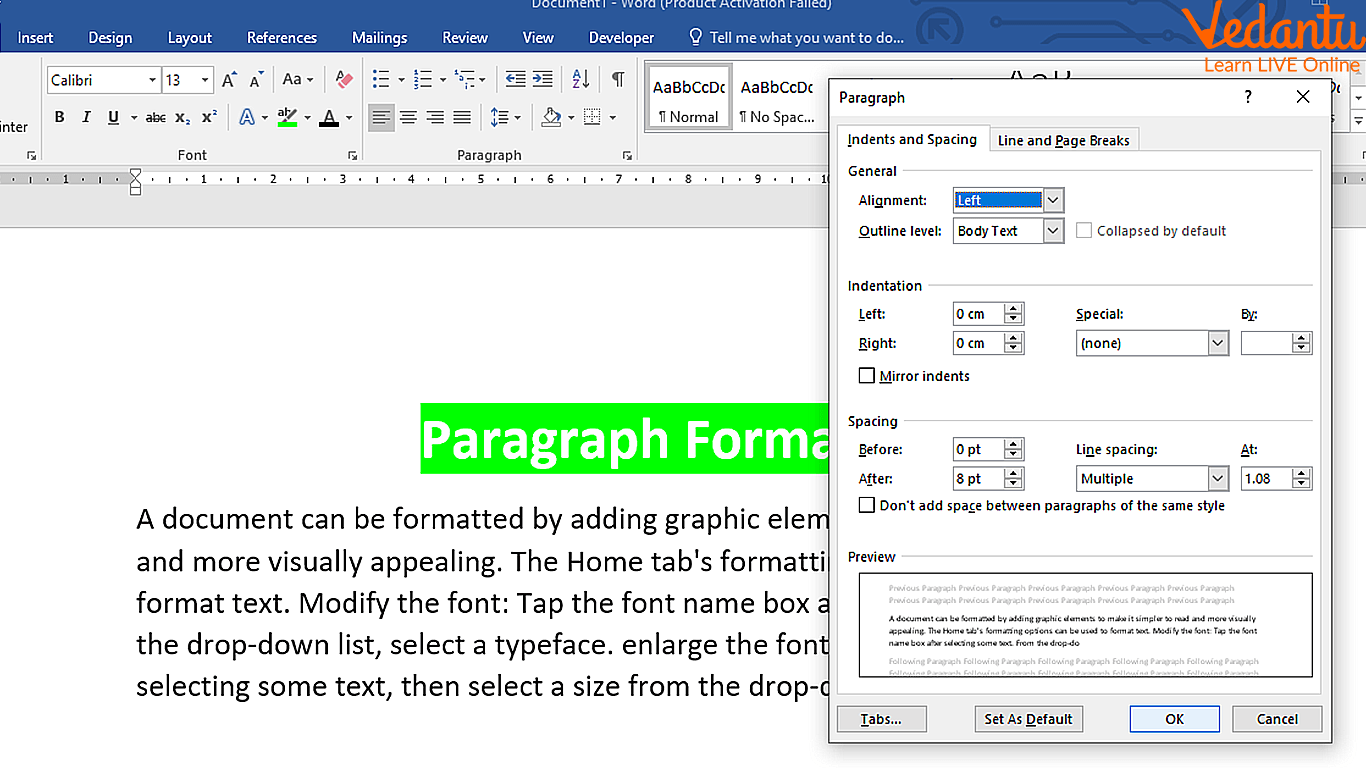
- Text alignment - Left, Center, Right, Justify
- Line spacing
- Indentation
- Bullets and numbering
Features and Characteristics
- Improves document readability and presentation.
- Provides various font styles and sizes.
- Supports alignment and spacing adjustments.
- Allows highlighting and color customization.
- Enables structured documents using headings and styles.
- Easy to modify and update at any time.
Advantages
- Enhances the professional look of documents.
- Makes content easy to understand.
- Highlights important information clearly.
- Improves organization and structure.
- Saves time using predefined styles.
Disadvantages / Limitations
- Over formatting can make documents look cluttered.
- Inconsistent formatting reduces professionalism.
- Large documents may require time to standardize formatting.
- Compatibility issues may occur in different word processors.
Applications and Use Cases
- Creating school and college assignments.
- Preparing business reports and proposals.
- Designing resumes and cover letters.
- Writing research papers and articles.
- Drafting official letters and notices.
Quick Facts About Formatting Word Document
| Category | Details | Example |
|---|---|---|
| Type | Document Formatting Tool | Microsoft Word |
| Main Types | Character and Paragraph Formatting | Bold, Alignment |
| Used For | Improving document appearance | Reports, Letters |
| Common Features | Font, Size, Color, Spacing | 12 pt Arial |
These quick facts summarize the important aspects of Formatting Word Document in computer science and digital documentation.
Interesting Facts About Formatting Word Document
- Word processors allow real time preview of formatting changes.
- Styles help maintain consistency across long documents.
- Formatting does not change the actual data stored in the document.
- Professional documents follow standard formatting guidelines.
- Automatic formatting tools can correct spacing and alignment.
- Templates provide predefined formatting for specific purposes.
Conclusion
Formatting Word Document is a fundamental concept in computer science and digital document creation. It helps organize and present information clearly through character formatting, paragraph formatting, and text highlighting. Proper formatting improves readability, professionalism, and communication effectiveness. By understanding formatting techniques and features, students and professionals can create well structured documents suitable for academic, personal, and business purposes. Mastering document formatting is an essential digital skill in today’s technology driven world.
FAQs on Formatting Word Document Concepts and Techniques
1. What is formatting in a Word document?
Formatting in a Word document refers to changing the appearance and layout of text to improve readability and presentation.
- Includes font style, size, color, and alignment
- Controls paragraph spacing, margins, and line spacing
- Enhances document structure for reports, assignments, and professional documents
- Important for exam submissions, office documentation, and academic writing
2. Why is formatting important in Microsoft Word?
Formatting is important because it improves document readability, structure, and professional appearance in Microsoft Word.
- Makes content easy to understand
- Highlights headings and key points
- Ensures proper layout for printing and PDF export
- Required in school exams, project reports, and office documentation
3. What are the main types of formatting in MS Word?
The main types of formatting in MS Word are character formatting, paragraph formatting, and page formatting.
- Character formatting: Font, size, bold, italic, underline
- Paragraph formatting: Alignment, indentation, spacing, bullets
- Page formatting: Margins, orientation, size, columns
4. How do you apply character formatting in Word?
Character formatting in Microsoft Word is applied by selecting text and modifying font settings from the toolbar.
- Select the text to format
- Use the Home tab to change font style and size
- Apply Bold, Italic, Underline options
- Change text color or highlight text
5. What is paragraph formatting in Word?
Paragraph formatting controls the layout and alignment of text blocks in a Word document.
- Includes left, right, center, justify alignment
- Adjusts line spacing and paragraph spacing
- Sets indentation and tab stops
- Adds bullets and numbering for structured content
6. What is page formatting in MS Word?
Page formatting in MS Word defines the overall layout and design of the document page.
- Set page margins and orientation (Portrait or Landscape)
- Choose paper size like A4 or Letter
- Add headers and footers
- Insert page numbers for reports and assignments
7. What are styles in Microsoft Word?
Styles in Microsoft Word are predefined formatting sets used to maintain consistent document structure.
- Examples include Heading 1, Heading 2, Normal
- Used to create automatic Table of Contents
- Ensure uniform formatting across large documents
- Useful for academic papers and professional reports
8. How do you format a document for exams or academic submissions?
To format a Word document for exams or academic submissions, follow standard academic formatting guidelines.
- Use clear fonts like Times New Roman or Arial
- Set font size typically to 12 pt
- Apply 1.5 or double line spacing
- Use proper margins and page numbers
9. What are the advantages of proper document formatting?
Proper document formatting improves readability, professionalism, and document organization.
- Enhances visual clarity
- Improves communication of ideas
- Helps in automated processing like printing and PDF conversion
- Supports structured documentation in business and education
10. What is the difference between formatting and editing in Word?
Formatting changes the appearance of text, while editing modifies the actual content in a Word document.
- Formatting: Font, alignment, spacing, layout changes
- Editing: Adding, deleting, or correcting text
- Formatting improves presentation
- Editing improves accuracy and clarity
