









What is Dysprosium Definition Properties Electron Configuration and Uses
Below the main body of the periodic table are two rows of elements. These are the lanthanides and the actinides. If you consider the atomic numbers of the elements, you will notice they fit in the areas below scandium and yttrium. The reason they don't seem to be (usually) listed here is that this could make the table too wide to print on paper. Each of these rows of elements has characteristic properties.
Lanthanides are the rare-earth element elements of the modern periodic table i.e. the elements with atomic numbers from fifty-eight to seventy-one following the element lanthanum. Dysprosium (Dy) is a chemical element, a rare-earth metal of the lanthanide series of the periodic table.
What is Dysprosium?
Dysprosium is the 66th element within the periodic table. The Dysprosium symbol is Dy within the periodic table. Dysprosium is a lustrous, soft, and silvery metal. It's stable in air at room temperature even though it's slowly oxidised by oxygen. It reacts with cold water and quickly dissolves in acids. It forms many brightly coloured salts. Dysprosium's characteristics are often strongly affected by the presence of impurities.
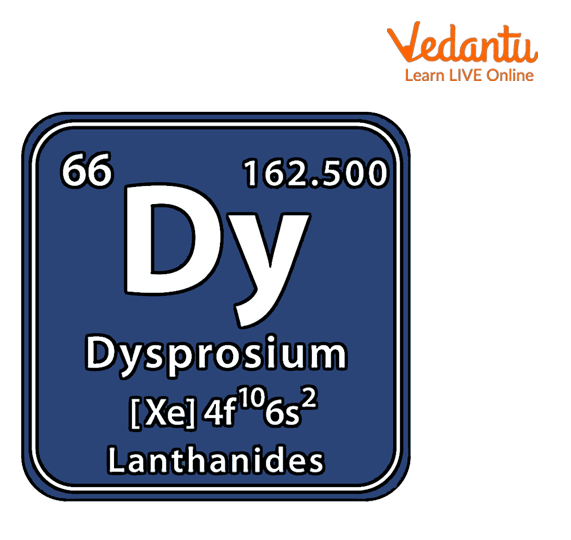
Dysprosium
History of Dysprosium
Dysprosium was discovered in 1886 by Paul-Émile Lecoq De Boisbaudran in Paris. Its discovery came as a result of analysis into yttrium oxide, first made in 1794, and from that other rare earth (aka lanthanoids) were afterward to be extracted, specifically erbium in 1843, then holmium in 1878, and at last dysprosium. De Boisbaudran’s technique involved endless precipitation applied on the marble slab of his fireplace at home.
Pure samples of dysprosium weren't available till Frank Spedding and colleagues at Iowa State University developed the technique of ion-exchange chromatography around 1950. From then on, it was attainable to separate the rare-earth element elements in a reliable and efficient manner, though that technique of separation has currently been superseded by liquid-liquid exchange technology.
Dysprosium Electron Configuration
Generally, lanthanides and actinides have electron configurations that follow the Aufbau rule. There are some exceptions in a few of the lanthanide and actinide elements.
The electronic configuration of the lanthanoids is 4f1-14 5d0-1 6s2.
Dy (Dysprosium) is an element with position number sixty-six within the periodic table.
Reduced electronic configuration Dy:
[Xe] 4f10 6s2
Chemical Properties of Dysprosium
In common with several alternative lanthanides, dysprosium is found within the minerals monazite and bastnasite. It's additionally found in smaller quantities in many alternative minerals like xenotime and fergusonite.
It may be extracted from these minerals by solvent extraction or ion exchange. It can also be prepared by the reduction of Dy trifluoride with Ca metal. It seems like silvery, lustrous, and soft metal.
The Chemical Properties of Dysprosium are as Follows:
The element possesses wonderful stability at room temperature and often gets oxidised in the presence of oxygen.
This metal has about twenty-nine isotopes of mass numbers between 141 to 169. The number of naturally occurring isotopes for Dy is approximately seven, and all are better known to be stable isotopes.
The earth’s crust consists of about 5.2 mg/kg and also the concentration of dysprosium in seawater is about 0.9 mg/L.
The worldwide production of dysprosium (Dy) is around 100 tonnes and approx 99% of this can be created by artificial means in China.
Uses of Dysprosium
Being a radioactive element, the metal finds useful applications within the field of radioactivity.
Dysprosium is used in control rods in reactors of nuclear energy plants as they have the potential to absorb neutrons.
Metal bromide and iodide are used for high-intensity lamps.
Since the magnetic susceptibility is high, it's utilised in the applications of the data storage system.
The salts of dysprosium like aluminium garnet and iron garnet are used in adiabatic refrigerators.
Dysprosium Oxide and Dysprosium Nitrate
Dysprosium oxide with chemical composition Dy2O3, is one of the rare-earth element oxide families. It is a white slightly hygroscopic powder, and it's highly insoluble and thermally stable.
Dysprosium Nitrate could be a salt of dysprosium and nitric acid with the formula Dy(NO3)3.
When dysprosium oxide is dissolved in water it forms a crystalline hydrate of yellow colour.
Interesting Facts
Dysprosium is one of the most abundant lanthanide elements and is over twice as abundant as tin. Dysprosium(Dy) is rarely encountered as a free element however is found in several minerals.
Dysprosium has no biological role. Soluble dysprosium salts are gently toxic by consumption, whereas insoluble salts are non-toxic. From toxicity tests on mice, it had been calculated that a dose of five hundred grams or more would be required to put human life in danger.
Conclusion
The dysprosium (Dy) element was discovered by a French chemist named Paul-Émile Lecoq de Boisbaudran in the year 1886. This element with the symbol Dy is abundantly found in nature and even found in several minerals like gadolinite, xenotime, euxenite, fergusonite, and polycrase, which might even be known as sources of dysprosium.


FAQs on Dysprosium Element Overview Properties and Applications
1. What is dysprosium?
Dysprosium is a rare earth element with atomic number 66 and the chemical symbol Dy.
- It belongs to the lanthanide series in the periodic table.
- Dysprosium is a silvery metallic element that is relatively soft and reactive.
- It commonly forms the +3 oxidation state, written as Dy3+.
- It is mainly used in high-performance magnets and nuclear reactor control rods.
2. What is the electron configuration of dysprosium?
The ground-state electron configuration of dysprosium (Dy) is [Xe] 4f10 6s2.
- The noble gas core [Xe] represents 54 electrons.
- The remaining electrons fill the 4f and 6s subshells.
- This 4f electron arrangement is responsible for dysprosium’s magnetic properties.
- In the common ion Dy3+, three electrons are removed, typically from 6s and 4f orbitals.
3. What group and period is dysprosium in?
Dysprosium is in period 6 and belongs to the lanthanide series of the f-block.
- Atomic number: 66
- Block: f-block
- It is often associated with group 3 elements but is specifically classified as a lanthanide.
- Lanthanides are also called rare earth metals.
4. What are the common oxidation states of dysprosium?
The most common oxidation state of dysprosium is +3.
- The stable ion formed is Dy3+.
- This oxidation state appears in compounds such as Dy2O3 and DyCl3.
- Less common oxidation states like +2 can occur but are rare and less stable.
- The +3 state is typical for most lanthanide elements.
5. What is the formula of dysprosium oxide?
The chemical formula of dysprosium(III) oxide is Dy2O3.
- It contains two Dy3+ ions and three O2- ions.
- The formula balances total positive and negative charges.
- It is a white solid commonly used in ceramics and magnetic materials.
- It can be formed by heating dysprosium metal in oxygen: 4Dy(s) + 3O2(g) → 2Dy2O3(s).
6. How does dysprosium react with water?
Dysprosium reacts slowly with cold water to form dysprosium hydroxide and hydrogen gas.
- The balanced reaction is: 2Dy(s) + 6H2O(l) → 2Dy(OH)3(aq) + 3H2(g).
- The product Dy(OH)3 contains dysprosium in the +3 oxidation state.
- The reaction is faster with hot water.
- This behavior is typical of many lanthanide metals.
7. Why is dysprosium considered a rare earth element?
Dysprosium is considered a rare earth element because it belongs to the lanthanide series and occurs in low concentrations in Earth’s crust.
- It is not extremely rare, but it is widely dispersed and difficult to extract.
- It is typically found in minerals like xenotime and monazite.
- Separation requires complex processes such as solvent extraction or ion-exchange methods.
- The term "rare earth" refers to geochemical occurrence, not actual scarcity.
8. What are the main uses of dysprosium in chemistry and industry?
Dysprosium is mainly used to improve the heat resistance of neodymium–iron–boron (NdFeB) magnets.
- It increases magnetic stability at high temperatures.
- It is used in control rods in nuclear reactors due to its high neutron absorption cross-section.
- Dysprosium compounds are used in lasers and lighting applications.
- Its oxide Dy2O3 is used in ceramics and electronic materials.
9. What is the atomic mass of dysprosium?
The standard atomic mass of dysprosium is approximately 162.50 u.
- Atomic number: 66
- It has multiple stable isotopes, including Dy-162, Dy-163, and Dy-164.
- The atomic mass represents the weighted average of its naturally occurring isotopes.
- This value is used in mole and molar mass calculations for dysprosium compounds.
10. What type of element is dysprosium metal?
Dysprosium is a lanthanide metal and is classified as a reactive, electropositive element.
- It is a silvery-white metallic solid at room temperature.
- It readily forms ionic compounds such as DyCl3.
- It loses three electrons to form the stable Dy3+ ion.
- Its chemical behavior is similar to other rare earth metals like terbium and holmium.
