






CBSE has introduced the CBSE on screen marking system for the evaluation of Class 12 Board Examination 2026 answer books. This is a major shift from the traditional physical evaluation process to a digital evaluation method. Under this system, Class 12 answer books are scanned and made available to examiners on a secure digital platform for checking.
As per CBSE’s official circular dated February 9, 2026, the Board decided to introduce On-Screen Marking OSM for Class XII answer books beginning with the 2026 examinations, while Class 10 answer books will continue to be evaluated in physical mode in 2026. CBSE also stated that it conducts Class 10 and Class 12 exams in India and across 26 countries, covering nearly 46 lakh students.
What is CBSE On Screen Marking?
CBSE on screen marking is a digital evaluation system in which physical answer books are scanned and uploaded to an online evaluation portal. Examiners check the scanned copies on a computer screen and enter marks digitally.
CBSE’s FAQ defines On Screen Marking as a digital evaluation system where actual answer books are scanned and made available on screen for evaluation. The Board also clarifies that there is no difference in the evaluation criteria between traditional checking and On Screen Marking CBSE evaluation. The difference is only that the answer book is shown on a monitor and marks are awarded digitally.
CBSE Class 12 On-Screen Marking 2026 Latest Update
The CBSE Class 12 on-screen marking system has been implemented for the Class 12 Board Exams 2026. This means Class 12 answer scripts will be digitally evaluated, but students will still write their exams in physical answer books.
Important Points:
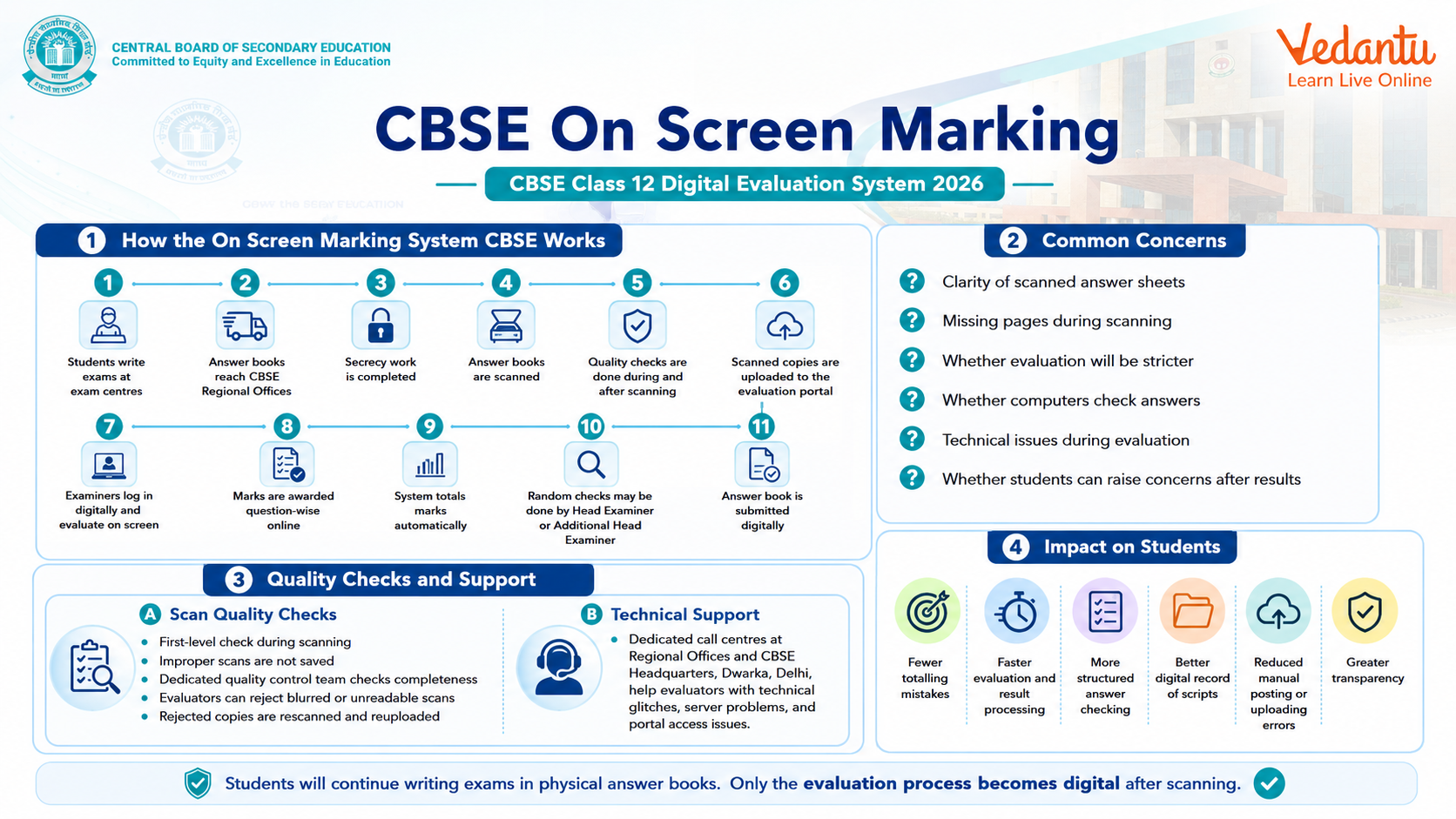
How the On Screen Marking System CBSE Works
The on screen marking system CBSE follows a structured process from answer book collection to digital evaluation.
Students write exams at their exam centres.
Answer books are received at CBSE Regional Offices.
Secrecy work is completed.
Answer books are scanned at Regional Offices.
First-level quality checks are done during scanning.
Second-level quality checks are done after scanning.
Scanned images are uploaded to the evaluation portal.
Examiners log in digitally and evaluate answers on the computer screen.
Marking schemes for all 116 subjects are uploaded on the OSM portal and also provided physically.
Examiners award marks question-wise online.
The system automatically totals the marks.
Evaluated answer books may be randomly checked by the Additional Head Examiner or Head Examiner.
Once evaluation is complete, the answer book is submitted digitally.
Does CBSE On Screen Marking Mean Computer Checking?
No. CBSE has clearly stated that computers do not check the answers. Human examiners continue to evaluate the answer scripts. The only change is that teachers check scanned copies on a computer instead of checking physical answer books on paper.
This is important for students because the CBSE on screen marking system does not replace teachers with machines. It only changes the medium of evaluation.
Why CBSE Introduced On Screen Marking?
CBSE introduced the CBSE on screen marking system to make evaluation more accurate, transparent, fast, and secure. According to CBSE, the system aims to reduce manual errors, improve speed of evaluation, and ensure secure handling of answer sheets.
CBSE’s official circular also lists multiple expected benefits, including elimination of totalling errors, automated coordination, faster evaluation with wider teacher participation, savings in transportation time and costs, reduced manpower for verification, and environmentally sustainable digital evaluation.
Benefits of CBSE On Screen Marking System
The on screen marking system CBSE is expected to benefit students, schools, teachers, and the Board in several ways.
Key Benefits
CBSE’s FAQ specifically states that OSM eliminates totalling, posting and uploading errors, ensures every answer is evaluated completely, reduces manual handling, saves time and effort, promotes transparency and eco-friendly digital processes, and maintains complete secrecy.
CBSE On Screen Marking System Login
The CBSE on screen marking system login is meant for authorised examiners and school-related users involved in the evaluation process. Teachers with valid OASIS data and credentials are provided access as per CBSE’s process.
CBSE has stated that login credentials are made available to examiners according to their data available on the OASIS portal. Examiners then log in digitally and evaluate answers on the computer screen.
Students should note that the CBSE on screen marking login, on screen marking CBSE login, and CBSE on-screen marking system login are not general public login pages for students. These are evaluation-related access points for authorised teachers and officials.
CBSE On Screen Marking Portal
The CBSE on screen marking portal is the digital platform where scanned answer books and marking schemes are made available to examiners. It allows teachers to evaluate answer scripts question-wise and submit marks online.
According to CBSE’s FAQ, scanned images are uploaded on the evaluation portal after quality checks. Marking schemes for all 116 subjects are uploaded on the OSM portal and also provided physically to support evaluators.
Infrastructure Required for CBSE On Screen Marking
To implement the CBSE on screen marking system, CBSE asked schools to ensure basic digital readiness.
Schools Need:
Computer lab with Public Static IP
PC or laptop with Windows OS 8 or above
4 GB RAM or higher
1 GB free space on C drive
Latest browser such as Chrome, Edge, IE, or Firefox
Adobe Reader
Reliable internet connectivity with minimum 2 Mbps speed
Uninterrupted power supply
These requirements were listed in CBSE’s circular dated February 9, 2026.
Teacher Training for CBSE On Screen Marking
CBSE has conducted training and mock sessions to familiarise teachers with the OSM process. The Board mentioned that teachers were trained through webinars, individual online training, login training, practice with answer books, mass mock evaluation, annotation guides, videos, circulars, doubt-clearing sessions, and hand-holding sessions.
CBSE also stated that training of teachers and examiners was conducted on January 19, 2026, dry run evaluation was conducted on January 20 and 21, 2026, and mass mock evaluation was held on February 26, 2026 in five slots. A live webcast on Board Exam 2026 modalities and On Screen Marking for Class 12 was conducted on February 13, 2026 and was joined by about 4,00,000 online views.
CBSE On-Screen Marking Concerns
Some students and parents may search for CBSE on-screen marking concerns because digital evaluation is a new process for Class 12 in 2026. Common concerns may include:
Whether scanned answer sheets will be clear
Whether any page can go missing during scanning
Whether digital evaluation will be stricter
Whether computers will check answers
Whether technical issues can affect evaluation
Whether students can raise concerns after results
CBSE’s FAQ answers many of these concerns. It states that answer scripts are scanned without cutting the spine or de-threading using book scanners. It also states that quality checks are done, and if any ambiguity is found, the answer script is rescanned and then sent for evaluation.
CBSE On-Screen Marking Issues and Quality Checks
The most discussed CBSE on-screen marking issues are usually related to scan quality, technical glitches, and portal access. CBSE has described multiple safeguards for these issues.
Scan Quality Checks
CBSE Says:
First-level check is done during scanning.
If an answer book is not scanned properly, it is not saved.
A dedicated Quality Control Team checks whether the complete answer book has been scanned properly.
Evaluators can reject scanned copies if they are blurred or unreadable.
Rejected answer books are rescanned and made available again after quality checks.
Technical Support
CBSE also created dedicated call centres at Regional Offices and CBSE Headquarters, Dwarka, Delhi, for evaluators to resolve technical glitches, server problems, or related queries.
Does OSM Lead to Stricter Marking?
No. CBSE has clearly clarified that OSM does not lead to stricter marking. The marking scheme remains the same. OSM changes only the method of evaluation, not the criteria for awarding marks.
This means students should understand that CBSE on screen marking is a change in checking mode, not a change in the marking rules.
How CBSE On Screen Marking Impacts Students
The CBSE Class 12 on-screen marking system can impact students in the following ways:
Fewer totalling mistakes
Faster evaluation and result processing
More structured answer checking
Better digital record of evaluated scripts
Reduced manual posting and uploading errors
Greater transparency in the evaluation process
Students do not need to change how they write the exam. They will continue writing answers in physical answer books. The change happens after the exam, when answer books are scanned and evaluated digitally.
What Students Should Do If They Suspect a Marking Error
If students feel there is a genuine issue after the results, they should follow CBSE’s official process only. They may:
Apply for a scanned copy or photocopy of the evaluated answer book through the official CBSE process.
Check whether all answers have been evaluated.
Check whether marks have been counted correctly.
Look for any obvious marking or totalling discrepancy.
Apply for verification or re-evaluation only through the official CBSE portal when the window is active.
Students should avoid relying on unofficial links or third-party claims related to evaluation or rechecking.
Difference Between Traditional Evaluation and On Screen Marking CBSE
Myths and Facts About CBSE On Screen Marking
Conclusion
The CBSE on screen marking system for Class 12 Exams 2026 is an important digital evaluation reform. Under this system, students write answers in physical answer books, but teachers evaluate scanned copies through the CBSE on screen marking portal. CBSE has introduced this system to improve accuracy, transparency, speed, and reduce manual errors.
While students may have concerns about scan quality or technical issues, CBSE’s official FAQ explains that multiple quality checks, evaluator rejection options, rescanning facilities, mock evaluations, teacher training, and call centre support have been arranged. Overall, on screen marking CBSE is designed to modernise evaluation without changing the marking scheme or replacing human examiners.
