








NEET 2026 Counseling and Seat Allotment for Private Colleges Explained
Are you aiming for MBBS or BDS admission in a private medical college for NEET 2026? Understanding how to get admitted to private medical colleges through NEET is essential for your application strategy, mark targets, and counselling choices. With all medical admissions (including private colleges) streamlined through NEET-UG, it is crucial to know the requirements, process, and options available. This guide will help you navigate the path from NEET 2026 to private medical college admission in a way that's clear, realistic, and suited to student needs.
Is NEET Required for Admission in Private Medical Colleges?
Yes, NEET-UG is mandatory for admission to all MBBS and BDS courses in private medical colleges across India. This includes every state and deemed university. No private medical college can admit students to MBBS without a valid NEET score, regardless of management quota or NRI quota seats. As per Medical Council of India (now NMC) and recent government guidelines, NEET is the single entrance for medical undergraduate seats—government, private, and deemed universities all come under its purview. There is no legal or valid way to get direct MBBS admission in private colleges without NEET, so if you find sources claiming how to get admission in private medical college without NEET, please consider them misleading.
How Many Marks Are Required in NEET for MBBS in Private Colleges?
The minimum marks required in NEET to get MBBS admission in private medical colleges vary from state to state, and from one college to another, based on:
Your NEET score and corresponding All India Rank
The cut-off for private college seats (management/NRI quota) in your preferred state
Number of applicants and seat matrix for that year
As a general estimate, for NEET 2026, qualifying marks are not enough—competitive marks for private MBBS seats typically range between 250 to 450. Some top private medical colleges have much higher cut-offs. For example, in states like Karnataka, Tamil Nadu, Bihar, and Uttarakhand, management quota seats may close between 350-550 NEET marks depending on college reputation and fee structure. State quota reservations may also impact cut-offs if you hold state domicile.
To explore state-specific trends, you can check details on private medical colleges in Karnataka accepting NEET score, Bihar private colleges, or Tamil Nadu private colleges.
NEET 2026 Private Medical College Admission Process
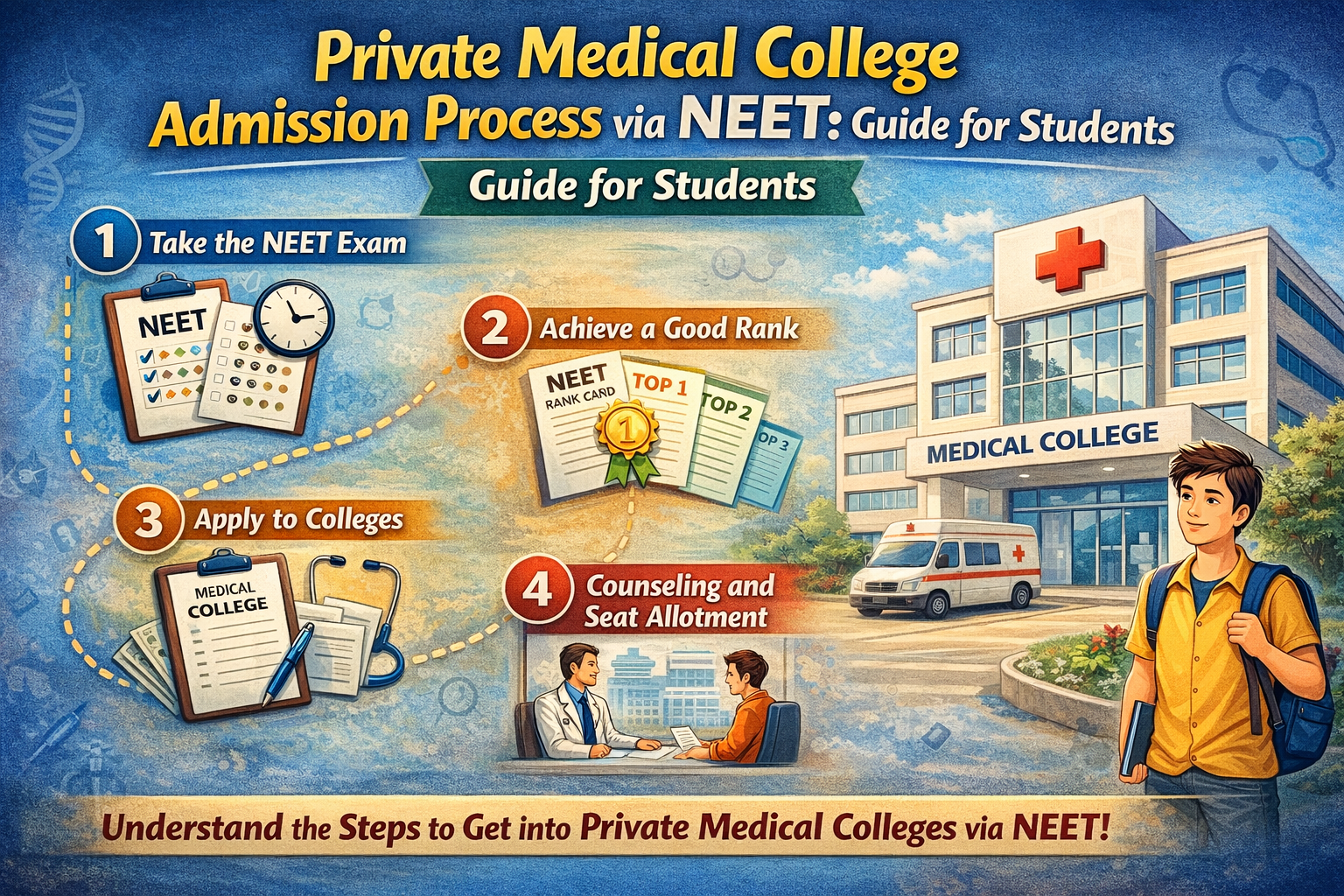
The admission process for MBBS and BDS seats in private medical colleges via NEET 2026 involves multiple coordinated steps:
Appear for NEET-UG 2026 and secure a qualifying score.
Register for the central (MCC) and/or state-level counselling, depending on the state and type of seat.
Fill in your choices for preferred private medical colleges and courses during counselling.
Participate in the seat allotment process, where colleges are allotted based on your NEET rank, choices, and reservation quota eligibility.
If allotted a college, complete document verification and pay the admission fee to confirm your seat.
Each state has its own counselling authority for private seats under state quota and management quota, so be sure to regularly check state counselling websites for timelines and instructions after your NEET 2026 results are announced.
Types of Seats in Private Medical Colleges
Here’s a brief overview of seat types available in private colleges through NEET:
State Quota Seats: For candidates with state domicile or specific eligibility as per state rules. Lower fee structure, relatively higher cut-off.
Management Quota Seats: Open to all NEET-qualified aspirants across India, generally higher fee, moderate cut-off.
NRI Quota Seats: For NRI candidates, requires NEET qualification. Highest fee, flexible cut-off, but still based on merit in some states.
All these seats still require NEET qualification and formal participation in the counselling process. There is no bypass or shortcut for direct admission without NEET.
Documents Required for Private MBBS Admission via NEET
NEET 2026 admit card and result (score card)
Class 10 & 12 marksheets and certificates
ID proof (Aadhaar, Passport, etc.)
Category certificate (if applicable)
Domicile certificate (for state quota)
Passport-size photographs
Other documents as notified by the counselling authority or allotted college
Ensure you prepare scanned copies and originals of all documents before the start of counselling to avoid last-minute issues.
How to Choose the Right Private Medical College
When shortlisting private medical colleges via NEET 2026, keep these factors in mind:
Teaching quality, hospital infrastructure, and clinical exposure
Approval/accreditation status from NMC
Historical cut-offs and placement of graduates
Location, hostel and campus facilities
Total fees structure and refund policy
Refer to resources like top Indian private medical colleges accepting NEET score to explore best-fit options.
You can also check state-specific details on private colleges in Uttarakhand or others relevant to your preferences and eligibility.
Key Steps for NEET 2026 Private College Aspirants
Start serious NEET preparation in Class 11 or as early as possible.
Regularly solve practice questions and take mock tests to benchmark your score progress.
Focus on scoring above 350-400 in NEET for a good chance in reputed private colleges; higher scores improve your options and scholarships.
Shortlist colleges by state, fees, and cut-off trends as counselling approaches.
Stay updated with NEET 2026 official notifications for exam dates, counselling, and seat matrix announcements.
Getting admitted to a private medical college through NEET in 2026 is a structured and transparent process—NEET qualification is compulsory for all MBBS seats in private institutions, including management and NRI quota. Mark targets often mean aiming higher than the minimum qualifying score, and success depends on smart preparation, state counselling awareness, and timely documentation. Start your NEET 2026 journey with focus, follow all updates, and make sure your efforts are guided towards realistic private college admission goals.
FAQs on Private Medical College Admission Process via NEET: 2026 Guide for Students
1. What is the process to get admission to private medical colleges through NEET?
Admission to private medical colleges through NEET is based on your NEET score and rank followed by counselling.
After qualifying NEET, candidates must participate in state or central counselling for seat allotment in private medical colleges.
The process includes registration, choice filling, seat allocation, document verification, and final admission.
2. Why is NEET mandatory for private medical college admissions?
NEET is mandatory for private medical colleges to ensure a fair and transparent selection process based on merit.
It standardizes eligibility for MBBS admission across the country.
Only students who clear NEET can apply for MBBS seats in private as well as government medical colleges.
3. What are the eligibility criteria for private MBBS seats through NEET?
Candidates must qualify NEET, meet the minimum cutoff, and fulfill age and academic requirements for private MBBS seats.
Applicants must have passed Class 12 with Physics, Chemistry, Biology, and English.
Minimum age should be 17 years on or before 31st December of the admission year.
4. How are private medical college fees decided for NEET admissions?
The fee structure in private medical colleges through NEET is set by college authorities or state regulatory bodies.
Fees may vary based on the college's location, facilities, and category of seat (management, NRI, etc.).
Students should check the official college or state counselling website for detailed fee information.
5. What is the counselling process for private medical colleges after NEET?
After qualifying NEET, students must register for counselling conducted by state or central authorities to secure seats in private medical colleges.
The process includes online registration, filling college choices, seat allotment, report to the allotted college, and document verification.
6. Can NRI or management quota seats in private medical colleges be accessed through NEET?
Yes, NRI and management quota seats in private medical colleges are also filled through NEET qualification.
Candidates must fulfill NEET eligibility and may need separate registration for management or NRI quotas.
7. What documents are required for admission to private medical colleges through NEET?
Students must present essential documents like NEET scorecard, admit card, 12th mark sheet, ID proof, and passport-size photographs during admission.
Additional documents may include caste certificate, domicile certificate, and counselling allotment letter.
8. What is the difference between all-India quota and state quota for private medical colleges through NEET?
All-India quota allows candidates from any state to apply for private medical college seats, while state quota is reserved for candidates belonging to that particular state.
Private colleges often have a certain percentage of seats reserved for state quota and others open to all-India applicants.
9. How can students prepare for NEET to get admission in private medical colleges?
Consistent study, understanding the NEET syllabus, practicing mock tests, and solving previous years’ papers help students prepare for NEET.
A strategic revision plan and time management are key to securing a good NEET score for private medical college admission.
10. Is there a separate cutoff for private medical colleges in NEET?
Yes, private medical colleges may have different NEET cutoffs based on seat category and college preference.
Cutoff marks for private colleges are often lower than government colleges but can vary each year depending on the competition and number of applicants.
