






How to Identify a Wolf Snake and Tell It Apart from Venomous Snakes
The Wolf Snake is a small, non-venomous reptile often confused with dangerous snakes because of its colour and pattern. It gets its name from its sharp, wolf-like teeth used to catch prey. Found mainly in Asia, especially in India, this snake is shy and prefers hiding in dark places. Learning about Wolf Snake facts, habitat, diet, and characteristics helps us understand why this harmless snake is important for nature.
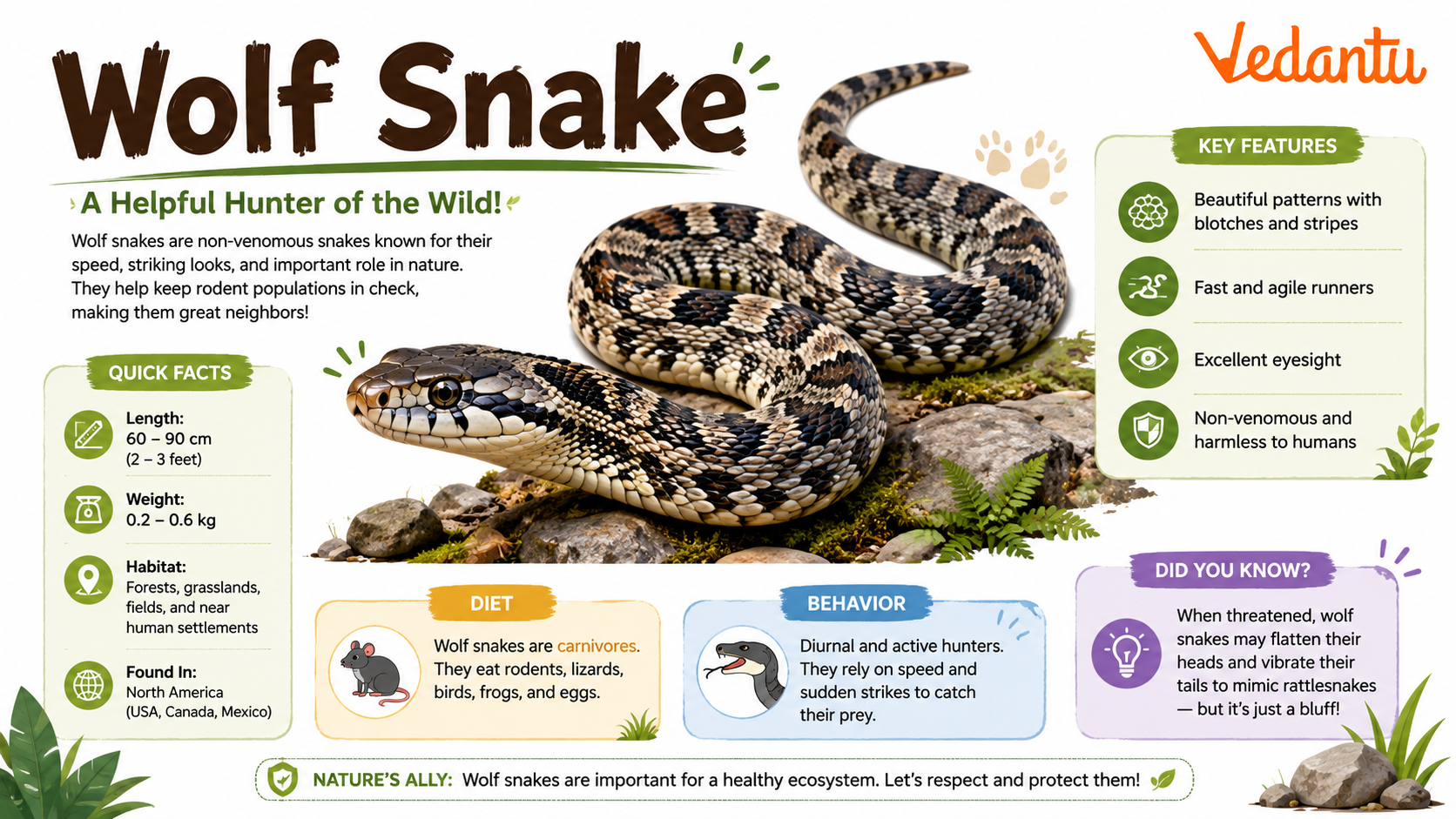
Quick Facts About Wolf Snake
| Feature | Details |
|---|---|
| Common Name | Wolf Snake |
| Scientific Name | Lycodon species |
| Animal Group | Reptile |
| Size | About 30–80 cm long |
| Diet | Lizards, small frogs, geckos |
| Habitat | Forests, villages, gardens, rocky areas |
| Activity | Nocturnal (active at night) |
| Venom | Non-venomous |
| Conservation Status | Least Concern (most species) |
Appearance and Physical Characteristics
- Slender and smooth body.
- Shiny scales that reflect light.
- Usually dark brown or black in colour.
- White or yellow bands across the body.
- Flat head slightly wider than the neck.
- Sharp, curved teeth like a wolf (hence the name).
Wolf Snake Habitat and Distribution
- Found in India, Sri Lanka, Southeast Asia, and parts of East Asia.
- Lives in forests, grasslands, rocky areas, and even cities.
- Often hides under stones, logs, tree bark, or inside houses.
- Prefers warm tropical and subtropical climates.
The Wolf Snake habitat is very flexible. It easily adapts to human surroundings and is commonly seen near buildings where lizards are found.
Diet and Feeding Habits
Carnivore (meat-eater).
House geckos and small lizards.
Mostly at night.
Grabs prey with sharp teeth and swallows it whole.
The Wolf Snake diet helps control lizard populations in homes and gardens, making it useful for humans.
Behaviour and Lifestyle
- Shy and secretive in nature.
- Active mainly at night (nocturnal).
- Excellent climber of walls and trees.
- May bite if handled, but the bite is harmless.
- Prefers hiding during the daytime.
Though it may look aggressive when threatened, the Wolf Snake usually tries to escape rather than attack.
Wolf Snake Life Cycle
- Egg Laying: Female lays 3–10 eggs in a safe, hidden place.
- Incubation: Eggs hatch after several weeks.
- Young Snakes: Baby snakes look like small adults and can hunt on their own.
- Adult Stage: Grow to full size within a few years.
The Wolf Snake life cycle does not include metamorphosis. Young ones are independent from birth.
What Makes the Wolf Snake Special?
Importance and Role in Nature
- Controls lizard and small frog populations.
- Maintains balance in the food chain.
- Serves as prey for birds and larger animals.
- Part of healthy ecosystem biodiversity.
The Wolf Snake importance lies in keeping small animal populations balanced and supporting ecosystem stability.
Amazing Wolf Snake Facts
Interesting Facts About Wolf Snake
- The name “Lycodon” means “wolf tooth” in Greek.
- They can climb vertical walls in search of geckos.
- Most species are small and thin compared to other snakes.
- They prefer dark, quiet hiding places.
Fun Facts for Kids
FAQs on Wolf Snake Facts, Habitat, and Identification Guide
1. What is a Wolf Snake?
A Wolf Snake is a small, non-venomous snake known for hunting like a wolf and often being mistaken for a krait.
- The scientific name is Lycodon.
- It belongs to the Colubridae family.
- It is called “wolf” because of its strong teeth and hunting style.
- Common in Asia, especially India and Southeast Asia.
- Often confused with the Common Krait due to similar color patterns.
2. Is a Wolf Snake venomous or dangerous?
A Wolf Snake is non-venomous and generally not dangerous to humans.
- It does not have harmful venom.
- It may bite if threatened, but the bite is mild.
- It is not considered a poisonous snake.
- It prefers to escape rather than attack.
3. Where do Wolf Snakes live?
Wolf Snakes live in warm regions and are commonly found in forests, grasslands, and human settlements.
- Native to India, Sri Lanka, Nepal, and Southeast Asia.
- Found in villages and even inside houses.
- Prefer dark places like cracks, holes, and under rocks.
- Active mostly during the night (nocturnal).
4. What does a Wolf Snake eat?
A Wolf Snake eats small animals, mainly lizards and geckos.
- Feeds on house geckos and small reptiles.
- Sometimes eats frogs and small rodents.
- Uses its strong jaws to catch prey.
- Helps control pest populations.
5. How can you identify a Wolf Snake?
You can identify a Wolf Snake by its banded body and shiny scales.
- Usually dark brown or black with white or yellow bands.
- Has smooth, glossy scales.
- Head is slightly wider than the neck.
- Looks similar to the Common Krait, but bands are broken or uneven.
6. Why is the Wolf Snake often confused with a Krait?
The Wolf Snake is confused with the Common Krait because both have black and white bands.
- Both species share similar body colors.
- Kraits have more uniform, clean white bands.
- Wolf Snakes have broken or irregular bands.
- Kraits are highly venomous, while Wolf Snakes are not.
7. Are Wolf Snakes active during the day or night?
Wolf Snakes are mostly nocturnal snakes, meaning they are active at night.
- Hunt for food after sunset.
- Hide in cracks and holes during the day.
- Use darkness to catch prey easily.
- Commonly seen near lights where geckos gather.
8. Do Wolf Snakes lay eggs?
Yes, Wolf Snakes are egg-laying snakes (oviparous).
- Females lay small clutches of eggs.
- Eggs are placed in safe, hidden areas.
- Baby snakes hatch fully formed.
- Young snakes can hunt soon after hatching.
9. What should you do if you see a Wolf Snake?
If you see a Wolf Snake, stay calm and keep a safe distance.
- Do not try to touch or harm it.
- Remember it is non-venomous.
- Allow it to move away on its own.
- Contact local wildlife experts if needed.
10. Why are Wolf Snakes important for the environment?
Wolf Snakes play an important role in keeping the ecosystem balanced.
- Control populations of lizards and small pests.
- Serve as prey for larger animals.
- Help maintain the natural food chain.
- Support biodiversity in forests and villages.
