






What Do Weasels Eat, Where Do They Live, and How Do They Survive?
Quick Facts and Statistics
| Feature | Details |
|---|---|
| Common Name | Weasel |
| Scientific Genus | Mustela |
| Animal Group | Mammal |
| Size | 17–33 cm (body length, without tail) |
| Weight | 25–250 grams (varies by species) |
| Lifespan | 2–5 years in the wild |
| Habitat | Forests, grasslands, farms, wetlands |
| Diet | Small mammals, birds, eggs |
| Conservation Status | Mostly Least Concern (varies by species) |
Appearance and Physical Characteristics
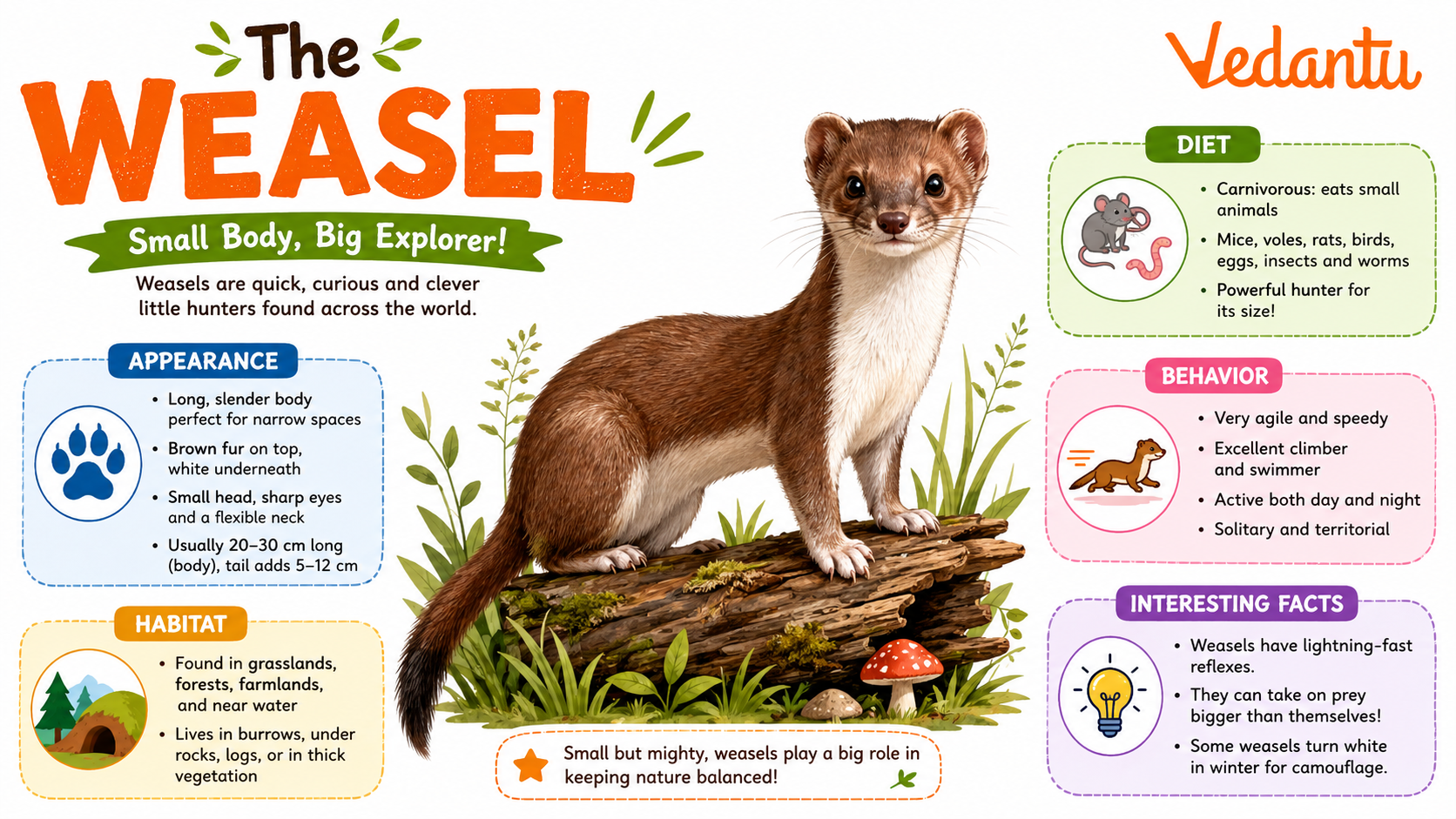
- Long, slim body with short legs.
- Small head, round ears, and sharp teeth.
- Brown fur on the back and white or pale underside.
- Some species turn white in winter (for camouflage).
- Long tail, sometimes with a black tip.
Weasel Habitat and Distribution
- Found in North America, Europe, Asia, and parts of North Africa.
- Prefer forests, grasslands, hedgerows, and farmlands.
- Often live near areas with plenty of rodents.
- Use burrows made by other animals for shelter.
Weasel Diet and Feeding Habits
- Strict carnivores (meat-eaters).
- Eat mice, rats, voles, rabbits, birds, and eggs.
- Hunt using speed, surprise, and sharp teeth.
- Bite the neck of their prey to kill quickly.
Behaviour and Lifestyle
- Mostly solitary animals.
- Very active and energetic.
- Can be active during day or night.
- Highly territorial and fearless.
- Use scent glands to mark their territory.
Weasel Life Cycle
- Mating: Usually in spring or summer.
- Gestation: About 1 month (varies by species).
- Birth: Females give birth to 3–10 kits.
- Young Ones: Kits are born blind and helpless.
- Growth: They open eyes after about 3 weeks.
- Independence: Young weasels start hunting at a few months old.
What Makes the Weasel Special?
Can twist and turn easily inside tunnels.
Excellent eyesight, smell, and quick reflexes.
Some species turn white in winter.
Known for attacking prey larger than itself.
Importance and Role in Nature
Amazing Weasel Facts
- Weasels have very fast metabolisms and need to eat often.
- They can move in a bouncing, zig-zag pattern.
- The smallest weasel species is one of the smallest carnivores in the world.
- They store extra food in burrows for later.
- Weasels are closely related to ferrets and stoats.
- Their bodies are built perfectly for chasing prey underground.
Fun Facts for Kids
FAQs on Weasel: Complete Guide to This Small, Clever Predator
1. What is a weasel?
A weasel is a small, fast, and clever carnivorous mammal known for its long body and hunting skills.
- Belongs to the Mustelidae family (same family as ferrets, otters, and minks)
- Has a slim body, short legs, and a pointed snout
- Covered in brown, white, or reddish fur
- Famous for being quiet and quick hunters
2. Where do weasels live?
Weasels live in many parts of the world, especially in forests, grasslands, and farms.
- Found in North America, Europe, Asia, and parts of Africa
- Prefer woodlands, fields, and meadows
- Often hide in burrows, hollow logs, or rock piles
- Can live near farms to hunt rodents
3. What do weasels eat?
Weasels are meat-eaters that hunt small animals for food.
- Eat mice, rats, and other rodents
- Hunt rabbits, small birds, and eggs
- Sometimes eat insects and frogs
- Use sharp teeth and quick moves to catch prey
4. Are weasels dangerous to humans?
Weasels are generally not dangerous to humans and usually avoid people.
- They are shy and prefer to run away
- May bite only if trapped or scared
- Rarely attack humans
- More interested in hunting small animals
5. How big is a weasel?
A weasel is a small animal with a long, thin body.
- Usually 6 to 12 inches (15–30 cm) long
- Tail adds another 2 to 5 inches
- Weighs about 1 to 9 ounces
- Males are usually bigger than females
6. What is the difference between a weasel and a ferret?
The main difference between a weasel and a ferret is that ferrets are domesticated while weasels are wild animals.
- Weasels live in the wild; ferrets are often kept as pets
- Ferrets are usually larger and calmer
- Weasels are more aggressive hunters
- Both belong to the Mustelidae family
7. Do weasels change color in winter?
Some weasels change fur color in winter to blend in with snow.
- Turn from brown to white fur in cold climates
- This helps with camouflage
- The white winter coat is sometimes called an ermine
- Not all species change color
8. How long do weasels live?
Weasels usually live a short life compared to many animals.
- In the wild, they live about 1 to 3 years
- Some may live up to 5 years
- Face dangers from predators like hawks and foxes
- Also threatened by habitat loss
9. What animals hunt weasels?
Weasels have several natural predators in the wild.
- Hawks and owls
- Foxes and coyotes
- Large snakes
- Domestic dogs and cats in some areas
10. Why are weasels important to the ecosystem?
Weasels play an important role in keeping nature balanced.
- Control populations of mice and rats
- Help farmers by reducing crop pests
- Serve as prey for larger animals
- Support a healthy food chain
