






Vine Snake Habitat, Diet, Venom, and Unique Hunting Adaptations
The Vine Snake is one of nature’s best camouflaged reptiles. With its long, slender body and leaf-like appearance, it blends perfectly with branches and vines. Found mainly in forests and gardens, this snake is known for its sharp vision and quick hunting skills. In this page, explore interesting Vine Snake facts, its habitat, diet, characteristics, life cycle, and why it plays an important role in nature.
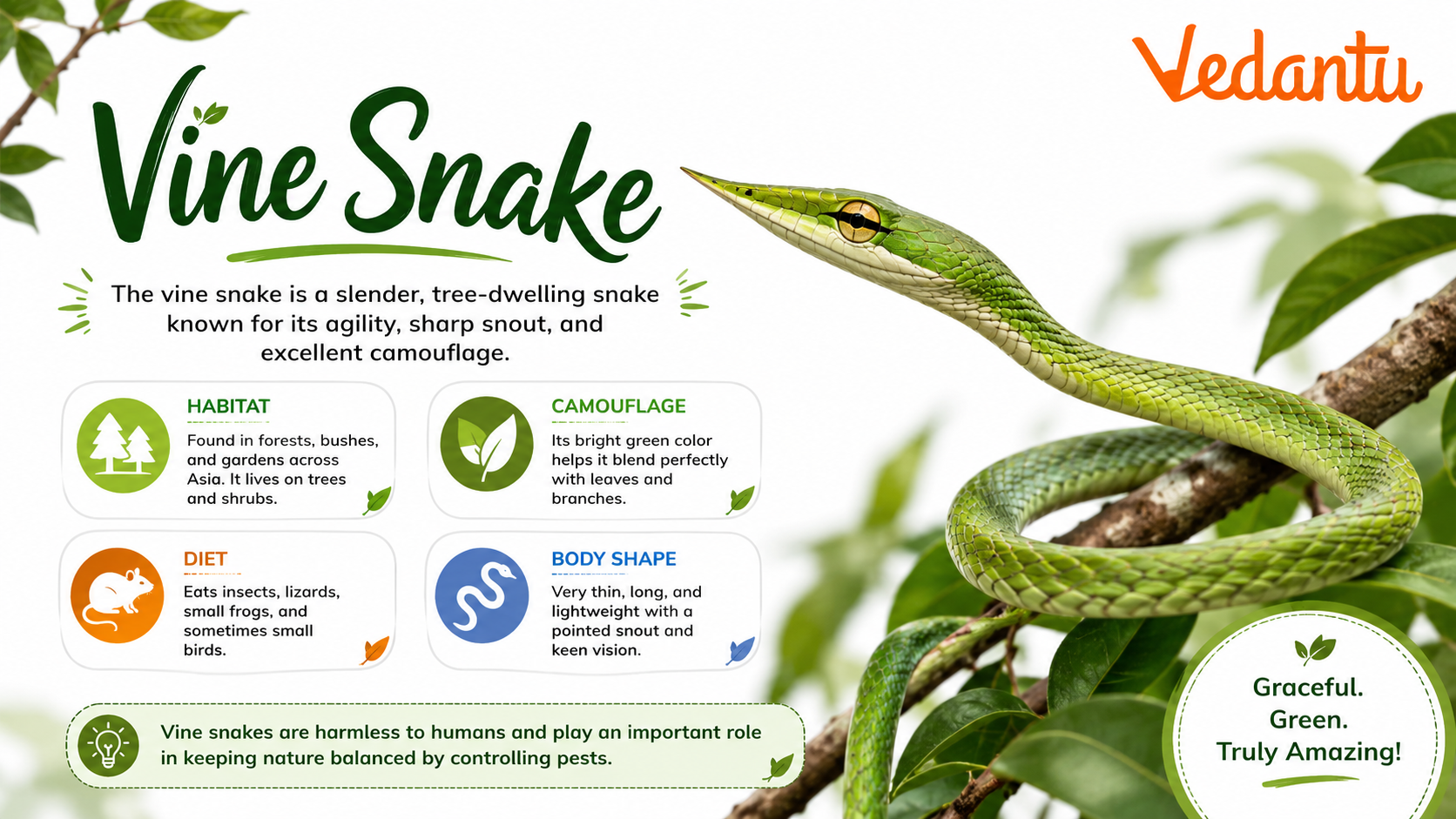
Quick Facts About Vine Snake
| Feature | Details |
|---|---|
| Common Name | Vine Snake |
| Scientific Name | Ahaetulla species |
| Animal Group | Reptile |
| Length | 1–2 meters |
| Habitat | Forests, gardens, shrubs, trees |
| Diet | Lizards, frogs, small birds |
| Activity | Mostly diurnal (active during day) |
| Conservation Status | Least Concern (in most regions) |
Appearance and Physical Characteristics
- Very thin and long body, looks like a green vine.
- Usually bright green, but can also be brown or grey.
- Pointed snout and large sharp eyes.
- Horizontal, keyhole-shaped pupils.
- Scaly, smooth skin that helps it glide through branches.
Vine Snake Habitat and Distribution
- Found mainly in South and Southeast Asia.
- Common in India, Sri Lanka, Thailand, and nearby countries.
- Lives in forests, bushes, gardens, and plantations.
- Prefers warm and tropical climates.
- Spends most of its time on trees and shrubs.
Diet and Feeding Habits
- Carnivorous reptile.
- Eats small lizards, frogs, and sometimes birds.
- Uses excellent eyesight to locate prey.
- Strikes quickly and injects mild venom to subdue prey.
Behaviour and Lifestyle
- Mostly active during the day (diurnal).
- Moves slowly and gently to avoid attention.
- Non-aggressive unless disturbed.
- Relies on camouflage rather than speed.
- Often seen stretched straight like a twig.
Vine Snake Life Cycle
- Mating: Occurs during warmer months.
- Eggs or Live Birth: Some species lay eggs, while others give birth to live young.
- Hatchlings: Baby snakes are small but fully independent.
- Growth: They shed their skin as they grow.
- Adult Stage: Reach full size in a few years.
What Makes the Vine Snake Special?
Importance and Role in Nature
Amazing Vine Snake Facts
- Its body is so thin that it looks like a stick.
- It can remain motionless for long periods.
- It uses both eyes together to focus on prey.
- Some species change slightly in colour.
- Its venom is not deadly to humans.
- It can flatten its body when threatened.
Fun Facts for Kids
FAQs on Vine Snake: Complete Guide to This Slender Tree-Dwelling Reptile
1. What is a Vine Snake?
A Vine Snake is a long, thin tree-dwelling snake known for blending in with branches and leaves.
- Belongs to the Ahaetulla genus (Asian vine snakes)
- Also called green vine snake or whip snake
- Has a very slender body that looks like a vine
- Lives mostly in trees and bushes
- Famous for excellent camouflage and sharp eyesight
2. Where do Vine Snakes live?
Vine Snakes mainly live in warm tropical forests and wooded areas.
- Found in South and Southeast Asia
- Common in countries like India, Sri Lanka, Thailand, and Indonesia
- Prefer rainforests, gardens, and shrubs
- Spend most of their time in trees (arboreal habitat)
3. Are Vine Snakes venomous?
Yes, Vine Snakes are mildly venomous, but they are not dangerous to humans.
- Their venom helps catch small prey
- Not harmful to people in most cases
- Bites may cause mild swelling or irritation
- They are shy and rarely bite unless threatened
4. What do Vine Snakes eat?
Vine Snakes eat small animals that live in trees and bushes.
- Feed on lizards and geckos
- Also eat frogs and small birds
- Use sharp eyesight to spot moving prey
- Strike quickly to catch their food
5. How long can a Vine Snake grow?
A fully grown Vine Snake can reach up to 6 feet (about 1.8 meters) in length.
- Body is extremely thin compared to its length
- Looks longer because of its slender shape
- Helps them move easily through branches
6. What color is a Vine Snake?
Most Vine Snakes are bright green, which helps them hide in trees.
- Common color: bright green
- Some species may be brown or yellowish
- Green color provides perfect camouflage
- Blends in with leaves and vines
7. How does a Vine Snake protect itself?
A Vine Snake protects itself by using camouflage and warning displays.
- Stays very still to look like a vine
- Expands its neck to show black and white patterns
- Opens mouth wide to scare predators
- Relies more on hiding than fighting
8. Are Vine Snakes dangerous to kids or pets?
Vine Snakes are generally not dangerous to kids or pets if left alone.
- They are shy and non-aggressive
- Bite only when handled or threatened
- Their venom is mild for humans and large animals
- Best to observe from a safe distance
9. Why do Vine Snakes have pointed noses?
Vine Snakes have pointed noses to help them move easily through leaves and branches.
- Sharp snout helps in hunting prey
- Improves their aerodynamic shape
- Makes them look more like a twig or vine
- Enhances their camouflage in nature
10. What makes Vine Snakes unique?
Vine Snakes are unique because of their slim bodies, sharp vision, and tree-living lifestyle.
- Extremely slender body shape
- Large eyes with horizontal pupils
- Excellent arboreal climbers
- Masters of camouflage in tropical forests
