






Where Do Urials Live and What Makes This Wild Sheep Unique?
The Urial is a wild sheep known for its strong body, beautiful curved horns, and amazing climbing skills. Found in rocky mountains and dry grasslands, this animal is perfectly adapted to tough landscapes. Urial facts are fascinating for students because they show how animals survive in extreme habitats. Let’s explore the Urial habitat, diet, characteristics, life cycle, and why this wild sheep is important in nature.
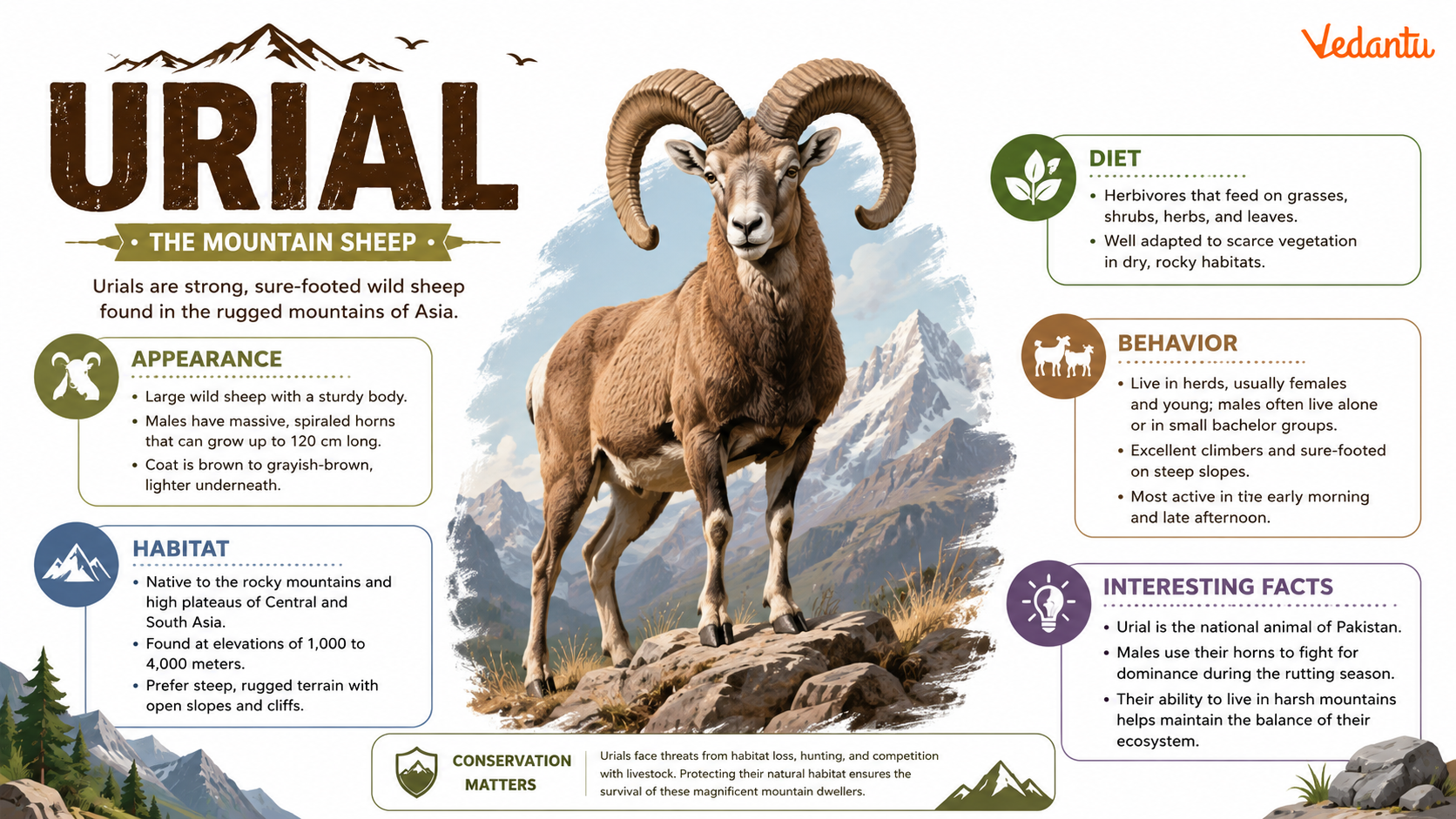
Quick Facts About Urial
| Feature | Details |
|---|---|
| Common Name | Urial |
| Scientific Name | Ovis vignei |
| Animal Group | Mammal |
| Type | Wild Sheep |
| Height | About 80–90 cm at shoulder |
| Weight | Male: 50–90 kg | Female: 30–50 kg |
| Lifespan | 8–13 years in the wild |
| Habitat | Rocky hills, grasslands, and dry mountains |
| Diet | Grasses, shrubs, herbs |
| Conservation Status | Vulnerable |
| Found In | India, Pakistan, Iran, Afghanistan |
Appearance and Physical Characteristics
- Strong and muscular body built for climbing.
- Short brown or reddish coat with lighter underparts.
- Males have long, thick, curved horns.
- Females have smaller and thinner horns.
- White patch on the throat and chest in males.
Urial Habitat and Distribution
- Lives in dry grasslands and rocky mountain slopes.
- Prefers open areas where it can see predators easily.
- Found in South and Central Asia.
- In India, mainly found in Ladakh and parts of Jammu & Kashmir.
Diet and Feeding Habits
- Urial diet mainly includes grasses and small plants.
- Also eats shrubs, herbs, and leaves.
- It is a herbivore.
- Grazes mostly in the early morning and late evening.
Behaviour and Lifestyle
- Usually active during the day (diurnal).
- Females and young live in small herds.
- Adult males may live alone or form bachelor groups.
- Very alert and quick to run when danger appears.
- Strong legs help them climb steep rocky slopes easily.
Urial Life Cycle
- Mating Season: Usually in winter. Males fight using their horns.
- Pregnancy: Lasts about 5 months.
- Birth: Females give birth to 1 lamb (sometimes twins).
- Young Stage: Lambs can stand and walk shortly after birth.
- Adult Stage: Become fully grown in 2–3 years.
What Makes the Urial Special?
Importance and Role in Nature
Amazing Urial Facts
- Male Urials clash horns during the breeding season.
- Their horns grow throughout their life.
- They can run quickly on steep slopes.
- Urials are one of the smallest wild sheep species.
- They prefer open land instead of dense forests.
- Their coat becomes thicker during winter.
- They rely on speed and height to escape predators.
Interesting Facts About Urial
Fun Facts for Kids
- Baby Urials are called lambs.
- They can stand within minutes of birth.
- Their curved horns look like big spirals.
- They love living on rocky hills.
- They are super fast runners!
FAQs on Urial (Ovis vignei): Habitat, Diet, and Unique Traits
1. What is a Urial?
A Urial is a wild sheep species that lives in the mountains and grasslands of Central and South Asia.
- The scientific name of Urial is Ovis vignei.
- It is also called the arkar or shapo.
- It belongs to the wild sheep group in the animal kingdom.
- Urials are known for their strong legs and curved horns.
2. Where do Urials live?
Urials live in dry mountains, hills, and grassy areas of Asia.
- They are found in India, Pakistan, Iran, and Central Asia.
- They prefer rocky slopes and open grasslands.
- Urials avoid thick forests and very cold snowy regions.
3. What do Urials eat?
Urials are herbivores, which means they only eat plants.
- They eat grass, shrubs, and leaves.
- In dry seasons, they feed on herbs and small bushes.
- They graze mostly during early morning and evening.
4. What do Urials look like?
Urials are medium-sized wild sheep with strong bodies and curved horns.
- Males have large, curled horns.
- Their fur is usually reddish-brown or light brown.
- They have a lighter-colored belly and legs.
- Males often have a short neck mane.
5. How big can a Urial grow?
A full-grown Urial is about the size of a small goat.
- Height: Around 80–90 cm at the shoulder.
- Weight: Between 35–90 kg, depending on gender.
- Males are usually larger and heavier than females.
6. Are Urials endangered?
Yes, Urials are considered vulnerable due to population decline.
- Their conservation status is Vulnerable on the IUCN Red List.
- Main threats include habitat loss and hunting.
- Conservation programs help protect wild sheep populations.
7. How are Urials different from other wild sheep?
Urials are smaller and have unique horn shapes compared to other wild sheep species.
- Their horns are more open and curved than those of argali sheep.
- They live in lower hills compared to some mountain sheep.
- They are closely related to mouflon and argali.
8. What are the predators of Urials?
Urials have natural predators that hunt them in the wild.
- Main predators include wolves, leopards, and snow leopards.
- Young lambs are more at risk from wild animals.
- They use their speed and rocky habitats to escape danger.
9. How do Urials protect themselves?
Urials protect themselves by living in groups and staying alert.
- They form small herds for safety.
- They have excellent vision to spot predators.
- They quickly run up steep rocky slopes to escape.
10. Why are Urials important to the ecosystem?
Urials play an important role in keeping mountain ecosystems balanced.
- They help control plant growth by grazing.
- They serve as prey for large predators like leopards.
- Their presence shows a healthy grassland ecosystem.
