






Where Do Uakari Monkeys Live, What Do They Eat, and Why Are They Endangered?
The Uakari is one of the most unusual and eye-catching monkeys in the world. Famous for its bright red face and short tail, this monkey lives deep inside the Amazon rainforest. Uakaris are social, active, and perfectly adapted to life in flooded forests. In this page, explore interesting Uakari facts, learn about its habitat, diet, characteristics, life cycle, and discover what makes this monkey truly special.
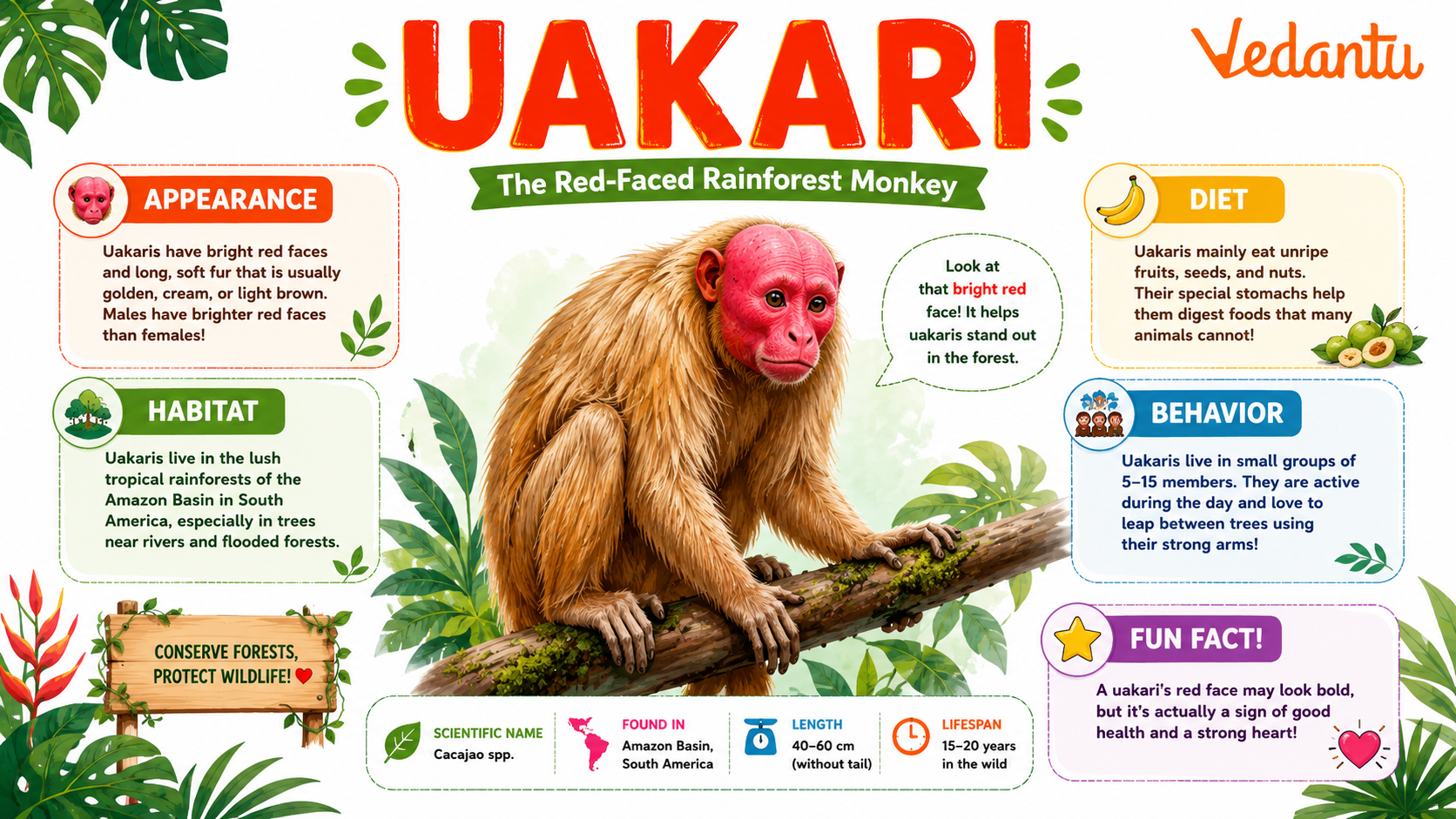
Quick Facts and Statistics
| Feature | Details |
|---|---|
| Common Name | Uakari |
| Scientific Name | Cacajao |
| Animal Group | Mammal (Primate) |
| Size | 40–45 cm (body length) |
| Weight | 2.5–3.5 kg |
| Lifespan | Up to 20 years (in the wild) |
| Habitat | Flooded Amazon rainforest |
| Diet | Mainly fruits and seeds |
| Conservation Status | Vulnerable (some species) |
Appearance and Physical Characteristics
- Bright red face: Hairless and colourful, especially in healthy adults.
- Short tail: Unlike many monkeys, Uakaris have a very short tail.
- Thick fur: Long, shaggy coat covering the body.
- Strong jaws: Specially adapted to crack hard seeds.
- Compact body: Medium-sized and well-built for tree climbing.
Habitat and Distribution
The Uakari habitat is mainly found in the Amazon Basin of South America.
- Countries: Brazil, Peru, and Colombia
- Lives in flooded forests called várzea forests
- Prefers areas near rivers and swampy lands
- Spends most of its life high up in trees
These monkeys are specially adapted to survive in areas that are flooded for many months every year.
Diet and Feeding Habits
Uakari diet: Mostly frugivorous (fruit-eating), but they also eat seeds and insects.
- Unripe fruits
- Hard seeds
- Nuts
- Occasionally insects
Their powerful jaws and strong teeth help them break open tough seeds that other monkeys cannot eat. This reduces competition for food.
Behaviour and Lifestyle
Uakaris live in large groups that may include 10 to 100 members.
They are diurnal, meaning they are active in the daytime.
They move quickly by jumping and climbing between branches.
Use calls, facial expressions, and body movements.
Life Cycle and Reproduction
- Birth: Female usually gives birth to one baby.
- Infant Stage: Baby clings to its mother for safety.
- Juvenile Stage: Learns climbing and feeding skills.
- Adult Stage: Becomes fully independent and joins group activities.
The Uakari life cycle shows strong maternal care, with mothers protecting and feeding their young for many months.
What Makes the Uakari Special?
Importance and Role in Nature
- Seed Dispersal: Helps spread seeds across the forest.
- Forest Health: Supports plant growth and biodiversity.
- Food Chain Role: Acts as prey for large predators.
Amazing Uakari Facts
Fun Facts for Kids
- The Uakari looks like it is always blushing!
- It has one of the shortest tails among monkeys.
- It loves crunchy seeds.
- It spends most of its time jumping in trees.
- Its face becomes paler if it gets sick.
FAQs on Uakari Monkey: Fascinating Facts About This Red-Faced Amazon Primate
1. What is a Uakari?
A Uakari is a small monkey known for its bright red face and short tail, living in the Amazon rainforest.
- It belongs to the New World monkey family.
- Famous for its red face and bald head.
- Lives mostly in the Amazon Basin of South America.
- Spends most of its time in trees (arboreal animal).
2. Why does the Uakari have a red face?
The red face of a Uakari shows that it is healthy and strong.
- The bright red color comes from blood vessels under the skin.
- A healthy Uakari has a brighter red face.
- Pale faces can mean sickness like malaria.
- The red face helps in mate selection and social signals.
3. Where do Uakari monkeys live?
Uakari monkeys live in the flooded forests of the Amazon rainforest in South America.
- Found in Brazil, Peru, and Colombia.
- Prefer river edges and swampy forests.
- Adapted to seasonal flooding areas.
- Live high in the forest canopy for safety.
4. What do Uakari monkeys eat?
Uakari monkeys mainly eat hard fruits and seeds found in the rainforest.
- Strong teeth help crack hard nuts and seeds.
- Also eat fruits, leaves, and insects.
- Sometimes feed on small animals.
- Their diet helps spread forest seeds.
5. How big is a Uakari monkey?
A Uakari is a medium-sized monkey with a short tail and sturdy body.
- Body length: about 40–45 cm.
- Weight: around 3–4 kg.
- Has a very short tail compared to other monkeys.
- Covered in thick, shaggy fur.
6. Are Uakari monkeys endangered?
Some species of Uakari are considered Vulnerable or Endangered due to habitat loss.
- Main threat is deforestation in the Amazon.
- Hunted in some areas for food.
- Climate change affects flooded forests.
- Protected in some wildlife reserves.
7. How do Uakari monkeys behave in groups?
Uakari monkeys are social animals that live in large groups.
- Groups can have 10 to 100 members.
- Communicate with sounds and facial expressions.
- Work together to find food.
- Stay in groups for protection from predators.
8. What predators hunt Uakari monkeys?
Uakari monkeys must watch out for predators in the rainforest.
- Hunted by eagles and large birds of prey.
- Threatened by jaguars and wild cats.
- Snakes may attack young monkeys.
- Humans are also a major threat.
9. How long do Uakari monkeys live?
Uakari monkeys can live for many years, especially in safe environments.
- Live about 15–20 years in the wild.
- May live longer in zoos or protected areas.
- Life span depends on food and safety.
- Young monkeys stay close to their mothers.
10. What makes the Uakari different from other monkeys?
The Uakari stands out because of its red face and very short tail.
- Unlike many monkeys, it has a bald, bright red face.
- Its short tail is unusual for tree-dwelling monkeys.
- Specialized teeth for hard seed eating.
- Lives in unique flooded Amazon forests.
