






What Makes the Tuatara a Living Fossil? Habitat, Lifespan, and Unique Features
The Tuatara is one of the most unique reptiles on Earth. Although it looks like a lizard, it is not a true lizard at all! It belongs to a very ancient group of reptiles that lived during the time of dinosaurs. Found only in New Zealand, the Tuatara is often called a “living fossil” because it has changed very little over millions of years. Let’s explore amazing Tuatara facts, habitat, diet, life cycle, and special characteristics.
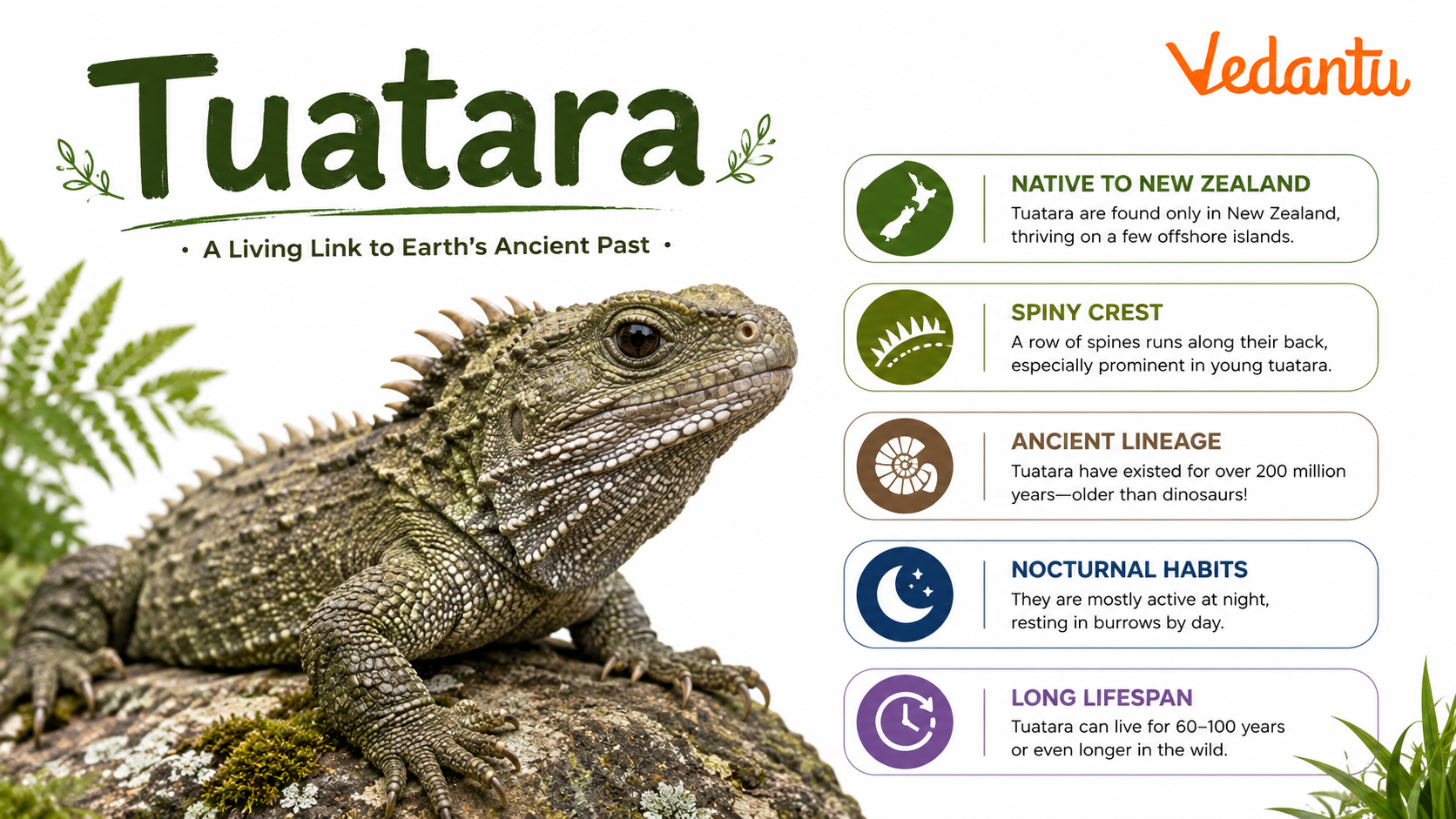
Quick Facts About Tuatara
| Feature | Details |
|---|---|
| Common Name | Tuatara |
| Scientific Name | Sphenodon punctatus |
| Animal Group | Reptile |
| Average Length | 50–75 cm |
| Weight | Up to 1.5 kg |
| Lifespan | 60–100+ years |
| Habitat | Rocky islands, coastal forests |
| Diet | Insects, birds, eggs, small animals |
| Conservation Status | Vulnerable |
Appearance and Physical Characteristics
- Looks similar to a lizard but belongs to a different reptile group.
- Has rough, scaly skin in grey, olive, or brown colours.
- Features a spiny crest along its back, especially in males.
- Has a strong tail used for balance and defence.
- Possesses sharp teeth fused to the jawbone.
Tuatara Habitat and Distribution
- Found only in New Zealand.
- Lives mainly on small offshore islands.
- Prefers cool, coastal forests and rocky areas.
- Often shares burrows with seabirds.
Diet and Feeding Habits
The Tuatara diet mainly includes small animals. It is a carnivore and hunts mostly at night.
- Insects and spiders
- Worms and snails
- Small lizards
- Bird eggs and chicks
Behaviour and Lifestyle
- Mostly nocturnal (active at night).
- Solitary and territorial.
- Slow-moving but alert hunters.
- Can live in the same burrow for many years.
Tuataras grow slowly and take many years to reach adulthood. They are known for their calm but defensive behaviour when threatened.
Tuatara Life Cycle
- Egg Stage: Females lay 6–10 eggs in soil burrows.
- Incubation: Eggs take 12–15 months to hatch – one of the longest incubation periods among reptiles.
- Hatchling: Baby tuataras are independent from birth.
- Juvenile Stage: Grow very slowly over many years.
- Adult Stage: Reach maturity at about 10–20 years.
What Makes Tuatara Special?
Importance and Role in Nature
Amazing Tuatara Facts
- Tuatara means “peaks on the back” in the Māori language.
- They survived the extinction of dinosaurs.
- Their brain and heart are considered very primitive.
- They can regrow lost tails.
- They have two rows of teeth in the upper jaw and one in the lower jaw.
- They breathe very slowly, sometimes once per hour when resting.
Fun Facts for Kids
FAQs on Tuatara: The Ancient Reptile That Outlived Dinosaurs
1. What is a Tuatara?
A Tuatara is a rare reptile from New Zealand that looks like a lizard but belongs to its own unique group.
- It is often called a “living fossil”
- Belongs to the reptile order Sphenodontia
- Has existed for over 200 million years
- Is not a lizard, even though it looks like one
2. Where do Tuataras live?
The Tuatara habitat is mostly small offshore islands of New Zealand.
- Lives in cool coastal forests
- Often stays in burrows
- Shares burrows with seabirds
- Protected in wildlife reserves and sanctuaries
3. Why is the Tuatara called a living fossil?
The Tuatara is called a living fossil because it has changed very little since the age of the dinosaurs.
- Ancestors lived during the Dinosaur Era
- Body structure stayed almost the same for millions of years
- It is the last surviving member of its reptile group
4. What does a Tuatara eat?
The Tuatara diet includes insects and small animals.
- Eats insects, spiders, and worms
- May eat small birds and eggs
- Sometimes eats lizards and frogs
- Hunts mostly at night (nocturnal hunter)
5. How long do Tuataras live?
A Tuatara lifespan is very long compared to most reptiles.
- Can live over 100 years
- Some may reach 120 years or more
- Grows slowly throughout its life
- Takes many years to become an adult
6. Do Tuataras have a third eye?
Yes, the Tuatara has a special feature called a third eye on top of its head.
- Also called the parietal eye
- Can sense light and dark
- Covered by scales as it grows older
- Helps control body temperature and daily cycles
7. Are Tuataras endangered?
The Tuatara is a protected species and was once endangered due to predators.
- Threatened by rats and other introduced animals
- Habitat loss reduced their numbers
- Now protected by New Zealand conservation laws
- Breeding programs help increase the population
8. How are Tuataras different from lizards?
Although they look alike, Tuatara vs lizard differences are important.
- Tuatara belong to Sphenodontia, not Squamata (lizards and snakes)
- Have a unique skull structure
- Have two rows of teeth on the upper jaw
- Possess a visible third eye
9. How do Tuataras reproduce?
The Tuatara reproduction process is slow and unusual.
- Females lay eggs every 2–5 years
- Eggs take about 12–15 months to hatch
- Temperature decides the baby’s sex
- Young tuataras grow very slowly
10. Why are Tuataras important to New Zealand?
The Tuatara is an important symbol of New Zealand wildlife and natural history.
- Represents ancient reptile evolution
- Important in Māori culture
- Helps scientists study dinosaurs and early reptiles
- Protected as a national treasure
