






Why the Tsetse Fly Is Dangerous: Sleeping Sickness and Its Impact
The Tsetse Fly is a small but powerful insect found mainly in Africa. Though it looks like an ordinary fly, it is famous for spreading a serious disease called sleeping sickness in humans and animals. Learning about Tsetse Fly facts, Tsetse Fly habitat, diet, characteristics, and life cycle helps us understand why this insect is important in science and health studies.
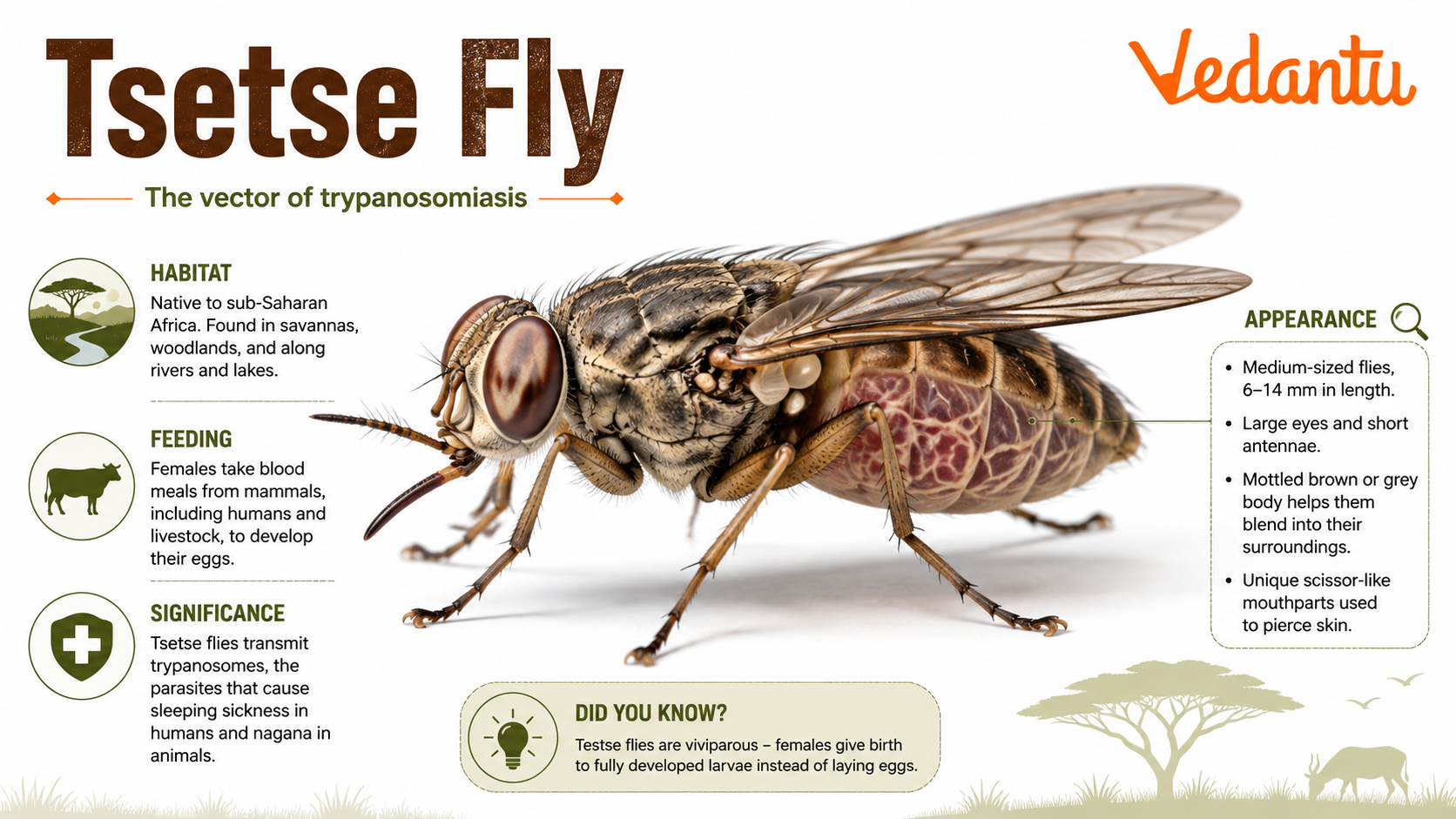
Quick Facts About Tsetse Fly
| Feature | Details |
|---|---|
| Common Name | Tsetse Fly |
| Scientific Name | Glossina |
| Animal Group | Insect |
| Size | 6–14 mm long |
| Lifespan | 1–4 months |
| Habitat | Grasslands, forests, riverbanks in Africa |
| Diet | Blood of mammals |
| Special Feature | Spreads sleeping sickness |
Appearance and Physical Characteristics
- Medium-sized fly, bigger than a housefly.
- Brown or grey body with a long pointed mouthpart (proboscis).
- Wings fold neatly one over the other when resting.
- Distinct hatchet-shaped cell in the wing pattern.
- Strong, sharp mouth used for piercing skin and sucking blood.
Tsetse Fly Habitat and Distribution
- Found only in sub-Saharan Africa.
- Lives near rivers, lakes, forests, and savannas.
- Prefers warm and humid climates.
- Often hides in bushes or shaded vegetation.
The Tsetse Fly habitat is closely linked to animals because it depends on mammals for blood meals. Areas with wild animals or livestock are common locations.
Diet and Feeding Habits
Carnivorous (blood-feeding insect).
Blood of humans, cattle, antelopes, and other mammals.
Uses its sharp proboscis to pierce skin and suck blood.
Blood provides proteins and nutrients for survival and reproduction.
Behaviour and Lifestyle
- Active mainly during the daytime.
- Attracted to movement and dark colours.
- Strong fliers and can travel long distances.
- Rest on vegetation between meals.
- Both males and females bite repeatedly.
Tsetse Fly Life Cycle
- Mating: Male and female mate once in their lifetime.
- Larva Development: Female carries a single larva inside her body.
- Birth: Female gives birth to a fully developed larva.
- Pupa Stage: Larva buries into soil and forms a hard pupal case.
- Adult Fly: Adult emerges after about 3–4 weeks.
The Tsetse Fly life cycle is unusual because it does not lay many eggs like other flies. Instead, it produces one larva at a time.
What Makes the Tsetse Fly Special?
Spreads African sleeping sickness in humans.
Gives birth to live larvae instead of laying eggs.
Detects animals from a distance.
Specially adapted for piercing skin.
Importance and Role in Nature
- Part of the food chain – eaten by birds and reptiles.
- Helps scientists study disease control and insect biology.
- Influences livestock farming and human settlement in Africa.
Amazing Tsetse Fly Facts
- There are about 30 different species of Tsetse Flies.
- They can live up to four months in the wild.
- They are most active during warm daylight hours.
- Their bite can be painful.
- They are attracted to blue and black colours.
- They rely only on blood throughout their life.
Fun Facts for Kids
FAQs on Tsetse Fly: Complete Guide to Habitat, Diet, and Diseases
1. What is a Tsetse Fly?
A Tsetse Fly is a large biting fly found in Africa that feeds on blood and can spread serious diseases.
- Belongs to the genus Glossina
- Lives mainly in sub-Saharan Africa
- Feeds on the blood of humans and animals
- Known for spreading African sleeping sickness
- Looks similar to a housefly but slightly bigger
2. Where do Tsetse Flies live?
Tsetse flies live mostly in warm parts of Africa near forests and grasslands.
- Found in sub-Saharan Africa
- Prefer savannas, woodlands, and riverbanks
- Avoid very dry deserts and cold mountains
- Common in countries like Kenya, Tanzania, and Uganda
3. Why are Tsetse Flies dangerous?
Tsetse flies are dangerous because they spread diseases to humans and animals through their bite.
- Transmit African Trypanosomiasis (Sleeping Sickness)
- Spread Nagana disease in cattle
- Cause fever, weakness, and brain problems
- Can be deadly if not treated
4. What is African Sleeping Sickness?
African Sleeping Sickness is a serious disease caused by parasites spread by the tsetse fly.
- Also called Human African Trypanosomiasis (HAT)
- Caused by Trypanosoma parasites
- Symptoms include fever, headaches, and extreme tiredness
- Can affect the brain and sleep patterns
- Needs early medical treatment
5. What do Tsetse Flies eat?
Tsetse flies feed only on blood to survive and reproduce.
- Both male and female flies bite
- Feed on humans, cows, wild animals
- Use a sharp mouthpart to pierce skin
- Need blood meals for energy and reproduction
6. How can you identify a Tsetse Fly?
You can identify a tsetse fly by its size, folded wings, and long biting mouthpart.
- About the size of a housefly but sturdier
- Wings fold completely over each other
- Has a long, forward-pointing proboscis
- Often brown or gray in color
7. How do Tsetse Flies reproduce?
Tsetse flies have a unique life cycle where the female gives birth to one fully developed larva at a time.
- Female carries larva inside her body
- Feeds larva with special nutrients
- Gives birth to a single large larva
- Larva buries in soil to become a pupa
8. How can people prevent Tsetse Fly bites?
People can prevent tsetse fly bites by wearing protective clothing and avoiding risky areas.
- Wear long-sleeved clothes in neutral colors
- Avoid thick bushes and riverbanks
- Use insect repellents (though they are less effective)
- Travel in vehicles rather than walking in infested areas
9. Are Tsetse Flies active during the day or night?
Tsetse flies are mostly active during the daytime when they search for blood meals.
- Most active in warm daylight hours
- Rest in shaded areas during extreme heat
- Less active at night
- Attracted to moving objects and dark colors
10. Why are Tsetse Flies important to the ecosystem?
Although harmful, tsetse flies play a role in Africa’s natural ecosystem.
- Serve as food for birds and other insects
- Help control overgrazing by limiting cattle farming
- Part of the natural biodiversity of African habitats
- Studied by scientists to understand parasite diseases
