






What Do Swallowtail Butterflies Eat and Where Do They Live?
The Swallowtail Butterfly is one of the most beautiful and eye-catching butterflies in the world. Known for its bright colours and long “tail-like” extensions on its wings, it looks like a tiny flying painting. These butterflies are not just pretty to see, but also very important pollinators. Learning about Swallowtail Butterfly facts, habitat, diet, characteristics, and life cycle helps us understand their role in nature.
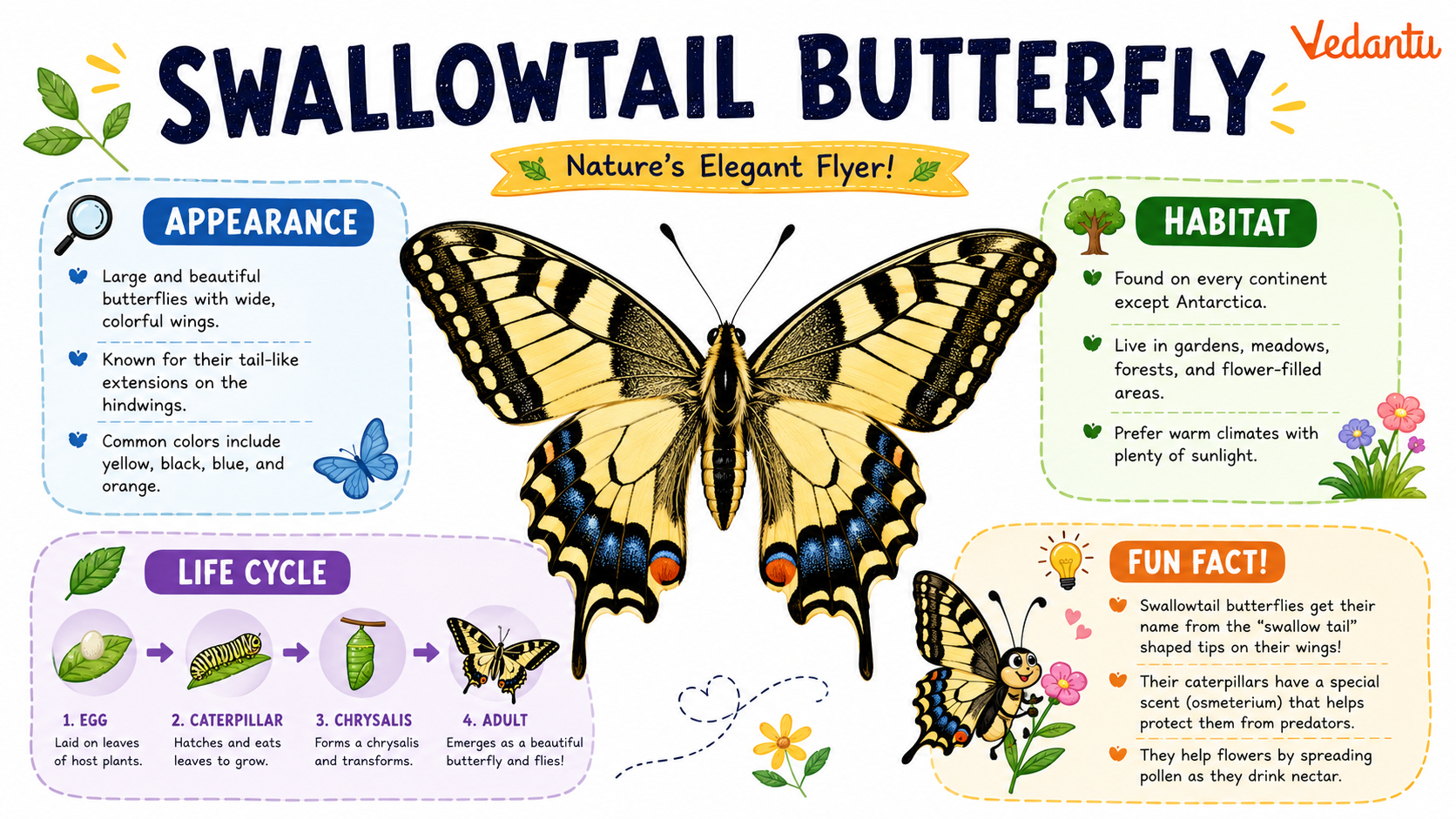
Quick Facts About Swallowtail Butterfly
| Feature | Details |
|---|---|
| Common Name | Swallowtail Butterfly |
| Scientific Family | Papilionidae |
| Animal Group | Insect |
| Wingspan | 7–15 cm (varies by species) |
| Diet | Nectar (adult), leaves (caterpillar) |
| Habitat | Gardens, forests, meadows, grasslands |
| Lifespan | 2–4 weeks (adult stage) |
| Special Feature | Tail-like extensions on hind wings |
Appearance and Physical Characteristics
- Large and colourful wings with yellow, black, blue, or red patterns.
- Long “tails” on the hind wings that look like a swallow bird’s tail.
- Six legs and two long antennae.
- Lightweight body covered with tiny scales.
- Compound eyes for wide-angle vision.
Habitat and Distribution
- Found in Asia, Europe, North America, Africa, and Australia.
- Lives in forests, gardens, parks, and grasslands.
- Prefers sunny and warm climates.
- Lays eggs on specific host plants like citrus, parsley, and milkweed.
Diet and Feeding Habits
Adult Swallowtail Butterflies feed on flower nectar using their long tube-like tongue called a proboscis.
The caterpillar eats leaves of host plants and grows quickly before forming a chrysalis.
While drinking nectar, they help in pollination.
They are eaten by birds, spiders, and small animals.
Behaviour and Lifestyle
- Active during the day (diurnal).
- Strong and graceful fliers.
- Males often patrol areas to find females.
- Rest with wings open or slightly closed.
- Some species migrate short distances.
Life Cycle of Swallowtail Butterfly
- Egg: Laid on leaves of host plants.
- Caterpillar (Larva): Eats leaves and grows rapidly.
- Chrysalis (Pupa): Transformation stage inside a protective case.
- Adult Butterfly: Emerges with colourful wings.
What Makes Swallowtail Butterfly Special?
Flight Adaptations
- Large wings for powerful and steady flight.
- Lightweight body helps them glide easily.
- Wing scales create bright colours and patterns.
- Strong flight muscles allow quick escape from danger.
Importance and Role in Nature
Amazing Swallowtail Butterfly Facts
- There are over 550 species of Swallowtail Butterflies.
- Some species are among the largest butterflies in the world.
- Caterpillars can look like bird droppings for camouflage.
- Their tails can break off to escape predators.
- They taste with their feet!
- Different species have different colour patterns.
Fun Facts for Kids
FAQs on Swallowtail Butterfly: Identification, Habitat, and Life Cycle Explained
1. What is a Swallowtail Butterfly?
A Swallowtail Butterfly is a large, colorful butterfly known for its tail-like wing extensions.
- Belongs to the family Papilionidae
- Has long “tails” on the hind wings that look like a swallow bird’s tail
- Found in gardens, forests, and meadows around the world
- Known for bright colors like yellow, black, blue, and red
2. Why is it called a Swallowtail Butterfly?
The Swallowtail Butterfly gets its name from the long tails on its back wings that look like a swallow bird’s tail.
- The tail shape resembles forked bird tails
- These tails may help confuse predators
- Not all species have long tails, but most do
3. Where do Swallowtail Butterflies live?
Swallowtail butterflies live in many parts of the world, especially in warm and sunny areas.
- Found in North America, Europe, Asia, Africa, and Australia
- Prefer gardens, forests, grasslands, and meadows
- Often seen near flowers and host plants
4. What do Swallowtail Butterflies eat?
Swallowtail butterflies drink sweet nectar from flowers as their main food source.
- Adults feed on flower nectar
- Caterpillars eat leaves of host plants like parsley, dill, fennel, and citrus
- Use a long tongue called a proboscis to sip nectar
5. What is the life cycle of a Swallowtail Butterfly?
The Swallowtail Butterfly life cycle has four main stages called complete metamorphosis.
- Egg – laid on host plants
- Caterpillar (larva) – eats leaves and grows fast
- Chrysalis (pupa) – transforms inside a protective case
- Adult butterfly – emerges with wings
6. How big is a Swallowtail Butterfly?
Swallowtail butterflies are among the largest butterflies in the world.
- Wingspan ranges from 3 to 7 inches depending on the species
- The Giant Swallowtail is one of the biggest in North America
- Females are sometimes larger than males
7. Are Swallowtail Butterflies dangerous?
Swallowtail butterflies are harmless to people and do not bite or sting.
- Adults are gentle and safe to observe
- Caterpillars have a defense organ called osmeterium that releases a bad smell
- This defense scares predators but does not harm humans
8. What are common types of Swallowtail Butterflies?
There are many beautiful types of swallowtail butterflies around the world.
- Tiger Swallowtail – yellow with black stripes
- Black Swallowtail – black wings with yellow spots
- Giant Swallowtail – one of the largest species
- Pipevine Swallowtail – shiny blue-black wings
9. How do Swallowtail Butterflies protect themselves?
Swallowtail butterflies use clever tricks to stay safe from predators.
- Bright colors can warn birds that they may taste bad
- Wing tails may distract predators from vital body parts
- Caterpillars use camouflage or look like bird droppings
- Some release a smelly chemical using the osmeterium
10. How can you attract Swallowtail Butterflies to your garden?
You can attract swallowtail butterflies by planting the right flowers and host plants.
- Grow nectar plants like milkweed, zinnias, and butterfly bush
- Plant host herbs such as dill, parsley, fennel, and citrus trees
- Avoid using harmful pesticides
- Provide sunny spaces and fresh water
