






What Do Stag Beetles Eat and Where Do They Live?
The Stag Beetle is one of the most fascinating insects in the world. Famous for its large, antler-like jaws, this beetle looks like a miniature deer with armour! Found mainly in forests and gardens, the Stag Beetle plays an important role in nature. In this page, explore exciting Stag Beetle facts, its habitat, diet, characteristics, life cycle, and importance in a fun and easy way.
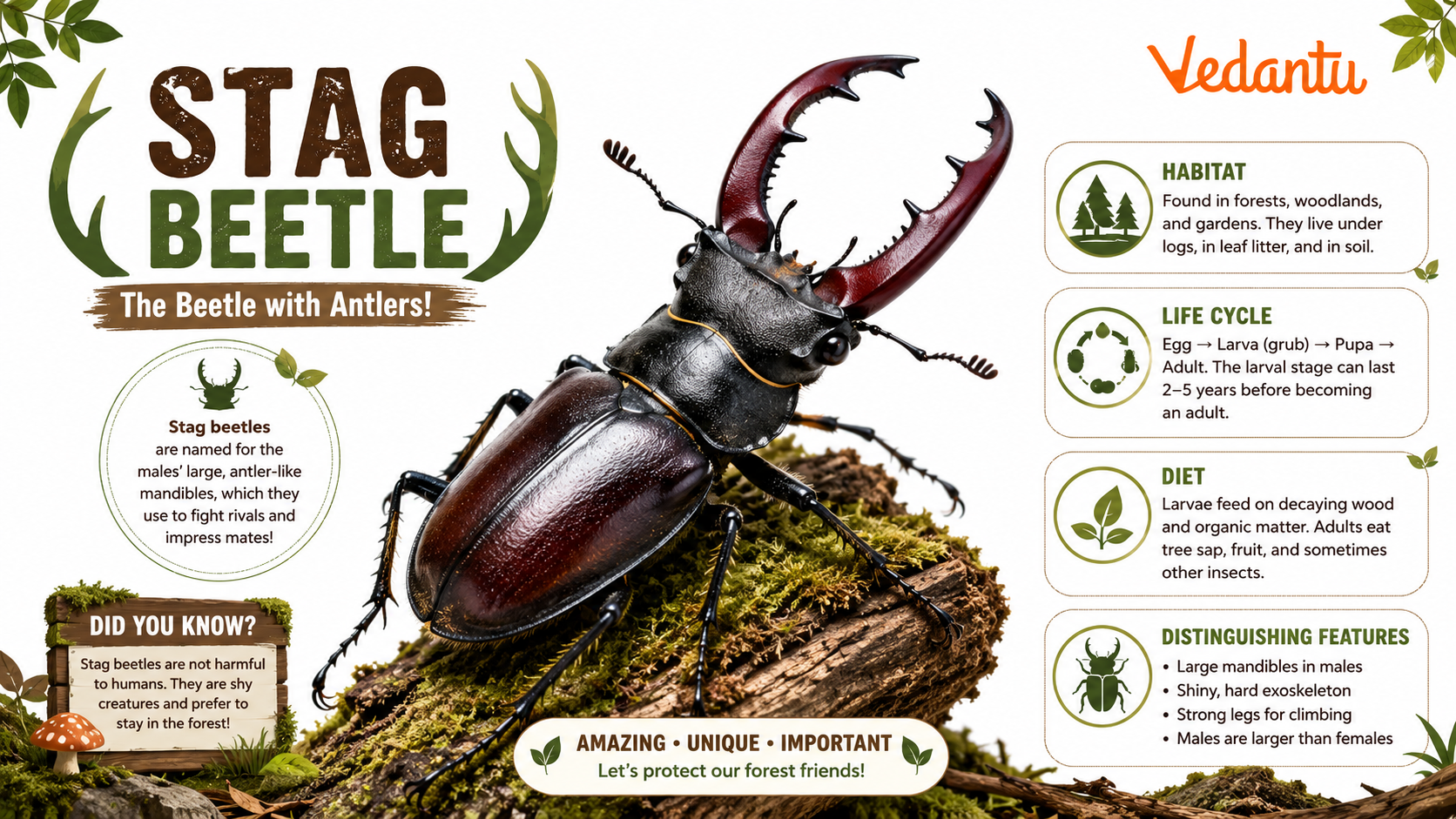
Quick Facts About Stag Beetle
| Feature | Details |
|---|---|
| Common Name | Stag Beetle |
| Scientific Name | Lucanus cervus |
| Animal Group | Insect |
| Size | Up to 8 cm (males larger than females) |
| Habitat | Woodlands, gardens, parks |
| Diet | Tree sap and decaying wood |
| Lifespan | 3–7 years (mostly as larvae) |
| Conservation Status | Near Threatened in some regions |
Appearance and Physical Characteristics
- Dark brown to shiny black body.
- Males have large, antler-like jaws called mandibles.
- Females have much smaller, stronger jaws.
- Hard outer covering called an exoskeleton.
- Six legs and strong claws for gripping tree bark.
- Wings hidden under hard wing covers.
Stag Beetle Habitat and Distribution
- Found mainly in Europe and parts of Asia.
- Prefers warm areas with plenty of dead wood.
- Lives in forests, parks, and even gardens.
- Larvae grow inside rotting logs and tree stumps.
The Stag Beetle habitat is closely connected to old trees and decaying wood. Without dead wood, these beetles cannot survive. This makes forests and natural gardens very important for their protection.
Diet and Feeding Habits
Feed on decaying wood underground for several years.
Drink tree sap and sweet liquids.
Adults cannot chew solid food.
Important decomposers in forests.
Behaviour and Lifestyle
- Mostly active during warm evenings.
- Males fly in search of females.
- Often seen in summer months.
- Use jaws to fight rivals.
- Spend most of their life underground as larvae.
Stag Beetle Life Cycle
- Egg Stage: Female lays eggs in rotting wood.
- Larva Stage: Cream-coloured grubs feed on wood for 3–5 years.
- Pupa Stage: Forms a cocoon in soil.
- Adult Stage: Emerges in summer and lives for a few months.
The Stag Beetle life cycle is long compared to many insects. Most of its life is spent growing underground before becoming an adult.
What Makes Stag Beetle Special?
Importance and Role in Nature
- Break down dead trees and recycle nutrients into soil.
- Support forest ecosystems.
- Provide food for birds and mammals.
- Indicate healthy woodland environments.
Amazing Stag Beetle Facts
Fun Facts for Kids
- They look like tiny warriors wearing armour.
- Baby Stag Beetles are called larvae or grubs.
- They love old tree stumps.
- Their big jaws are mostly for showing off.
- They are completely safe to observe.
FAQs on Stag Beetle: Fascinating Facts, Size, and Survival
1. What is a stag beetle?
A stag beetle is a large insect known for its big, antler-like jaws.
- It belongs to the Lucanidae family of beetles.
- Males have large mandibles that look like deer antlers.
- They are one of the largest beetles in the world.
- Stag beetles are found in forests, woodlands, and gardens.
2. Why do stag beetles have big jaws?
Male stag beetles use their large jaws mainly to fight other males.
- The jaws are called mandibles.
- They fight to win a mate during breeding season.
- The jaws look scary but are usually not dangerous to humans.
- Female stag beetles have much smaller jaws.
3. Where do stag beetles live?
Stag beetles live in places with lots of old wood and trees.
- They prefer woodlands and forests.
- They can also live in parks and gardens.
- Larvae grow inside rotting wood and tree stumps.
- They are commonly found in Europe, Asia, and parts of North America.
4. What do stag beetles eat?
Adult and baby stag beetles eat different types of food.
- Larvae feed on rotting wood underground.
- Adult beetles drink tree sap and fruit juices.
- They do not usually eat solid food as adults.
- They help recycle dead wood in nature.
5. How long do stag beetles live?
A stag beetle’s life cycle can last several years, but adults live only a short time.
- The larval stage can last 3 to 7 years underground.
- The adult stag beetle lives for only a few weeks.
- Most of their life is spent growing inside wood.
- They appear mostly in late spring and summer.
6. Are stag beetles dangerous to humans?
Stag beetles are generally harmless and not dangerous to people.
- Males may pinch with their mandibles, but it is rarely harmful.
- They do not sting or carry diseases.
- They are shy and prefer to avoid humans.
- They are considered an important part of the ecosystem.
7. Why are stag beetles important?
Stag beetles play an important role in keeping forests healthy.
- Their larvae break down dead and decaying wood.
- This process returns nutrients to the soil.
- They support biodiversity in woodland habitats.
- They are a sign of a healthy natural environment.
8. What is the life cycle of a stag beetle?
The stag beetle life cycle has four main stages.
- Egg – Laid in rotting wood.
- Larva – Feeds on wood for several years.
- Pupa – Changes into an adult inside the soil.
- Adult – Emerges to mate and lay eggs.
9. How big can a stag beetle grow?
Some stag beetles can grow very large compared to other insects.
- They can reach up to 7–12 cm (about 3–5 inches) long.
- Males are usually bigger than females.
- Their large size makes them one of the largest beetles in Europe.
- Size can vary depending on the species.
10. Are stag beetles endangered?
In some areas, stag beetles are considered near threatened due to habitat loss.
- Loss of woodlands and old trees reduces their habitat.
- Removing dead wood limits places for larvae to grow.
- Some countries protect them by law.
- People can help by leaving log piles and tree stumps in gardens.
