






What Do Spoonbills Eat? Habitat, Adaptations, and Unique Features
The spoonbill is a unique water bird known for its long legs and special spoon-shaped bill. These elegant birds are often seen walking slowly in shallow water, gently sweeping their bills from side to side. Spoonbill facts reveal that they are closely related to ibises and are found in wetlands across many parts of the world. Their unusual beak, beautiful feathers, and calm behaviour make them one of the most fascinating wetland birds to observe.
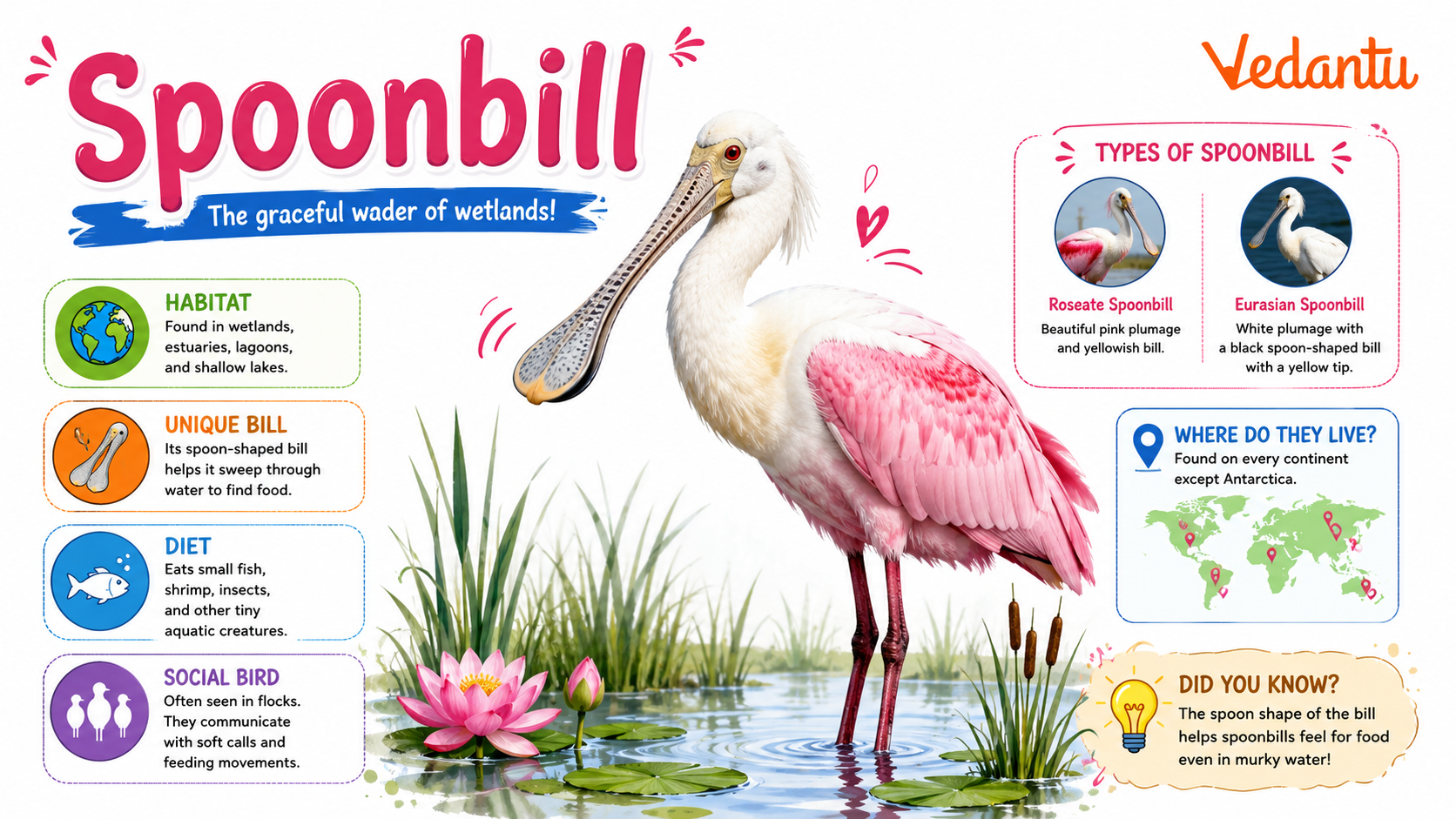
Quick Facts About Spoonbill
| Feature | Details |
|---|---|
| Common Name | Spoonbill |
| Scientific Family | Threskiornithidae |
| Animal Group | Bird |
| Size | 60–90 cm long |
| Wingspan | 120–135 cm |
| Habitat | Wetlands, marshes, lakes, lagoons |
| Diet | Fish, insects, crustaceans |
| Lifespan | Up to 15–20 years |
| Conservation Status | Varies by species (some Least Concern, some Near Threatened) |
Appearance and Physical Characteristics
- Long legs for walking in shallow water.
- Long, flat bill shaped like a spoon at the tip.
- Mostly white, pink, or pale feathers depending on species.
- Long neck that stretches forward during flight.
- Strong wings for steady and graceful flying.
Habitat and Distribution
- Freshwater marshes and swamps
- Shallow lakes and rivers
- Coastal lagoons and mudflats
- Mangroves and estuaries
Diet and Feeding Habits
- Small fish
- Shrimp and crabs
- Insects and larvae
- Frogs and tiny aquatic animals
- Walk slowly in shallow water.
- Swing their bill side to side.
- Snap it shut when they feel prey.
- Often feed in groups.
Behaviour and Lifestyle
- Usually social and live in colonies.
- Often nest in trees or reed beds near water.
- Active mainly during the day.
- Fly with neck stretched forward and legs extended behind.
- Communicate using soft grunts and bill-clattering sounds.
Life Cycle of a Spoonbill
- Egg Laying: Female lays 2–4 eggs in a nest made of sticks and reeds.
- Incubation: Both parents take turns keeping the eggs warm for about 3–4 weeks.
- Chicks: Baby spoonbills hatch with straight bills that flatten as they grow.
- Fledging: Chicks learn to fly after about 6–8 weeks.
- Adult Stage: They become fully mature in a few years and can live up to 20 years.
Flight Adaptations
- Large, broad wings for smooth gliding.
- Lightweight bones help reduce body weight.
- Strong chest muscles power long-distance flight.
- Some species migrate to warmer areas during winter.
What Makes Spoonbill Special?
Importance and Role in Nature
- Controlling fish and insect populations.
- Maintaining balance in wetland food chains.
- Indicating healthy wetland environments.
- Supporting biodiversity in marshes and lagoons.
Amazing Spoonbill Facts
Interesting Facts About Spoonbill
- Spoonbills are related to ibises.
- Their pink colour fades if their diet changes.
- They build nests close to water for easy feeding access.
- Some species are protected due to habitat loss.
Fun Facts for Kids
- Their bill looks like a spoon from your kitchen!
- They love walking slowly in water.
- Some spoonbills are bright pink like flamingos.
- They often live in big bird families.
- They use their bill like a detector to find food.
FAQs on Spoonbill Bird: Fascinating Facts, Habitat, and Behavior
1. What is a Spoonbill?
A Spoonbill is a large wading bird known for its long legs and flat, spoon-shaped bill.
- Belongs to the Threskiornithidae family (same family as ibises)
- Lives near wetlands, marshes, lakes, and coastal areas
- Uses its unique bill to catch small fish and aquatic animals
- Often confused with flamingos or herons because of long legs
2. Why do Spoonbills have spoon-shaped bills?
The spoon-shaped bill helps Spoonbills catch food easily in water.
- The flat tip acts like a natural scoop
- They sweep their bill side to side in shallow water
- Sensitive nerves help detect small fish, insects, and crustaceans
- This feeding method is called sweep feeding
3. Where do Spoonbills live?
Spoonbills live in warm and tropical regions around the world near water.
- Found in North America, South America, Europe, Africa, Asia, and Australia
- Prefer wetlands, lagoons, swamps, estuaries, and mangroves
- Migrate to warmer places during cold seasons
- Often nest in trees or reed beds near water
4. What do Spoonbills eat?
Spoonbills eat small water animals that live in shallow wetlands.
- Small fish
- Crabs and shrimp
- Insects and larvae
- Frogs and tiny aquatic creatures
5. Are Spoonbills related to flamingos?
Spoonbills are not flamingos, but they look similar because of their long legs and pink color.
- Spoonbills belong to the ibis and spoonbill family
- Flamingos belong to a different bird family
- Both are wading birds found in wetlands
- The Roseate Spoonbill is bright pink like a flamingo
6. Why are some Spoonbills pink?
Some Spoonbills turn pink because of the food they eat.
- The Roseate Spoonbill is naturally pink
- They eat shrimp and crustaceans rich in carotenoid pigments
- These pigments color their feathers
- Similar reason why flamingos are pink
7. How big is a Spoonbill?
A Spoonbill is a large bird with a wide wingspan and long legs.
- Length: about 60–90 cm (24–35 inches)
- Wingspan: up to 120–135 cm
- Weight: around 1–2 kg
- Long neck helps reach food in water
8. How do Spoonbills build their nests?
Spoonbills build simple nests close to water to keep their chicks safe.
- Use sticks, reeds, and twigs
- Nests are built in trees, bushes, or reed beds
- Lay about 2–5 eggs
- Both parents help protect and feed the chicks
9. Are Spoonbills endangered?
Some Spoonbill species are safe, but others face environmental threats.
- Main threats include wetland destruction and pollution
- Climate change affects breeding habitats
- Protected in many wildlife reserves
- Conservation programs help species like the Black-faced Spoonbill
10. What are the different types of Spoonbills?
There are several species of Spoonbills found around the world.
- Roseate Spoonbill (Americas)
- Eurasian Spoonbill (Europe and Asia)
- African Spoonbill
- Royal Spoonbill (Australia and New Zealand)
- Black-faced Spoonbill (East Asia)
