






What Do Sailfish Eat, How Fast Are They, and Where Do They Live?
The Sailfish is one of the most exciting and powerful fish in the ocean. Famous for its incredible speed and large sail-like fin, this marine predator is often called the fastest fish in the world. Sailfish are found in warm ocean waters and are known for their sharp bills and strong hunting skills. Learning about Sailfish facts, habitat, diet, and life cycle helps us understand how amazing and important these ocean hunters truly are.
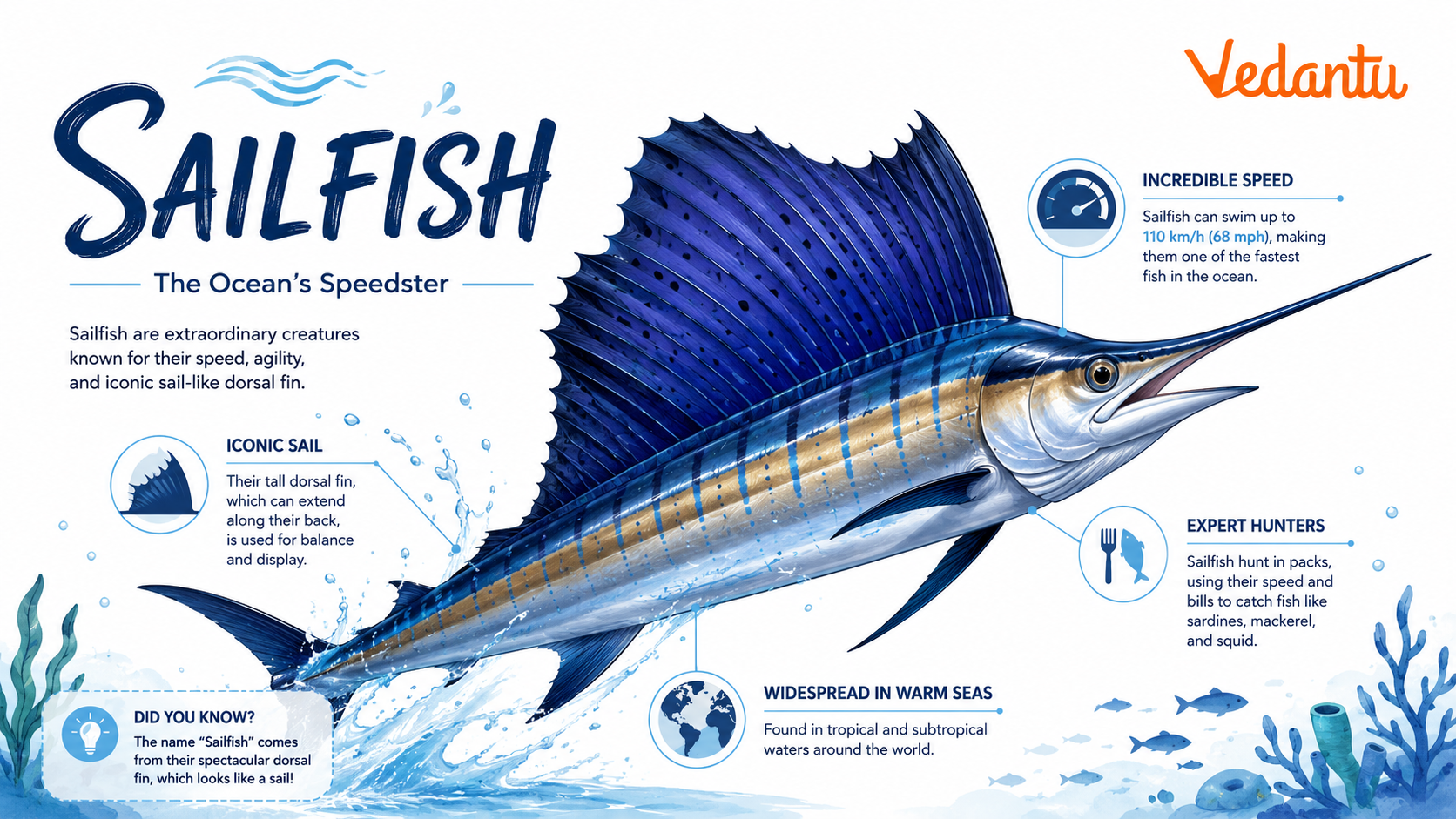
Quick Facts About Sailfish
| Feature | Details |
|---|---|
| Common Name | Sailfish |
| Scientific Name | Istiophorus |
| Animal Group | Fish (Marine) |
| Average Length | Up to 3 meters (10 feet) |
| Weight | Up to 100 kg |
| Lifespan | Up to 13–15 years |
| Habitat | Warm tropical and subtropical oceans |
| Diet | Small fish and squid |
| Top Speed | Up to 110 km/h (68 mph) |
| Conservation Status | Least Concern (varies by region) |
Appearance and Physical Characteristics
- Long, slim body built for fast swimming.
- Large sail-like dorsal fin that looks like a boat sail.
- Long pointed bill used to slash through schools of fish.
- Dark blue back and silvery-white belly.
- Smooth scales that reduce water resistance.
Sailfish Habitat and Distribution
- Found in Atlantic, Pacific, and Indian Oceans.
- Prefer warm tropical and subtropical waters.
- Usually live in the open ocean, away from the coast.
- Swim near the surface but can dive deeper when hunting.
Diet and Feeding Habits
The Sailfish diet mainly includes small, fast-moving marine animals.
- Small fish like sardines and anchovies
- Squid and other soft-bodied sea animals
- Occasionally crustaceans
Behaviour and Lifestyle
- Usually solitary but may hunt in small groups.
- Highly active and fast swimmers.
- Migrate long distances in search of food.
- Known for spectacular leaps out of the water.
Sailfish Life Cycle
- Egg Stage: Female Sailfish release thousands to millions of tiny eggs into the water.
- Larva Stage: Eggs hatch into tiny larvae that float near the surface.
- Juvenile Stage: Young Sailfish grow quickly and develop their long bill and sail fin.
- Adult Stage: Fully grown adults become powerful hunters of the open ocean.
The Sailfish life cycle is fast-paced, and they grow rapidly in their first few years.
What Makes Sailfish Special?
Importance and Role in Nature
Amazing Sailfish Facts
- Sailfish can swim faster than most cars drive in cities.
- Their sail fin can be taller than their body is thick.
- They are closely related to marlins and swordfish.
- Sailfish can change color quickly when excited or hunting.
- They have powerful muscles that help them burst forward at high speed.
- They are one of the most photographed big-game fish.
Interesting Facts About Sailfish
Fun Facts for Kids
- Sailfish are like race cars of the sea.
- Their “sail” looks like a giant fan on their back.
- They can jump high out of the water.
- They live in warm, sunny oceans.
- Baby Sailfish grow very quickly!
FAQs on Sailfish: The Fastest Fish in the Ocean Explained
1. What is a sailfish?
A sailfish is a large, fast ocean fish known for its huge sail-like fin and incredible speed.
- It is a marine fish found in warm oceans around the world.
- It belongs to the billfish family, which also includes marlins and swordfish.
- It has a long, sharp bill (pointed nose) used to catch prey.
- It is famous as one of the fastest fish in the ocean.
2. How fast can a sailfish swim?
A sailfish can swim up to 68 miles per hour (110 km/h), making it one of the fastest sea animals.
- It uses its powerful tail for quick bursts of speed.
- Its slim body helps reduce water resistance.
- The folded dorsal fin helps it move smoothly through water.
- This speed helps it catch fast-moving prey like tuna and mackerel.
3. Where do sailfish live?
Sailfish live in warm, tropical and subtropical oceans around the world.
- They are found in the Atlantic Ocean and Indo-Pacific Ocean.
- They prefer warm surface waters.
- They often swim in open seas but sometimes come near coastal areas.
- They migrate long distances following food sources.
4. What do sailfish eat?
Sailfish are carnivores that eat smaller fish and squid.
- Their diet includes sardines, anchovies, mackerel, and squid.
- They use their long bill to slash and stun prey.
- They often hunt in groups to trap schools of fish.
- Their speed helps them catch fast-moving prey.
5. Why is it called a sailfish?
The sailfish gets its name from its large, sail-like dorsal fin on its back.
- The tall dorsal fin looks like a boat’s sail.
- It can raise the fin to appear bigger and scare predators.
- It lowers the fin while swimming fast.
- The sail may also help when hunting schools of fish.
6. How big can a sailfish grow?
A sailfish can grow up to 10 feet (3 meters) long and weigh over 200 pounds (90 kg).
- Most adult sailfish are between 6 to 10 feet long.
- They have long, slender bodies.
- Females are usually larger than males.
- Their size helps them survive in the open ocean.
7. Are sailfish dangerous to humans?
Sailfish are not dangerous to humans and usually avoid people.
- They are shy and prefer deep ocean waters.
- They may only become dangerous if accidentally caught by fishermen.
- Their sharp bill can cause injury if handled carelessly.
- They are popular in sport fishing but are often released back into the sea.
8. How long do sailfish live?
Sailfish usually live about 4 to 5 years in the wild.
- They grow very quickly in their first year.
- Fast growth helps them avoid predators.
- They reproduce by laying many eggs in warm waters.
- Their short lifespan is common among fast-swimming ocean fish.
9. What are the main types of sailfish?
There are two main species of sailfish found in different oceans.
- Atlantic Sailfish (Istiophorus albicans)
- Indo-Pacific Sailfish (Istiophorus platypterus)
- Both species look very similar.
- They differ mainly in location and slight physical features.
10. What are some interesting facts about sailfish?
Sailfish are amazing ocean predators with unique features and behaviors.
- They are considered the fastest fish in the world.
- Their color can change to show excitement or stress.
- They often hunt in groups for better success.
- Their long billfish snout helps them slash through schools of fish.
- They are popular in marine biology studies and ocean wildlife documentaries.
