






What Is a Roller Bird? Habitat, Diet, and Unique Behaviors
The Roller Bird is one of the most beautiful and eye-catching birds found in open countryside and grasslands. Famous for its bright blue feathers and spectacular rolling flight display, this bird is a true sky performer. Many people search for Roller Bird facts, habitat, diet, and characteristics because of its vibrant colours and unique flying style. In India, the Indian Roller is especially admired and even considered a symbol of beauty and grace in many regions.
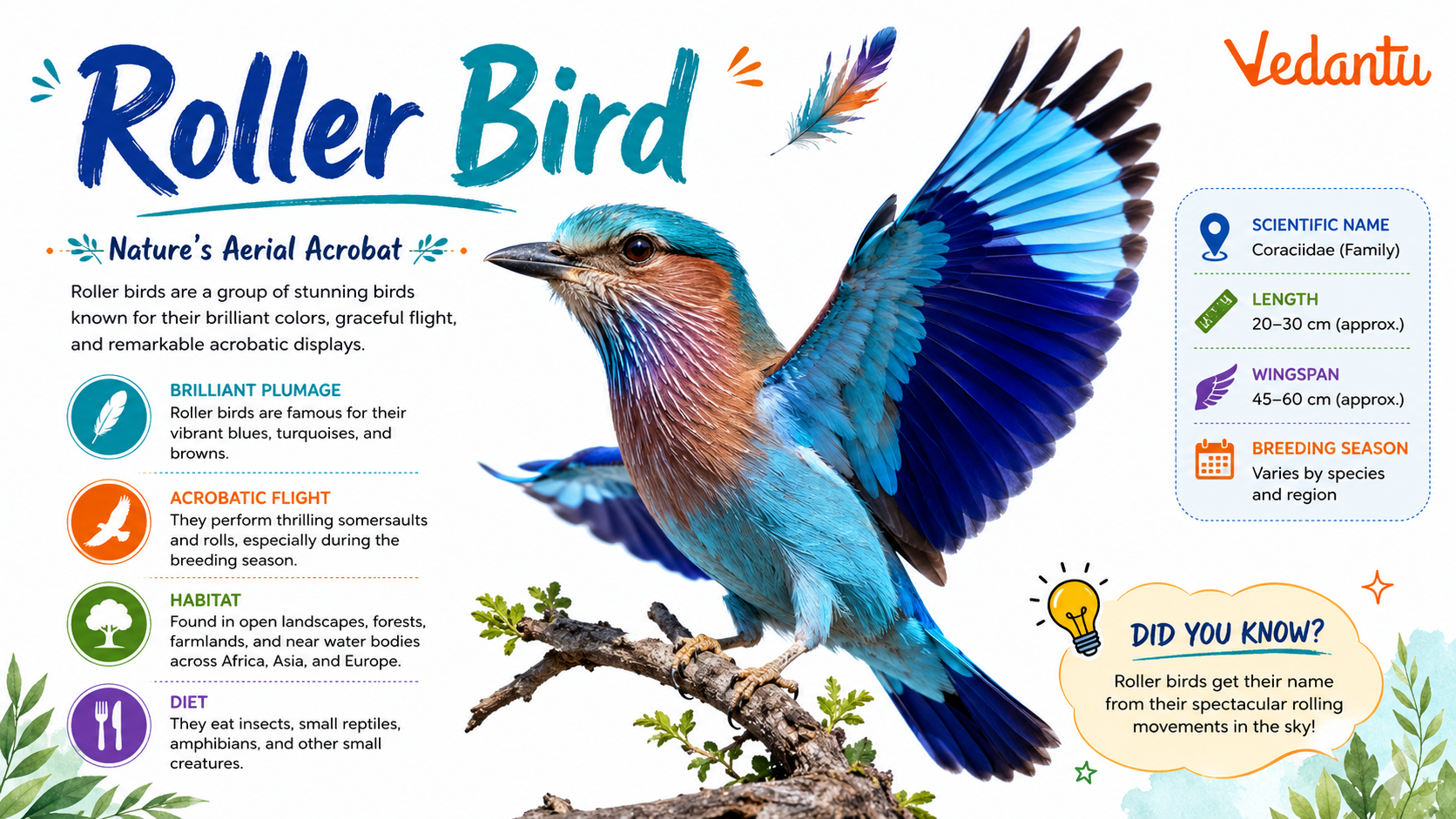
Quick Facts and Statistics
| Feature | Details |
|---|---|
| Common Name | Roller Bird (Indian Roller is most famous) |
| Scientific Name | Coracias benghalensis (Indian Roller) |
| Animal Group | Bird |
| Size | About 30–34 cm long |
| Weight | 150–180 grams (approx.) |
| Lifespan | Up to 9–10 years in the wild |
| Habitat | Open fields, grasslands, farmland, roadsides |
| Diet | Insects, small reptiles, frogs |
| Conservation Status | Least Concern |
Appearance and Physical Characteristics
- Medium-sized bird with a strong and compact body.
- Bright blue wings that shine in sunlight.
- Brownish chest and back.
- Short neck and large head.
- Strong black beak for catching prey.
- Short legs used mainly for perching.
Habitat and Distribution
- Found mainly in South Asia, including India, Sri Lanka, and parts of Southeast Asia.
- Prefers open grasslands, agricultural fields, and countryside areas.
- Often seen sitting on electric wires, poles, or tree branches.
- Avoids dense forests and very cold mountain regions.
The Roller Bird habitat usually includes open spaces where it can easily spot insects on the ground. It needs clear views to hunt successfully.
Diet and Feeding Habits
What Does a Roller Bird Eat?
Behaviour and Lifestyle
- Mostly solitary or seen in pairs.
- Active during the daytime (diurnal).
- Famous for rolling and diving flight displays during breeding season.
- Very territorial and protects its nesting area.
- Often seen near roads where insects are easy to find.
Flight Adaptations
- Strong wings for powerful and fast flight.
- Lightweight body helps in aerial acrobatics.
- Broad wings allow smooth gliding.
- Tail helps in balancing and sharp turns during flight.
The name “Roller” comes from its amazing rolling and tumbling movements in the air, especially during courtship displays.
Sound or Call
- Makes harsh “chack” or “rak” sounds.
- Calls loudly during breeding season.
- Uses calls to warn others of danger.
Life Cycle and Reproduction
- Nesting: Builds nests in tree holes, building cracks, or wall cavities.
- Eggs: Female lays 3–5 white eggs.
- Incubation: Eggs hatch after about 17–19 days.
- Chicks: Both parents feed the young birds.
- Fledging: Chicks leave the nest after about a month.
What Makes the Roller Bird Special?
Importance and Role in Nature
Amazing Roller Bird Facts
- The Indian Roller is the state bird of Odisha, Karnataka, and Telangana.
- Its bright blue wings are most visible during flight.
- It can spot insects from a long distance.
- It often hunts after rainfall when insects are active.
- Roller Birds are not true migratory birds but may move locally.
- They are highly adaptable to human settlements.
Fun Facts for Kids
FAQs on Roller Bird: Colorful Acrobat of the Skies
1. What is a Roller Bird?
A Roller Bird is a colorful bird known for its amazing rolling and diving flight displays in the sky.
- Belongs to the family Coraciidae
- Famous for fast spins and rolling movements during flight
- Found in Africa, Europe, and Asia
- Known for bright blue, green, and brown feathers
- Often searched as: What is a roller bird? and Why is it called a roller?
2. Why is it called a Roller Bird?
The Roller Bird gets its name from its rolling flight tricks performed during courtship or territory defense.
- Performs fast dives and twists in the air
- Rolls side-to-side while flying
- These aerial displays attract mates
- Common People Also Ask: Do roller birds really roll?
3. What does a Roller Bird look like?
Roller Birds are medium-sized birds with bright and beautiful feathers.
- Bright blue wings and tail
- Brown or cinnamon-colored back
- Strong black beak
- About the size of a crow
- Often searched as: Roller bird colors and How to पहचान a roller bird?
4. Where do Roller Birds live?
Roller Birds live in warm regions with open land and trees.
- Found in savannas, grasslands, and woodlands
- Common in Africa and parts of Europe and Asia
- Prefer open areas with scattered trees
- People also search: Roller bird habitat
5. What do Roller Birds eat?
Roller Birds are carnivorous and mostly eat insects and small animals.
- Grasshoppers and beetles
- Small lizards
- Frogs
- Occasionally small snakes
- Related query: What is the diet of a roller bird?
6. How do Roller Birds fly?
Roller Birds fly strongly and perform acrobatic aerial movements.
- Fast wing beats
- Sudden dives from high branches
- Rolling and twisting mid-air
- Used for courtship display
- Common search: Roller bird flight pattern
7. Are Roller Birds endangered?
Some species of Roller Birds are stable, but a few face habitat threats.
- Loss of natural habitats
- Climate change impact
- Human activities
- Conservation efforts protect nesting areas
- People also ask: Is the roller bird endangered?
8. How do Roller Birds build their nests?
Roller Birds usually nest inside tree holes or cavities.
- Use natural tree hollows
- Sometimes use old woodpecker holes
- Lay 3–5 white eggs
- Both parents help care for chicks
- Related search: Roller bird nesting habits
9. What are the different types of Roller Birds?
There are several species of Roller Birds around the world.
- European Roller
- Indian Roller
- Lilac-breasted Roller
- Abyssinian Roller
- Often searched as: Types of roller birds
10. Why are Roller Birds important in nature?
Roller Birds help control insect populations and support the ecosystem.
- Eat harmful insects
- Maintain ecological balance
- Add beauty to natural habitats
- Important for biodiversity
- People also search: Importance of roller birds in ecosystem
