






Where Do Quetzal Birds Live and Why Are They So Important in Rainforests?
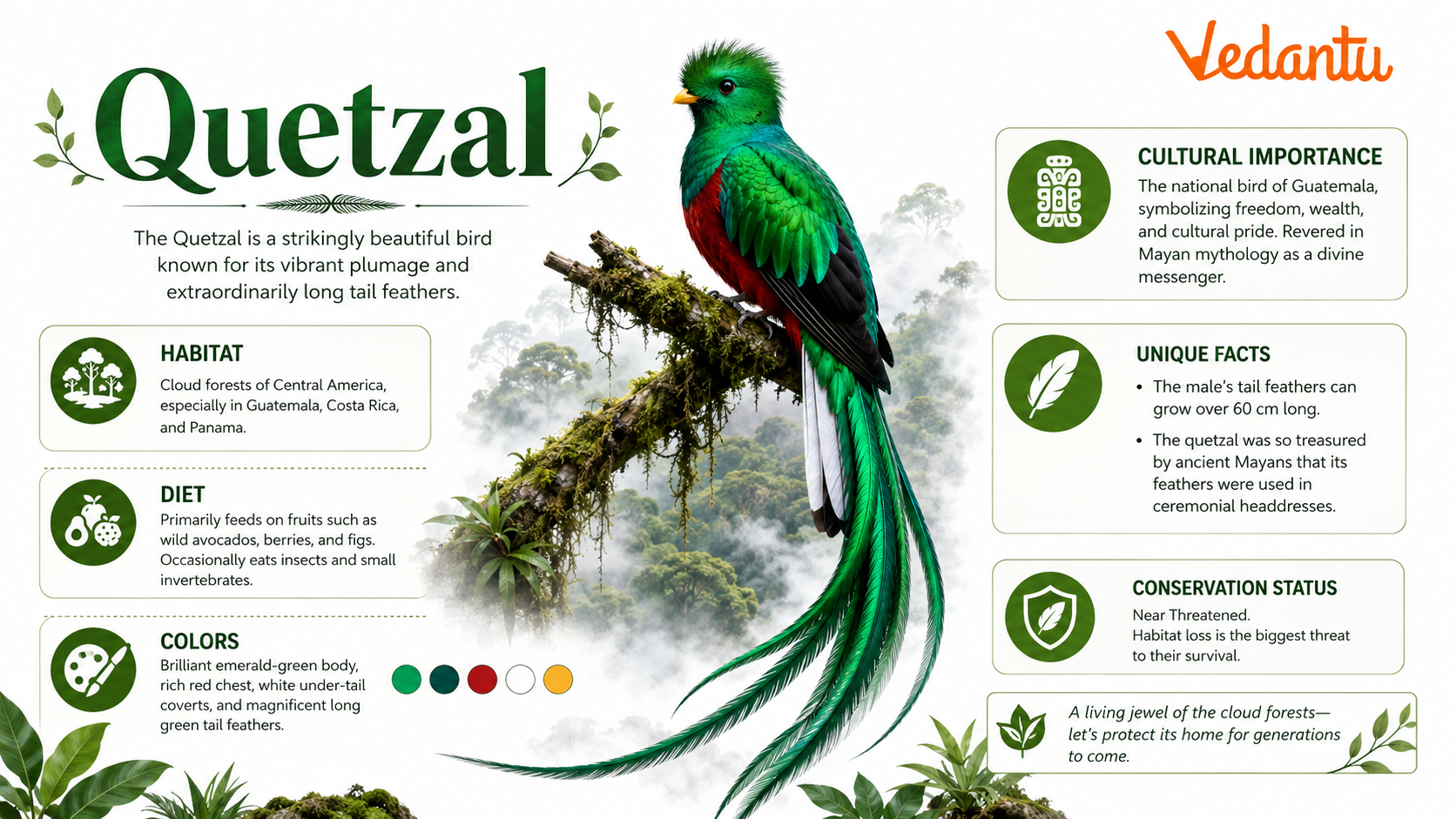
Quick Facts About Quetzal
| Feature | Details |
|---|---|
| Common Name | Quetzal |
| Scientific Name | Pharomachrus mocinno (Resplendent Quetzal) |
| Animal Group | Bird |
| Size | 36–40 cm (body), tail can grow up to 60 cm in males |
| Weight | About 200–230 grams |
| Habitat | Cloud forests and tropical rainforests |
| Diet | Mainly fruits, insects, small frogs |
| Lifespan | Up to 20–25 years (in the wild) |
| Conservation Status | Near Threatened |
Appearance and Physical Characteristics
- Shiny emerald-green body with a metallic glow.
- Bright red chest in males.
- Long, flowing tail feathers (in males).
- Short, strong beak for eating fruits.
- Large dark eyes adapted for forest life.
Quetzal Habitat and Distribution
- Lives in Central America.
- Found in countries like Guatemala, Costa Rica, Honduras, and Panama.
- Prefers cool, misty cloud forests at high altitudes.
- Builds nests in tree holes.
Diet and Feeding Habits
- Mainly frugivorous (fruit-eating bird).
- Loves wild avocados and other soft fruits.
- Also eats insects, lizards, and small frogs.
- Swallows fruits whole and later spreads seeds.
Behaviour and Lifestyle
- Mostly solitary or seen in pairs.
- Active during the day (diurnal).
- Moves quietly through forest trees.
- Does not migrate long distances but may move to lower forests during certain seasons.
Quetzal Life Cycle
- Egg Stage: Female lays 1–2 blue eggs inside tree holes.
- Incubation: Both parents take turns sitting on eggs.
- Chick Stage: Chicks hatch after about 17–18 days.
- Growth: Parents feed chicks insects and fruits.
- Adult Stage: Young birds grow full feathers and learn to fly.
Flight Adaptations
- Strong wings for short, powerful flights.
- Lightweight body for easy movement through trees.
- Long tail feathers help in balance and display.
- Sharp eyesight to move safely in thick forests.
Sound or Call
- Makes soft, musical whistles.
- Calls are used to attract mates.
- Also used to communicate between pairs.
What Makes the Quetzal Special?
Amazing Quetzal Facts
Fun Facts for Kids
- The Quetzal looks like a flying rainbow in the forest.
- Its tail feathers can flow like ribbons in the wind.
- It loves eating wild avocados!
- It is one of the most photographed birds in Central America.
- Its shiny feathers sparkle in sunlight.
FAQs on Quetzal Bird Guide: Habitat, Diet, and Unique Features
1. What is a Quetzal?
The Quetzal is a colorful tropical bird known for its bright feathers and long tail.
- The Resplendent Quetzal is the most famous species.
- It lives in Central America, especially in cloud forests.
- It is known for its shiny green and red plumage.
- The Quetzal is the national bird of Guatemala.
2. Where do Quetzals live?
Quetzals live in cool, tropical mountain forests called cloud forests.
- Found in Central America (Guatemala, Costa Rica, Panama, Honduras).
- Prefer high-altitude rainforests with lots of trees.
- Build nests in tree holes.
3. Why is the Quetzal important in history?
The Quetzal was sacred to ancient Mayan and Aztec civilizations.
- Its feathers were used in royal crowns and clothing.
- It symbolized freedom and wealth.
- The bird was linked to the god Quetzalcoatl.
4. What does a Quetzal look like?
The Quetzal has bright green feathers, a red chest, and a very long tail.
- Males have long, flowing tail feathers.
- Females have shorter tails and duller colors.
- Their feathers shine with a metallic green color.
5. What do Quetzals eat?
Quetzals mostly eat fruits, especially wild avocados.
- They love small fruits and berries.
- Sometimes eat insects, frogs, and small lizards.
- Help spread seeds in the forest.
6. Why is the Quetzal called the bird of freedom?
The Quetzal is called the bird of freedom because it was believed to die in captivity.
- Ancient people believed it could not live in a cage.
- It became a symbol of liberty and independence.
- Appears on the Guatemalan flag and coat of arms.
7. Is the Quetzal endangered?
The Resplendent Quetzal is considered near threatened due to habitat loss.
- Deforestation destroys cloud forests.
- Climate change affects its habitat.
- Protected in many national parks.
8. How big is a Quetzal?
A Quetzal is about the size of a crow, but males have very long tails.
- Body length: about 14–16 inches.
- Tail feathers can grow up to 3 feet long.
- Lightweight with strong wings.
9. What is special about the Resplendent Quetzal?
The Resplendent Quetzal is famous for its beauty and cultural importance.
- Known for its shimmering green feathers.
- Has extremely long tail plumes in males.
- Important symbol in Mayan culture.
10. How do Quetzals help the environment?
Quetzals help forests grow by spreading seeds.
- Eat fruits and drop seeds in new places.
- Support healthy rainforest ecosystems.
- Act as indicators of a healthy cloud forest habitat.
