






How Big Was a Plesiosaur? Diet, Habitat, and Extinction Explained
The Plesiosaur was a fascinating marine reptile that lived during the time of dinosaurs. With its long neck, small head, and powerful flippers, it looked like a swimming dragon of the ancient seas. Plesiosaur facts tell us that it was not a dinosaur, but a reptile that ruled the oceans millions of years ago. Its unique body shape and strong swimming skills make it one of the most interesting prehistoric sea creatures ever discovered.
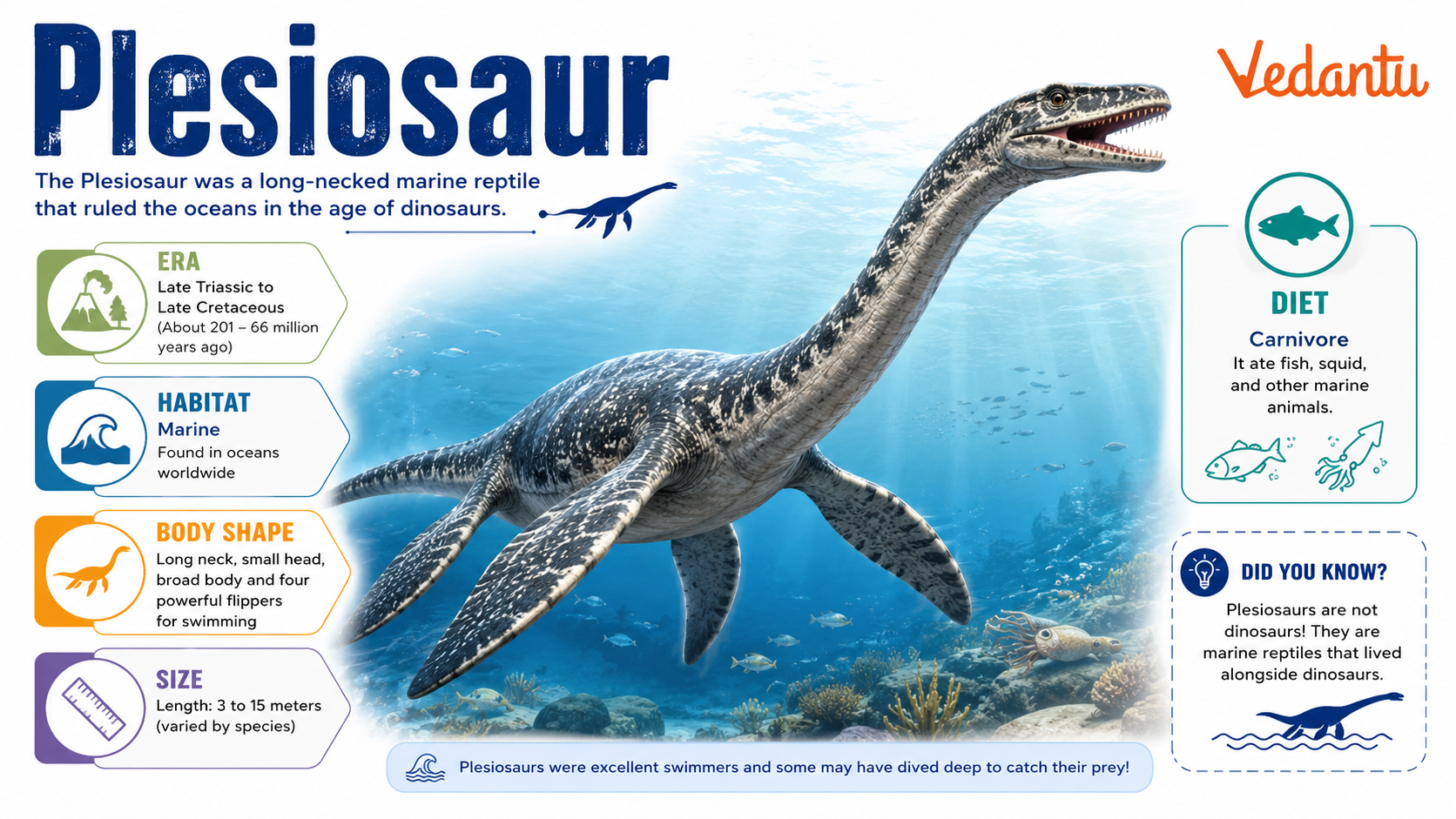
Quick Facts About Plesiosaur
| Feature | Details |
|---|---|
| Common Name | Plesiosaur |
| Animal Group | Marine Reptile |
| Time Period | Jurassic and Cretaceous Periods |
| Length | Up to 10–15 metres (in some species) |
| Habitat | Oceans and Seas |
| Diet | Carnivore (fish and sea animals) |
| Movement | Swam using four strong flippers |
| Status | Extinct |
Appearance and Physical Characteristics
- Long Neck: One of its most famous features, sometimes with more than 30 neck bones.
- Small Head: Compared to its body, the head was quite small.
- Sharp Teeth: Perfect for catching slippery fish.
- Broad Body: Strong and rounded, built for swimming.
- Four Flippers: Used like underwater wings to glide through water.
Plesiosaur Habitat and Distribution
The Plesiosaur habitat included warm, shallow seas that covered many parts of Earth during the Mesozoic Era.
- Lived in ancient oceans across Europe, North America, and other continents.
- Preferred marine environments, not land.
- Swam near coastlines and deeper waters.
- Fossils have been found in many countries.
Plesiosaur Diet and Feeding Habits
Behaviour and Lifestyle
- Spent most of its life swimming in the sea.
- Used all four flippers together to glide smoothly.
- Likely hunted alone rather than in groups.
- Had to come near the surface to breathe air.
Plesiosaur Life Cycle
- Birth: Some fossils suggest that Plesiosaurs gave birth to live young in water.
- Young Stage: Baby Plesiosaurs stayed in the ocean from birth.
- Growth: They grew larger as they hunted and survived predators.
- Adult Stage: Became strong marine hunters.
- Extinction: Disappeared about 66 million years ago during the mass extinction event.
What Made the Plesiosaur Special?
Importance and Role in Nature
- Maintained balance in marine ecosystems by controlling fish populations.
- Helped scientists understand prehistoric ocean life.
- Plesiosaur fossils give clues about Earth’s ancient climate and geography.
Amazing Plesiosaur Facts
Fun Facts for Kids
- Plesiosaurs lived at the same time as dinosaurs like T. rex.
- They could not walk on land like turtles.
- Their name means “near lizard” in Greek.
- They breathed air, not water.
- They were one of the top hunters of ancient seas.
FAQs on Plesiosaur Facts, Size, and Life in Prehistoric Oceans
1. What is a Plesiosaur?
A Plesiosaur was a large marine reptile that lived during the time of the dinosaurs.
- It lived in the Mesozoic Era, especially the Jurassic and Cretaceous periods
- It was not a dinosaur but a marine reptile
- It had a long neck, small head, wide body, and strong flippers
- It swam in ancient oceans alongside creatures like Ichthyosaurs and Mosasaurs
2. Was a Plesiosaur a dinosaur?
No, a Plesiosaur was not a dinosaur, but a sea reptile.
- Dinosaurs lived mostly on land
- Plesiosaurs lived in the ocean
- Both lived during the Age of Dinosaurs
- Scientists classify Plesiosaurs as marine reptiles, not dinosaurs
3. When did Plesiosaurs live?
Plesiosaurs lived about 201 to 66 million years ago during the Mesozoic Era.
- First appeared in the Early Jurassic Period
- Thrived in the Jurassic and Cretaceous oceans
- Became extinct around 66 million years ago
- Disappeared during the same extinction event as the dinosaurs
4. What did a Plesiosaur eat?
A Plesiosaur was a carnivore that ate fish and other sea animals.
- Ate fish, squid, and small marine reptiles
- Used sharp teeth to catch slippery prey
- Hunted in ancient seas and shallow coastal waters
- Some larger species may have eaten bigger prey
5. How big was a Plesiosaur?
Plesiosaurs varied in size, but many grew as long as a school bus.
- Average length: about 10–15 meters (33–50 feet)
- Some smaller species were only a few meters long
- Had very long necks compared to body size
- Large flippers helped them swim powerfully
6. What did a Plesiosaur look like?
A Plesiosaur had a unique body with a long neck and four flippers.
- Small head with sharp teeth
- Very long, flexible neck
- Wide, turtle-like body
- Four strong flippers instead of legs
7. How did Plesiosaurs swim?
Plesiosaurs swam using their four powerful flippers like underwater wings.
- Moved flippers in a flying motion
- Swam differently from fish and sharks
- Could glide smoothly through the water
- Well adapted for life in the ancient oceans
8. Where have Plesiosaur fossils been found?
Plesiosaur fossils have been discovered on many continents around the world.
- Found in North America, Europe, Australia, and Antarctica
- Usually discovered in ancient seabeds turned into rock
- Help scientists learn about prehistoric sea life
- Many fossils are displayed in natural history museums
9. Why did Plesiosaurs go extinct?
Plesiosaurs went extinct during the mass extinction event 66 million years ago.
- Likely caused by a large asteroid impact
- Led to climate changes and ocean disruption
- Wiped out many marine reptiles and dinosaurs
- Marked the end of the Cretaceous Period
10. Is the Loch Ness Monster a Plesiosaur?
Some people think the Loch Ness Monster looks like a Plesiosaur, but there is no scientific proof.
- The legend comes from Loch Ness in Scotland
- Plesiosaurs became extinct millions of years ago
- No fossils or real evidence show they are alive today
- Scientists consider Nessie a myth or folklore story
