






What Is a Placental Mammal? Reproduction, Placenta Function, and Common Examples
Placental mammals are the most advanced and largest group of mammals on Earth. From humans and elephants to whales and bats, they all belong to this amazing group. What makes them special is the presence of a placenta – a unique organ that helps the baby grow safely inside the mother’s womb. Placental mammal facts show how these animals are highly developed, intelligent, and adapted to almost every habitat on the planet.
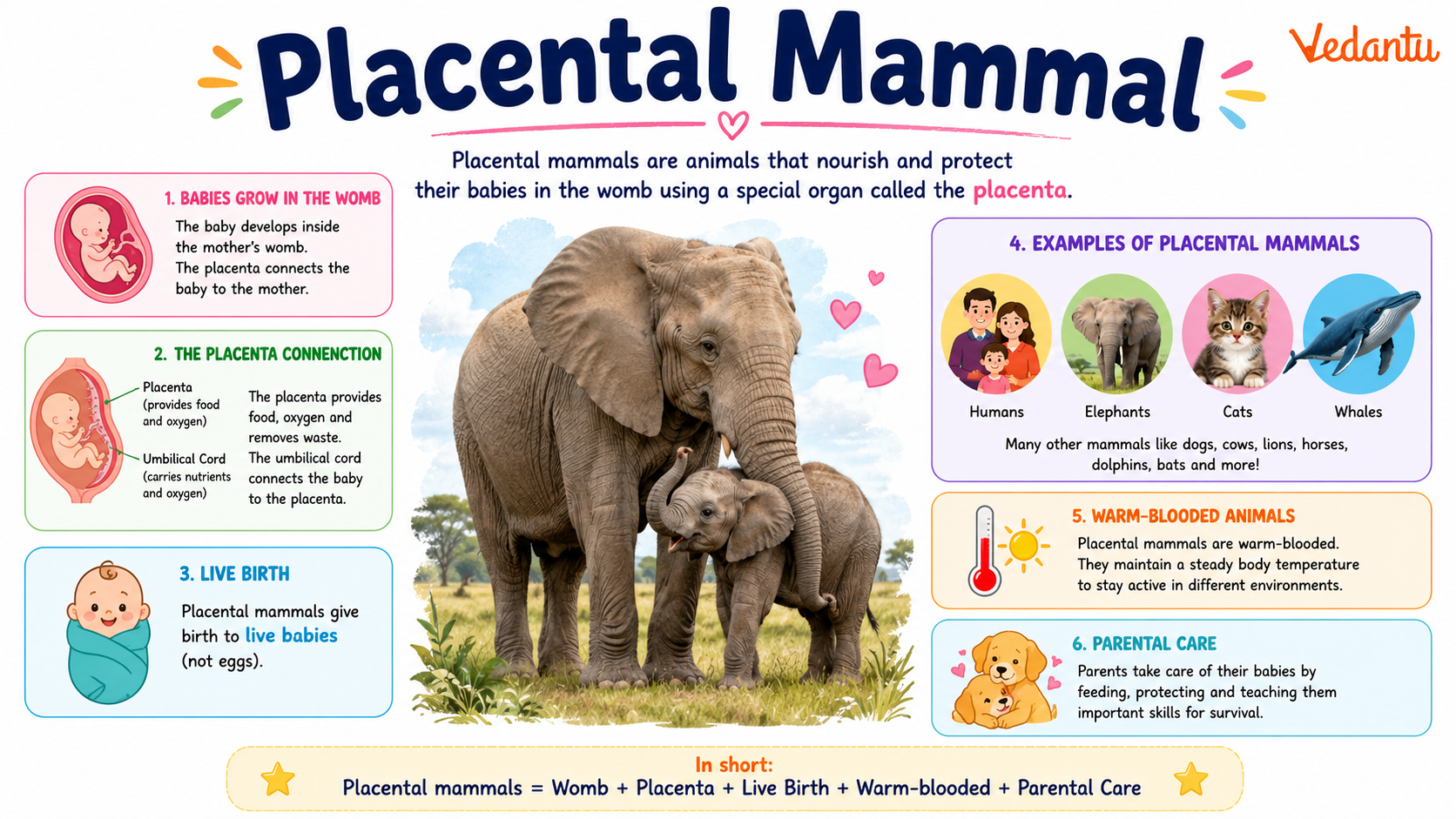
Quick Facts About Placental Mammals
| Feature | Details |
|---|---|
| Animal Group | Mammalia |
| Scientific Group Name | Eutheria |
| Reproduction Type | Live birth with placenta |
| Body Covering | Hair or fur |
| Body Temperature | Warm-blooded |
| Habitat | Land, water, air (almost everywhere) |
| Examples | Humans, dogs, whales, elephants, bats |
Physical Characteristics
- Have hair or fur on their body.
- Warm-blooded (maintain constant body temperature).
- Well-developed brain and nervous system.
- Have a diaphragm to help in breathing.
- Females have mammary glands to produce milk.
- Presence of a placenta during pregnancy.
Placental Mammal Habitat
One of the most interesting placental mammal facts is that they live almost everywhere on Earth.
- Forests: Monkeys, deer, tigers
- Deserts: Camels, foxes
- Oceans: Whales, dolphins
- Mountains: Goats, snow leopards
- Polar Regions: Polar bears, seals
- Air (flying): Bats
Diet and Feeding Habits
The placental mammal diet depends on the species. They can be herbivores, carnivores, or omnivores.
Eat plants, leaves, and fruits.
Example: Elephant, cow, deer.
Eat meat and hunt other animals.
Example: Lion, tiger, wolf.
Eat both plants and animals.
Example: Humans, bears.
Some filter-feed (whales) or eat insects (bats).
Behaviour and Lifestyle
- Many are social (wolves, elephants, humans).
- Some are solitary (leopards, tigers).
- Can be active during the day (diurnal) or night (nocturnal).
- Show advanced communication using sounds, body language, and facial expressions.
- Highly intelligent compared to many other animal groups.
Placental Mammal Life Cycle
- Fertilization: The embryo develops inside the mother’s uterus.
- Placenta Formation: Placenta connects mother and baby.
- Gestation Period: Baby grows fully inside the womb.
- Live Birth: Fully developed young one is born.
- Milk Feeding: Baby drinks mother’s milk.
- Growth: Young grows into an adult.
Types and Diversity
Placental mammals are divided into major groups based on their structure and habits.
Humans, monkeys, apes.
Dogs, cats, bears.
Whales and dolphins.
Rats, squirrels, beavers.
Importance and Role in Nature
Amazing Placental Mammal Facts
- More than 90% of all mammals are placental mammals.
- The blue whale is the largest placental mammal ever known.
- Bats are the only placental mammals capable of true flight.
- Humans are also placental mammals.
- Some placental mammals can live over 100 years (like whales).
- They have highly developed brains compared to other animal groups.
Fun Facts for Kids
FAQs on Placental Mammal: Definition, Characteristics, and Examples
1. What is a placental mammal?
A placental mammal is a type of mammal whose babies grow inside the mother’s womb and receive nutrients through a special organ called the placenta.
- Belongs to the group Placentalia
- Baby develops inside the uterus
- Gets oxygen and food from the placenta
- Born more developed than marsupials
- Examples include humans, dogs, whales, and elephants
Placental mammals are also called eutherian mammals and are the largest group of living mammals on Earth.
2. How does the placenta help a baby mammal grow?
The placenta helps the baby grow by passing nutrients and oxygen from the mother to the developing embryo.
- Connects the baby to the mother’s uterus
- Supplies oxygen and nutrients
- Removes waste products
- Protects the growing fetus
The placenta is a key feature of placental mammals and allows longer pregnancy compared to marsupials and monotremes.
3. What are some examples of placental mammals?
Placental mammals include many common animals found around the world.
- Humans
- Lions and dogs
- Elephants
- Dolphins and whales
- Bats
These animals belong to the group Eutheria, which makes up about 95% of all living mammal species.
4. How are placental mammals different from marsupials?
Placental mammals give birth to more developed young, while marsupials give birth to tiny, underdeveloped babies.
- Placental mammals: Long pregnancy, baby develops fully inside womb
- Marsupials: Short pregnancy, baby grows in a pouch
- Placental mammals use a complex placenta
- Marsupials include kangaroos and koalas
Both are mammals, but their reproductive systems are different.
5. When did placental mammals first appear on Earth?
Placental mammals first appeared during the time of the dinosaurs, over 100 million years ago.
- Evolved in the Cretaceous Period
- Survived the dinosaur extinction
- Rapidly diversified after 66 million years ago
After dinosaurs disappeared, placental mammals spread quickly and evolved into many different forms.
6. What are the main characteristics of placental mammals?
Placental mammals share special features that make them different from other animals.
- Have a well-developed placenta
- Give birth to live young
- Have hair or fur
- Feed babies with milk from mammary glands
- Warm-blooded (endothermic)
These traits help placental mammals survive in many habitats like forests, oceans, and deserts.
7. Are humans placental mammals?
Yes, humans are placental mammals because babies grow inside the uterus and are nourished by a placenta.
- Humans belong to the group Eutheria
- Embryo develops for about 9 months
- Baby receives nutrients through the umbilical cord and placenta
Like other placental mammals, humans give birth to well-developed young.
8. Where do placental mammals live?
Placental mammals live in almost every habitat on Earth.
- Forests – monkeys, deer
- Oceans – whales, dolphins
- Deserts – camels
- Polar regions – polar bears
- Air – bats
Their ability to adapt makes placental mammals the most successful group of mammals.
9. Why are placental mammals important?
Placental mammals are important because they help maintain balance in ecosystems and include humans.
- Control insect and prey populations
- Help in seed dispersal
- Provide food and resources
- Play key roles in food chains
Understanding placental mammals helps scientists study evolution, biodiversity, and conservation.
10. Do all mammals have a placenta?
No, not all mammals have a true placenta like placental mammals.
- Placental mammals: Have a complex placenta
- Marsupials: Have a simple, short-lived placenta
- Monotremes: Lay eggs and do not have a placenta
Only placental mammals (Eutherians) have a fully developed placenta that supports long fetal development.
