






Why Do Nightingales Sing? Diet, Migration and Fun Facts
The Nightingale is one of the most famous songbirds in the world, known for its beautiful and powerful voice. Even though it looks simple and small, its melodious song has inspired poets, writers, and music lovers for centuries. Found mostly in Europe, Asia, and parts of Africa, the Nightingale is a shy bird that prefers to stay hidden in bushes. Let’s explore interesting Nightingale facts, its habitat, diet, life cycle, and what makes it so special.
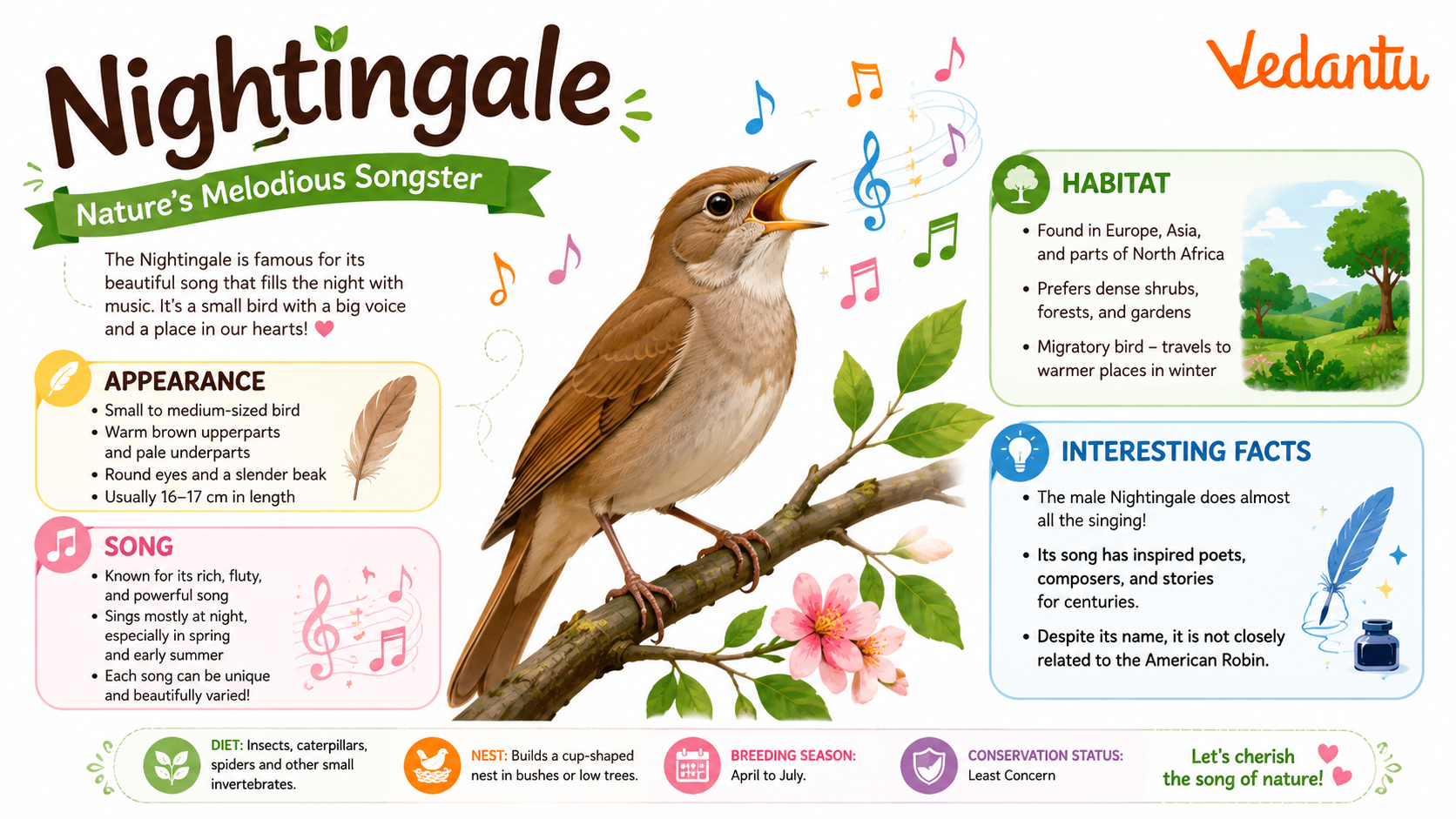
Quick Facts About Nightingale
| Feature | Details |
|---|---|
| Common Name | Nightingale |
| Scientific Name | Luscinia megarhynchos |
| Animal Group | Bird (Songbird) |
| Size | About 15–16 cm long |
| Weight | 15–22 grams |
| Diet | Insects, worms, berries |
| Habitat | Forests, bushes, woodlands |
| Lifespan | 2–5 years (in the wild) |
| Special Feature | Beautiful and powerful night song |
| Conservation Status | Least Concern |
Appearance and Physical Characteristics
- Small and slender body.
- Plain brown feathers with a slightly reddish tail.
- Light grey or pale underside.
- Strong legs for hopping on the ground.
- Sharp, pointed beak for catching insects.
Unlike colourful birds like parrots or peacocks, the Nightingale has simple brown feathers. Its beauty lies not in its looks but in its magical voice.
Nightingale Habitat and Distribution
- Found in Europe, parts of Asia, and North Africa.
- Lives in forests, woodlands, thick bushes, and scrublands.
- Prefers areas with dense shrubs for nesting.
- Migrates to Africa during winter.
The Nightingale habitat usually includes places with thick vegetation where it can hide safely. It spends most of its time close to the ground.
Diet and Feeding Habits
Insectivore (mainly eats insects).
Beetles, ants, worms, spiders.
Eats berries and fruits in autumn.
Forages on the ground and in low bushes.
The Nightingale diet helps control insect populations, making it important for maintaining ecological balance.
Behaviour and Lifestyle
- Mostly shy and secretive.
- Active during early morning and night.
- Males sing loudly to mark territory.
- Usually solitary except during breeding season.
- Strong migratory instinct.
Sound and Song
The Nightingale is world-famous for its rich, melodious, and complex song.
- Sings both during the day and at night.
- Has more than 200 different song variations.
- Song includes whistles, trills, and gurgling notes.
- Mainly males sing to attract females.
Life Cycle of a Nightingale
- Egg Stage: Female lays 4–5 eggs in a nest hidden in bushes.
- Incubation: Eggs hatch after about 13–14 days.
- Chicks: Blind and featherless at birth.
- Growth: Leave the nest in about 10–12 days.
- Adult: Ready to breed the next season.
Flight Adaptations
- Strong but short wings for quick flight.
- Lightweight body for easy migration.
- Good navigation skills during long-distance travel.
- Tail helps in balance and direction control.
Importance and Role in Nature
Amazing Nightingale Facts
Fun Facts for Kids
- The Nightingale is small but has a very loud voice!
- It sings even at night when most birds are sleeping.
- It hides in bushes, so spotting one is tricky.
- Its song has inspired many famous poems.
- It travels to Africa during winter.
FAQs on Nightingale Bird Guide: Songs, Habitat and Behavior
1. What is a Nightingale?
A Nightingale is a small brown songbird famous for its beautiful and powerful singing voice.
- Scientific name: Luscinia megarhynchos
- Belongs to the thrush family
- Known for singing at night as well as during the day
- Popular in poems, stories, and music
2. Why is the Nightingale famous for its song?
The Nightingale’s song is famous because it is loud, rich, and full of different musical notes.
- Can sing over 200 different song patterns
- Sings especially during the breeding season
- Male nightingales sing to attract females
- Often sings at nighttime, which makes it special
3. Where do Nightingales live?
Nightingales live in forests, gardens, and woodlands across parts of Europe, Asia, and Africa.
- Found in Europe and Western Asia during summer
- Migrate to Africa in winter
- Prefer bushy areas with lots of cover
- Build nests close to the ground
4. What does a Nightingale look like?
A Nightingale bird looks plain but has a strong and lovely voice.
- Small size (about 15–16 cm long)
- Brown feathers with a reddish tail
- Large dark eyes
- Blends easily into trees and bushes
5. What do Nightingales eat?
Nightingales eat insects and small fruits to stay healthy and active.
- Main diet includes insects, worms, and spiders
- Also eat berries in autumn
- Search for food on the ground
- Help control insect populations
6. Why do Nightingales sing at night?
Male nightingales sing at night mainly to attract a mate and protect their territory.
- Night singing reduces background noise
- Makes their song travel farther
- Shows strength to other male birds
- Common during spring breeding season
7. Are Nightingales mentioned in stories and poems?
Yes, the Nightingale appears in many famous poems, fairy tales, and songs.
- Featured in Hans Christian Andersen’s story “The Nightingale”
- Mentioned in poems by John Keats
- Symbol of love, beauty, and music
- Often represents nature’s voice
8. How long do Nightingales live?
A Nightingale usually lives for a few years in the wild.
- Average lifespan: 2–5 years
- Some may live longer in safe conditions
- Main threats include predators and habitat loss
- Migratory journeys can be dangerous
9. Are Nightingales endangered?
Nightingales are not globally endangered, but their numbers are decreasing in some areas.
- Classified as Least Concern worldwide
- Population declining in parts of Europe
- Threats include habitat destruction
- Conservation helps protect woodland habitats
10. How are Nightingales different from other songbirds?
Nightingales stand out because of their powerful night singing and rich variety of sounds.
- Sing louder than many small birds
- Known for complex musical phrases
- Mostly plain-looking compared to colorful birds
- Strong cultural symbol in music and literature
