






How the Nautilus Uses Its Shell to Survive in the Ocean Depths
The Nautilus is a fascinating sea creature that looks like it has come straight from prehistoric times. Known for its beautiful spiral shell, the Nautilus is often called a “living fossil” because it has existed for more than 500 million years. These deep-sea animals are related to octopuses and squids, but unlike them, they have an external shell. Let’s explore amazing Nautilus facts, habitat details, diet, life cycle, and what makes this ocean animal truly special.
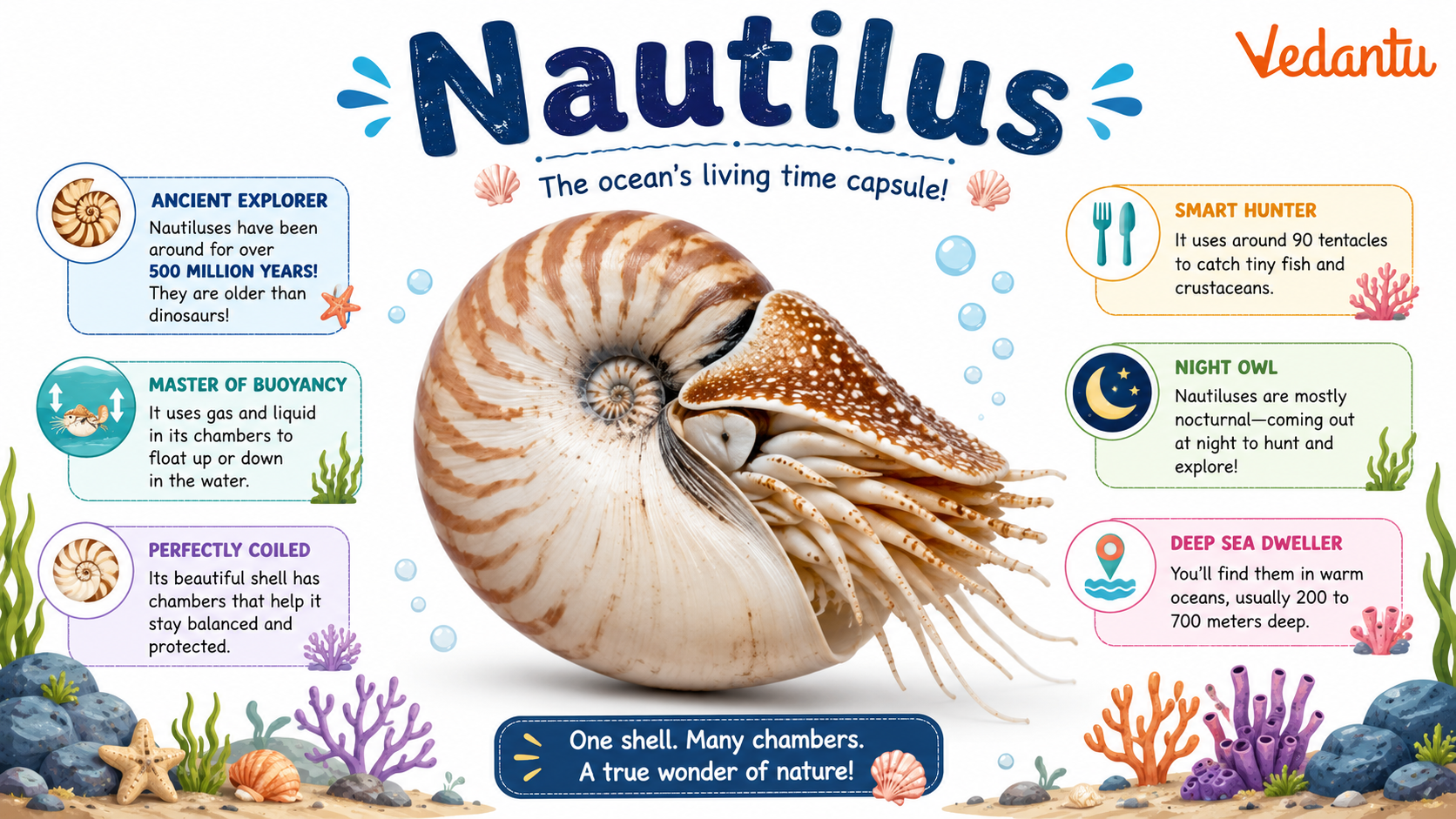
Quick Facts About Nautilus
| Feature | Details |
|---|---|
| Common Name | Nautilus |
| Scientific Name | Nautilus pompilius (most common species) |
| Animal Group | Mollusc (Cephalopod) |
| Habitat | Deep tropical oceans |
| Diet | Carnivore (small fish, crustaceans, carrion) |
| Lifespan | Up to 20 years (long for a cephalopod) |
| Movement | Jet propulsion |
| Special Feature | Multi-chambered spiral shell |
| Found In | Indo-Pacific Ocean |
Appearance and Physical Characteristics
- Has a beautiful spiral-shaped shell with brown and white stripes.
- Shell is divided into many air-filled chambers.
- Soft body lives in the largest outer chamber.
- Has up to 90 thin tentacles without suckers.
- Large, well-developed eyes for detecting light.
- Shell size can reach about 20 cm (8 inches) in diameter.
Nautilus Habitat and Distribution
- Lives in the deep slopes of coral reefs.
- Found mainly in the Indo-Pacific region (Australia, Philippines, Indonesia).
- Prefers depths of 100 to 700 meters.
- Comes to shallower waters at night to feed.
Diet and Feeding Habits
- The Nautilus diet mainly includes:
- Small fish
- Crabs and shrimp
- Dead animals (scavenger)
Behaviour and Lifestyle
- Mostly solitary animals.
- Active at night (nocturnal).
- Moves using jet propulsion by pushing water out of its body.
- Slow swimmer compared to squids and octopuses.
- Relies on smell more than sight to find food.
Nautilus Life Cycle
- Egg Stage: Females lay large eggs attached to rocks.
- Long Development: Eggs take about 9–12 months to hatch.
- Young Nautilus: Hatchlings already have small shells.
- Growth: As they grow, new chambers are added to the shell.
- Adult Stage: Becomes fully mature in about 10–15 years.
What Makes Nautilus Special?
Importance and Role in Nature
Amazing Nautilus Facts
- The Nautilus has up to 90 tentacles but no suckers.
- It can live much longer than octopuses and squids.
- Its shell is divided into 30 or more chambers.
- It pumps water in and out to move like a jet.
- It has simple eyes without a lens.
- It is considered near threatened due to shell trade.
Fun Facts for Kids
FAQs on Nautilus: The Living Fossil of the Deep Sea
1. What is a Nautilus?
A Nautilus is a marine mollusk known for its spiral shell and ancient history.
- It is a cephalopod, like octopus and squid.
- It has a beautiful spiral shell with chambers inside.
- It lives in the deep ocean waters of the Indo-Pacific.
- It is often called a living fossil because it has changed very little over millions of years.
2. Where does the Nautilus live?
The Nautilus habitat is mainly in deep tropical ocean waters.
- Found in the Indo-Pacific Ocean, near Australia and Southeast Asia.
- Lives at depths of about 100–600 meters.
- Stays near coral reefs and steep ocean slopes.
- Comes closer to the surface at night to search for food.
3. Why is the Nautilus called a living fossil?
The Nautilus is called a living fossil because it has existed for over 500 million years with little change.
- Appeared during the Paleozoic Era.
- Its shell design remains almost the same today.
- Provides clues about ancient marine life.
- Scientists study it to understand evolution and prehistoric oceans.
4. What does a Nautilus eat?
The Nautilus diet includes small sea animals and organic matter.
- Eats small fish and crustaceans.
- Feeds on shrimp and crabs.
- Sometimes scavenges dead animals on the ocean floor.
- Uses its many tentacles to catch food.
5. How does the Nautilus float and move in water?
The Nautilus shell helps it control buoyancy and move underwater.
- The shell has air-filled chambers.
- It adjusts gas and liquid inside chambers to float or sink.
- Moves using jet propulsion, pushing water out of its body.
- This system helps it survive in deep-sea environments.
6. How is the Nautilus different from other cephalopods?
The Nautilus is unique among cephalopods because it has an external shell.
- Unlike octopus and squid, it has a hard outer shell.
- Has up to 90 tentacles without suckers.
- Has simpler eyes compared to other cephalopods.
- Considered more primitive in evolution.
7. How big can a Nautilus grow?
A fully grown Nautilus can reach about 20–25 centimeters in shell diameter.
- About the size of a small melon.
- Shell grows in a perfect logarithmic spiral.
- Males are usually slightly larger than females.
- The shell grows as the animal matures.
8. Is the Nautilus endangered?
Some species of Nautilus are threatened due to overfishing and shell trade.
- Collected for their beautiful decorative shells.
- Slow reproduction makes recovery difficult.
- Protected under CITES regulations.
- Conservation efforts aim to protect deep-sea habitats.
9. How does a Nautilus reproduce?
The Nautilus reproduction process is slow and careful.
- Females lay a few large eggs.
- Eggs take up to 12 months to hatch.
- Young Nautilus hatch with small shells.
- They grow slowly compared to other marine animals.
10. Why is the Nautilus shell important in math and nature?
The Nautilus shell is famous for its spiral shape linked to mathematics and nature.
- Shows a near logarithmic spiral pattern.
- Often connected to the Golden Ratio.
- Represents symmetry and natural design.
- Studied in math, art, and marine biology.
