






What Do Mussels Eat and How Do They Help Marine Ecosystems?
Mussels are small shellfish that live in freshwater rivers, lakes, and salty oceans. Though they may look simple, mussels play a big role in keeping water clean and healthy. These two-shelled animals attach themselves to rocks and surfaces and quietly filter tiny food particles from water. Learning about mussel facts, mussel habitat, mussel diet, and mussel life cycle helps us understand why they are so important for aquatic ecosystems.
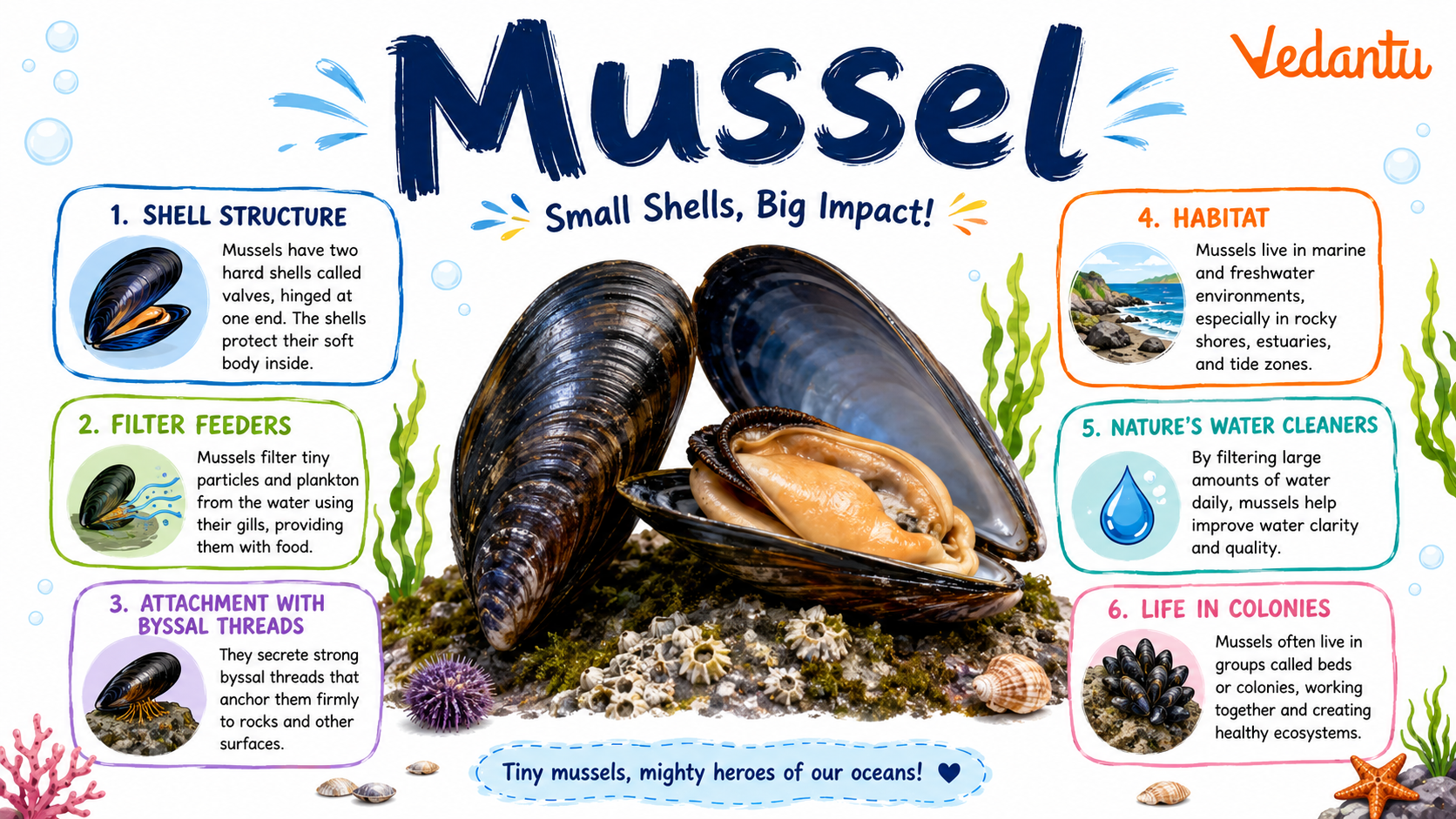
Quick Facts and Statistics
| Feature | Details |
|---|---|
| Common Name | Mussel |
| Animal Group | Mollusc (Bivalve) |
| Body Covering | Hard two-part shell |
| Size | 2–20 cm (depending on species) |
| Habitat | Oceans, rivers, lakes |
| Diet | Plankton and tiny particles |
| Lifespan | 5–70 years (varies by species) |
| Special Feature | Filters water for food |
Appearance and Physical Characteristics
- Two hard shells called valves.
- Soft body inside the shell.
- No head or obvious eyes.
- Strong foot used to move or attach.
- Produce sticky threads called byssal threads to hold onto rocks.
Habitat and Distribution
- Found on every continent except Antarctica.
- Live attached to rocks, docks, boats, or riverbeds.
- Prefer clean, oxygen-rich water.
- Often found in large groups called beds or colonies.
Diet and Feeding Habits
- Eat plankton, algae, and organic particles.
- Draw water in through one opening.
- Trap food particles using gills.
- Release clean water through another opening.
Behaviour and Lifestyle
- Mostly stay in one place after attaching.
- Live in groups for protection.
- Close shells when disturbed.
- Depend on water currents to bring food.
Mussels do not make sounds and have very simple movement. Their quiet lifestyle makes them easy to miss, but they are very important in aquatic ecosystems.
Mussel Life Cycle
Adults release eggs and sperm into the water for fertilisation.
Tiny larvae float freely in water.
Larvae settle on a surface like rock or riverbed.
Grows a hard shell and begins filter feeding.
The mussel life cycle varies between freshwater and marine species, but most go through a free-swimming larval stage before becoming attached adults.
What Makes Mussels Special?
Help improve water quality by filtering pollutants and particles.
Byssal threads act like natural glue underwater.
Hard shells protect from fish, crabs, and birds.
Important food for many animals and humans.
Importance and Role in Nature
- Keep water clean by filtering impurities.
- Provide habitat for small aquatic creatures.
- Serve as food for fish, birds, and mammals.
- Help scientists measure water pollution levels.
Amazing Mussel Facts
Interesting Facts About Mussels
- Freshwater mussels are among the most endangered animals in some regions.
- They help prevent harmful algal blooms.
- Their shells are made of calcium carbonate.
- Some species are farmed for food.
Fun Facts for Kids
FAQs on Mussel: Life Cycle, Habitat, and Importance
1. What is a mussel?
A mussel is a small shellfish that lives in water and has two hard shells joined by a hinge.
- It belongs to a group of animals called bivalves.
- Mussels live in both freshwater and saltwater habitats.
- They protect their soft bodies inside two strong shells.
- They are related to clams, oysters, and scallops.
2. Where do mussels live?
Mussels live in oceans, rivers, lakes, and coastal areas around the world.
- Marine mussels attach to rocks in oceans and seas.
- Freshwater mussels live in rivers and streams.
- They often form large groups called mussel beds.
- They prefer clean, oxygen-rich water.
3. How do mussels eat?
Mussels eat by filter feeding, which means they filter tiny food particles from water.
- They pull in water through a small opening.
- They trap plankton, algae, and nutrients.
- Clean water flows back out after filtering.
- This helps keep water ecosystems healthy.
4. Are mussels animals or plants?
Mussels are animals, not plants, because they move, eat food, and breathe.
- They belong to the animal kingdom.
- They are part of the mollusk family.
- Unlike plants, they cannot make their own food.
- They have simple organs like gills and a heart.
5. How do mussels attach to rocks?
Mussels attach to surfaces using strong, thread-like fibers called byssal threads.
- These threads act like natural glue.
- They stick to rocks, docks, and boats.
- This helps them survive strong waves and currents.
- The sticky material inspires biomimicry research.
6. What do mussels look like?
Mussels have smooth, dark shells that are oval or triangular in shape.
- Shell colors include blue, black, or brown.
- They have two matching shells connected by a hinge.
- Inside, the shell is shiny and smooth.
- The soft body stays protected inside the shell.
7. Are mussels good for the environment?
Yes, mussels are very important because they help clean and balance aquatic ecosystems.
- They filter and clean water pollution.
- They provide food for fish, birds, and sea animals.
- Mussel beds create habitats for small organisms.
- They support biodiversity in rivers and oceans.
8. Can people eat mussels?
Yes, many people eat mussels as a healthy type of seafood.
- They are rich in protein, iron, and omega-3 fatty acids.
- They are cooked by steaming, boiling, or baking.
- Popular in dishes like moules marinières.
- They must be cleaned and cooked properly for safety.
9. How do mussels reproduce?
Mussels reproduce by releasing eggs and sperm into the water.
- This process is called spawning.
- Fertilized eggs develop into tiny larvae.
- Larvae float in water before settling down.
- They grow hard shells as they mature.
10. How long do mussels live?
Mussels can live for several years, and some freshwater species live for decades.
- Most marine mussels live about 5–10 years.
- Some freshwater mussels can live over 50 years.
- Their lifespan depends on water quality and predators.
- Clean habitats help them live longer.
