






Types of Munia Birds, Their Diet, Nesting Habits, and Natural Habitat
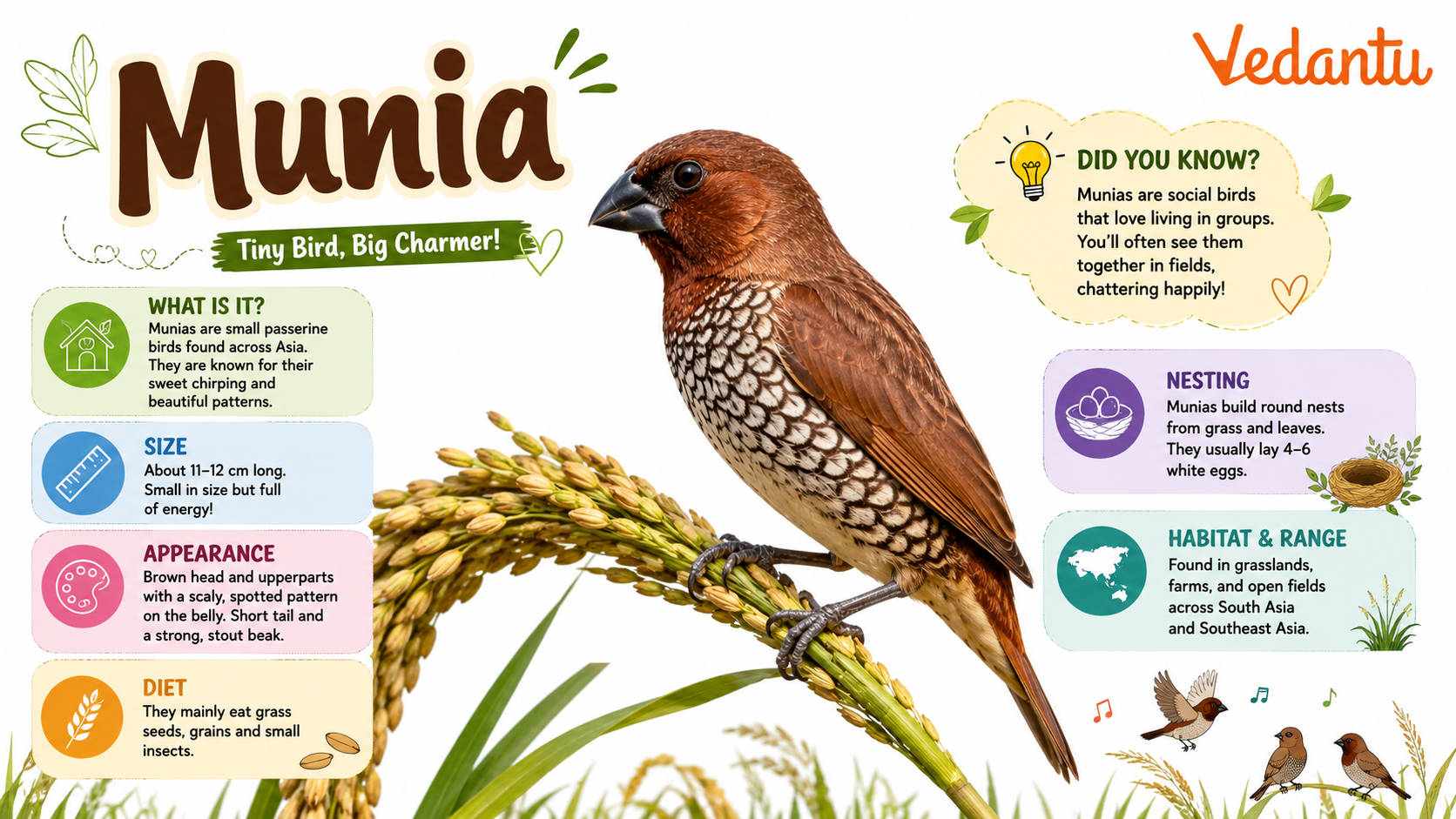
Quick Facts About Munia
| Feature | Details |
|---|---|
| Common Name | Munia |
| Scientific Name | Lonchura (Genus) |
| Animal Group | Bird |
| Size | About 10–12 cm long |
| Weight | Approximately 10–15 grams |
| Lifespan | 5–8 years (in the wild) |
| Habitat | Grasslands, fields, gardens, wetlands |
| Diet | Seeds, small grains, tiny insects |
| Movement | Flies in flocks |
| Conservation Status | Mostly Least Concern |
Appearance and Physical Characteristics
- Very small and lightweight bird.
- Short, thick, cone-shaped beak perfect for cracking seeds.
- Rounded body with a short tail.
- Soft brown, chestnut, white, or black markings depending on the species.
- Strong little legs for hopping on grass and branches.
Habitat and Distribution
- Commonly found in Asia, especially India and Southeast Asia.
- Live in grasslands, agricultural fields, gardens, and wetlands.
- Prefer warm and tropical climates.
- Build nests in bushes, tall grasses, or small trees.
Diet and Feeding Habits
- Mainly herbivorous (seed-eaters).
- Eat grass seeds, rice grains, and small millets.
- Sometimes feed on tiny insects for extra protein.
- Use their strong beaks to crack open hard seed shells.
Behaviour and Lifestyle
- Highly social birds that live in flocks.
- Active during the day (diurnal).
- Communicate using soft chirping sounds.
- Fly together in quick, coordinated movements.
- Stay close to each other for safety from predators.
Sound or Call
Munias make soft “chip-chip” or “chee-chee” sounds. These calls help them:
- Stay connected with their flock.
- Warn others about danger.
- Communicate during nesting.
Life Cycle of Munia
- Egg Stage: Female lays 4–8 small white eggs in a nest made of grass.
- Incubation: Both parents take turns keeping the eggs warm for about 12–14 days.
- Chicks: Baby Munias hatch blind and featherless.
- Growing Stage: Parents feed them seeds and tiny insects.
- Adult Stage: Chicks grow feathers and learn to fly within a few weeks.
Flight Adaptations
- Lightweight body helps in easy flight.
- Strong chest muscles for quick wing movement.
- Short wings allow fast and sharp turns.
- Fly in flocks for protection and better coordination.
What Makes Munia Special?
Types of Munia
- Scaly-breasted Munia
- White-rumped Munia
- Black-headed Munia
- Chestnut Munia
Importance and Role in Nature
Amazing Munia Facts
- Munias are also called “mannikins” in some countries.
- They often build round, ball-shaped nests.
- Some species adapt easily to city environments.
- They can travel together in large flocks.
- Both parents care for the chicks.
- Their scientific group name is Lonchura.
Interesting Facts About Munia
Fun Facts for Kids
- Munias are about the size of your palm!
- They love to hop more than walk.
- They chatter happily with their friends.
- They build cozy grass houses in bushes.
- They look like tiny balls of feathers.
FAQs on Munia Bird: A Complete Guide to Its Life and Behavior
1. What is a Munia bird?
Munia is a small, colorful seed-eating bird that belongs to the Estrildidae family and is commonly found in Asia and Africa.
- Also known as finches or mannikins
- Small size with short, thick beaks
- Feeds mainly on grass seeds and grains
- Often seen in flocks in fields and gardens
- Popular in birdwatching and pet bird discussions
2. Where do Munia birds live?
Munia birds live in warm regions such as Asia, Africa, and Australia.
- Common in India, Sri Lanka, Indonesia, and the Philippines
- Found in grasslands, farms, wetlands, and gardens
- Prefer areas with tall grasses for nesting
- Often seen near rice fields and open countryside
3. What do Munia birds eat?
Munia birds mainly eat seeds and small grains.
- Favorite food is grass seeds
- Also eat millet, rice, and small grains
- Sometimes feed on tiny insects during breeding season
- Drink fresh water daily
4. What does a Munia bird look like?
Munia birds are small, round birds with short tails and thick beaks.
- Usually brown, chestnut, black, or white in color
- Have a short, cone-shaped beak for cracking seeds
- Some species have spotted or scaly patterns
- Average length is about 10–12 cm
5. Are Munia birds social?
Yes, Munia birds are very social and live in groups called flocks.
- Travel and feed together
- Build nests close to each other
- Communicate using soft chirping sounds
- Feel safer in large groups
6. How do Munia birds build their nests?
Munia birds build round, ball-shaped nests using grass and leaves.
- Use dry grass, plant fibers, and leaves
- Nests are built in bushes or tall grasses
- Have a small side entrance
- Both male and female help in nest building
7. How long do Munia birds live?
Munia birds usually live for about 5 to 7 years in the wild.
- Life span depends on food and safety
- May live longer in protected environments
- Face threats from predators and habitat loss
- Healthy diet increases survival chances
8. What are some common types of Munia?
There are many species of Munia found around the world.
- Scaly-breasted Munia
- White-rumped Munia
- Chestnut Munia
- Black-headed Munia
9. Are Munia birds kept as pets?
Yes, some Munia species are kept as pet birds, but they need proper care.
- Require a spacious cage
- Need a seed-rich diet and clean water
- Prefer living in pairs or small groups
- Should be kept according to local wildlife laws
10. Why are Munia birds important to nature?
Munia birds help maintain balance in nature by controlling seeds and supporting ecosystems.
- Spread plant seeds across fields
- Serve as food for larger birds and animals
- Help farmers by eating excess grass seeds
- Indicate a healthy grassland habitat
