






What Do Mice Eat, Where Do They Live, and How Do They Survive?
A mouse is a small mammal known for its quick movements, sharp teeth, and curious nature. Found almost everywhere in the world, mice are one of the most adaptable animals on Earth. From forests and fields to houses and farms, these tiny creatures survive in many different environments. In this page, explore detailed mouse facts, mouse habitat, mouse diet, mouse life cycle, characteristics, and their importance in nature.
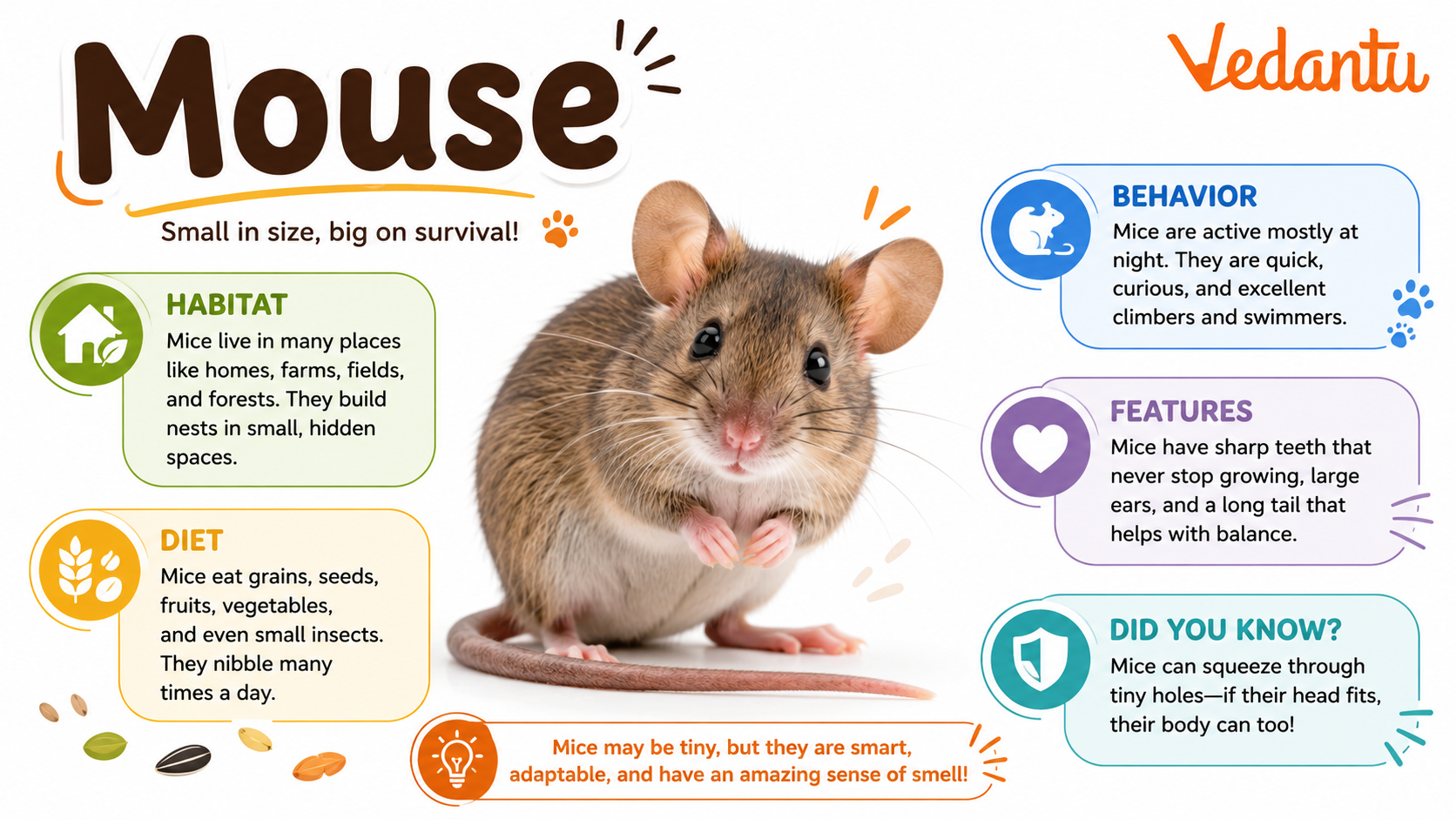
Quick Facts About Mouse
| Feature | Details |
|---|---|
| Common Name | Mouse |
| Scientific Name | Mus musculus (House Mouse) |
| Animal Group | Mammal |
| Size | 6–10 cm (body length) |
| Weight | 20–40 grams |
| Lifespan | 1–3 years |
| Habitat | Fields, forests, grasslands, and human homes |
| Diet | Seeds, grains, fruits, insects |
| Young One | Pup |
| Conservation Status | Least Concern (very common) |
Appearance and Physical Characteristics
- Small, rounded body with soft fur.
- Long, thin tail used for balance.
- Pointed nose with long whiskers.
- Large ears and bright, alert eyes.
- Sharp front teeth that grow continuously.
Mouse Habitat and Distribution
- Found on every continent except Antarctica.
- Lives in grasslands, farms, forests, and urban areas.
- Often builds nests in burrows, walls, or hidden corners.
- Prefers warm and sheltered places near food sources.
Mouse Diet and Feeding Habits
- Omnivore – eats both plants and small insects.
- Feeds on grains, seeds, fruits, nuts, and scraps.
- Uses sharp teeth to nibble and chew food.
- Mostly active and feeding at night.
Behaviour and Lifestyle
- Nocturnal – most active during night.
- Very fast runners and good climbers.
- Communicate using squeaks and body movements.
- Have a strong sense of smell and hearing.
- Live in small groups or colonies.
Mouse Life Cycle
- Birth: Baby mice (pups) are born blind and hairless.
- Growth: Eyes open after about 10–14 days.
- Young Stage: Start eating solid food in 3 weeks.
- Adult: Can reproduce in just 6–8 weeks.
What Makes Mouse Special?
Sound or Call
- Mice make high-pitched squeaking sounds.
- Use sounds to communicate danger or attract mates.
- Some sounds are too high for humans to hear.
Importance and Role in Nature
Amazing Facts About Mouse
- Mice can run up to 13 km per hour.
- They groom themselves like cats.
- A mouse’s heart beats about 600 times per minute.
- They can survive without drinking much water.
- Mice are excellent swimmers.
- They have been used in space experiments.
Interesting Facts About Mouse
- Mice use whiskers to sense nearby objects.
- They remember safe paths in their territory.
- Their teeth are stronger than many metals.
- They build nests using paper, cloth, or grass.
Fun Facts for Kids
FAQs on Mouse: Complete Guide to Behavior, Habitat, and Life Cycle
1. What is a mouse?
A mouse is a small rodent with a pointed nose, long tail, and sharp teeth.
- It belongs to the rodent family.
- It has soft fur, big ears, and whiskers.
- It is known for being quick and active.
- Common types include the house mouse and field mouse.
2. Where do mice live?
Mice live in many different habitats around the world.
- Homes and buildings (house mice).
- Fields, farms, and gardens.
- Forests and grasslands.
- Underground burrows for safety.
3. What do mice eat?
Mice are omnivores, which means they eat both plants and small insects.
- Seeds and grains.
- Fruits and vegetables.
- Nuts.
- Sometimes insects or tiny food scraps.
4. How big is a mouse?
A mouse is a very small animal, usually only a few inches long.
- Body length: about 2–4 inches.
- Tail length: nearly as long as its body.
- Weight: usually less than 1 ounce.
5. Are mice and rats the same?
Mice and rats are different types of rodents, although they look similar.
- Rats are larger and heavier.
- Mice have smaller bodies and thinner tails.
- Rats usually live longer than mice.
- Both belong to the rodent family.
6. How long do mice live?
Mice usually live for a short time, often about 1–2 years.
- Wild mice face predators like cats, snakes, and owls.
- Pet mice may live slightly longer with proper care.
- They reproduce quickly to survive.
7. Do mice make good pets?
Mice can be friendly and easy-to-care-for pets for kids with supervision.
- They need a clean cage and bedding.
- They eat seeds, pellets, and fresh food.
- They enjoy toys and tunnels.
- They should be handled gently.
8. Why do mice have long tails?
A mouse’s long tail helps with balance and temperature control.
- It helps them balance while climbing.
- It supports quick movements and turns.
- It helps regulate body heat.
9. What are baby mice called?
Baby mice are called pups.
- They are born blind and hairless.
- They depend on their mother for warmth and milk.
- They grow quickly within a few weeks.
10. Why are mice important to the ecosystem?
Mice play an important role in the ecosystem and food chain.
- They are prey for predators like owls, snakes, and cats.
- They help spread seeds.
- They are used in scientific research.
