






Mosasaur Size, Diet, Habitat, and Extinction Facts Explained
The Mosasaur was a powerful marine reptile that ruled the seas during the time of dinosaurs. Often mistaken for a dinosaur, it was actually a giant sea lizard. With sharp teeth, a long body, and a strong tail, the Mosasaur was one of the top predators of the Late Cretaceous oceans. These fascinating creatures help scientists understand prehistoric ocean life and the evolution of marine reptiles.
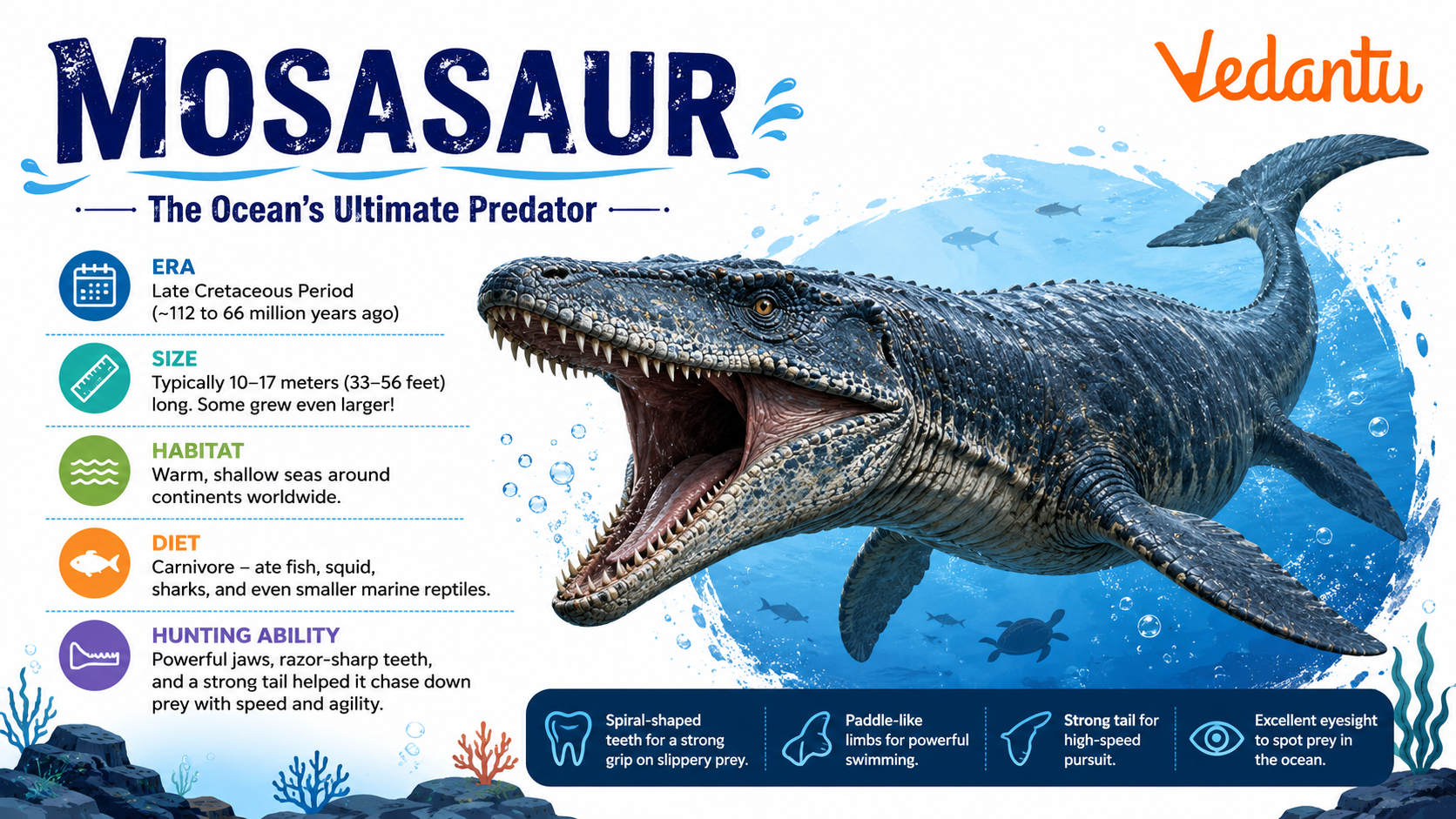
Quick Facts About Mosasaur
| Feature | Details |
|---|---|
| Common Name | Mosasaur |
| Scientific Family | Mosasauridae |
| Animal Group | Marine Reptile |
| Period | Late Cretaceous (about 70–66 million years ago) |
| Size | Up to 17 meters long (some species) |
| Diet | Carnivore – fish, ammonites, turtles, smaller reptiles |
| Habitat | Warm, shallow prehistoric seas |
| Status | Extinct |
Appearance and Physical Characteristics
- Long, streamlined body for fast swimming.
- Powerful tail shaped like a crescent for propulsion.
- Four paddle-like limbs instead of legs.
- Large skull with double-hinged jaws to swallow prey easily.
- Sharp, cone-shaped teeth for gripping slippery fish.
- Scaly skin like modern reptiles.
Mosasaur Habitat and Distribution
- Lived in warm, shallow seas during the Late Cretaceous period.
- Fossils have been found in North America, Europe, Africa, and Antarctica.
- At that time, large parts of continents were covered by oceans.
- Preferred coastal waters where prey was abundant.
Diet and Feeding Habits
The Mosasaur diet made it one of the most feared ocean predators.
- Ate fish, squid, ammonites, and marine birds.
- Some large species hunted sea turtles and even other Mosasaurs.
- Used powerful jaws to grab and swallow prey whole.
- Likely ambushed prey with quick bursts of speed.
Behaviour and Lifestyle
- Spent almost its entire life in water.
- Strong swimmer using side-to-side tail movement.
- Likely hunted alone rather than in groups.
- Breathed air like modern reptiles and whales.
Mosasaur Life Cycle
- Live Birth: Unlike many reptiles, Mosasaurs likely gave birth to live young in water.
- Juvenile Stage: Young Mosasaurs were already strong swimmers.
- Adult Stage: Grew rapidly and became powerful predators.
- Extinction: Disappeared about 66 million years ago during the mass extinction event.
What Made the Mosasaur Special?
Flexible jaws allowed it to swallow large prey.
Helped it swim like a modern shark.
Large eyes helped spot prey underwater.
Ruled the seas before the extinction event.
Importance and Role in Nature
Kept fish and other sea creature numbers balanced.
Shows how land reptiles adapted to ocean life.
Helps scientists study prehistoric oceans.
Provides clues about Earth’s past climate and disasters.
Amazing Mosasaur Facts
- The name “Mosasaur” means “Meuse River lizard.”
- It was not a dinosaur but a marine reptile.
- Some species were as long as a school bus.
- It had lungs and had to come to the surface to breathe.
- Fossils show bite marks from other Mosasaurs.
- They lived at the same time as Tyrannosaurus rex.
Fun Facts for Kids
FAQs on Mosasaur: The Giant Marine Reptile That Ruled Ancient Oceans
1. What is a Mosasaur?
A Mosasaur was a giant marine reptile that lived during the time of the dinosaurs in the Late Cretaceous period.
- It was not a dinosaur but a marine lizard.
- Lived about 70–66 million years ago.
- Swam in ancient oceans around the world.
- Belonged to a group of sea reptiles related to modern monitor lizards and snakes.
2. Was the Mosasaur a dinosaur?
No, a Mosasaur was not a dinosaur but a large ocean reptile.
- Dinosaurs lived mostly on land.
- Mosasaurs were fully aquatic reptiles.
- They are closer relatives to lizards and snakes.
- Often confused with dinosaurs because they lived at the same time.
3. How big was a Mosasaur?
A Mosasaur could grow as long as a school bus, making it one of the largest ocean predators of its time.
- Some species reached up to 50 feet (15 meters) long.
- Had a powerful tail for fast swimming.
- Large skull with many sharp teeth.
- Different species varied in size.
4. What did Mosasaurs eat?
Mosasaurs were fierce carnivores that hunted many sea animals.
- Ate fish and sharks.
- Hunted squid and shellfish.
- Sometimes preyed on other marine reptiles.
- Used sharp, cone-shaped teeth to grab slippery prey.
5. When did Mosasaurs live?
Mosasaurs lived during the Late Cretaceous period, near the end of the age of dinosaurs.
- Appeared about 98 million years ago.
- Became extinct around 66 million years ago.
- Disappeared during the same mass extinction as dinosaurs.
- Lived in warm, shallow seas worldwide.
6. Where did Mosasaurs live?
Mosasaurs lived in ancient oceans that once covered parts of today’s continents.
- Fossils found in North America, Europe, and Asia.
- Lived in the Western Interior Seaway of North America.
- Preferred warm, shallow seas.
- Adapted fully to marine life.
7. How did Mosasaurs swim?
Mosasaurs swam using a strong, shark-like tail that moved side to side.
- Had a long, powerful tail fin.
- Used paddle-shaped flippers for steering.
- Streamlined body helped them move quickly.
- Similar swimming style to modern sharks.
8. Why did Mosasaurs go extinct?
Mosasaurs went extinct during the mass extinction event that ended the age of dinosaurs.
- A large asteroid impact hit Earth 66 million years ago.
- Caused climate changes and ocean disruption.
- Food chains collapsed in the seas.
- Many marine reptiles could not survive.
9. How were Mosasaurs discovered?
The first Mosasaur fossils were discovered in the 18th century in Europe.
- Found near the Meuse River in the Netherlands.
- Name "Mosasaur" means "Meuse lizard."
- Fossils include skulls and full skeletons.
- Helped scientists learn about ancient sea life.
10. What makes Mosasaurs different from other marine reptiles?
Mosasaurs were unique because they were highly advanced ocean predators with flexible jaws and powerful tails.
- Had double-hinged jaws to swallow large prey.
- More closely related to lizards than to plesiosaurs or ichthyosaurs.
- Adapted fully to ocean life.
- Among the top predators of the Cretaceous oceans.
